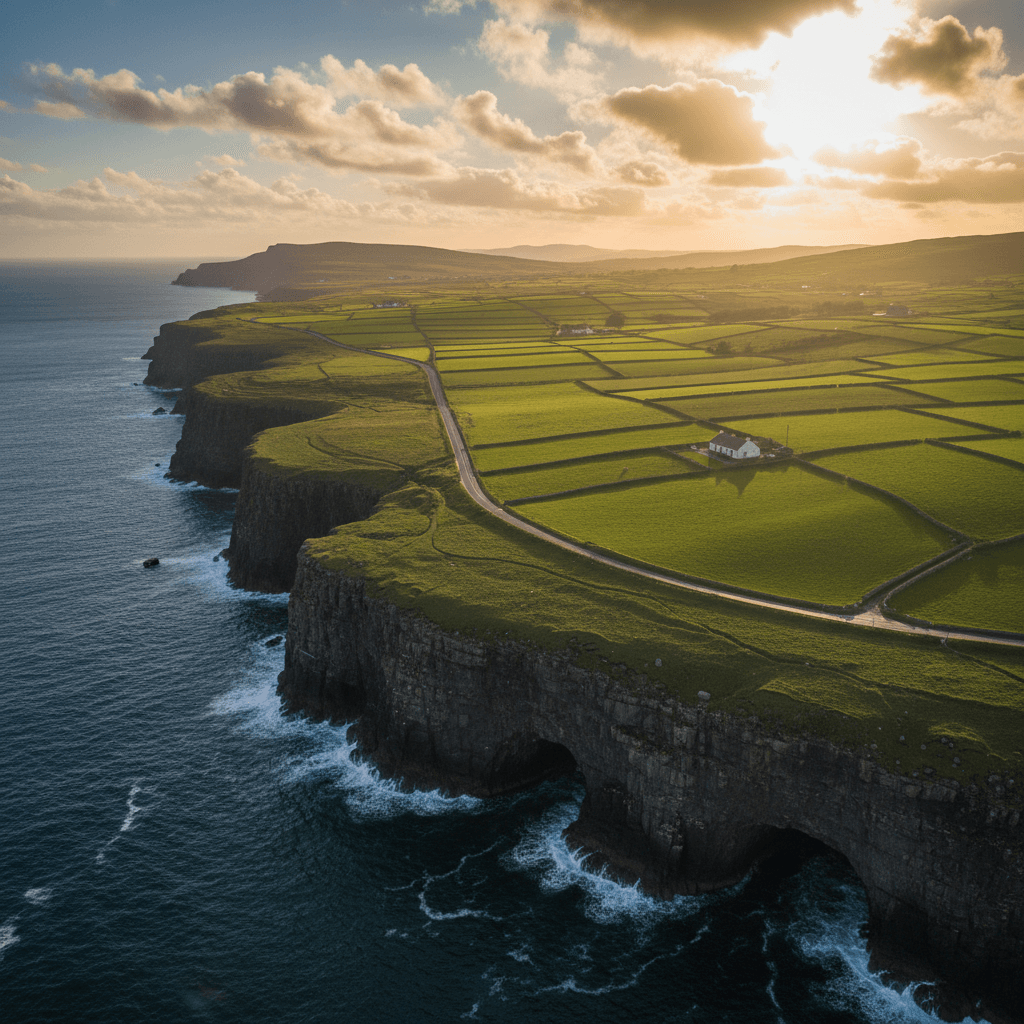
I've spent more than fifteen years driving Irish roads, taking visitors out for first laps of the Ring of Kerry, fixing punctures on the side of the N59 in Connemara, recommending pubs in towns nobody outside Ireland has ever heard of. This guide is everything I'd tell a friend who'd just booked their first trip and wanted to know how to do it properly.
It's long because the question — how do you plan a road trip in Ireland? — is genuinely worth answering in detail. If you only read one page on this site before you fly, this is the one.
Is Ireland Good for a Road Trip?
Yes. Emphatically, unreservedly yes — Ireland might be the single best country in Europe for a self-drive holiday, and I'd argue one of the best in the world.
Here's why.
The whole island is small. Ireland is about 500 km from north to south and 300 km east to west. The island fits comfortably inside the US state of Indiana. You can drive coast to coast — Dublin to Galway, the entire width of the country — in under three hours on the M6, including a coffee stop. Most Irish people consider a 90-minute drive a "long journey".
The variety is absurd for the size. In a single day you can drive from sandy white beaches on the Atlantic to limestone moonscape in the Burren to medieval castle ruins to mountain pass with a glacial valley below to a traditional pub with live music. I don't know any country with this much variety per square kilometre.
The roads are made for stopping. Ireland's road network — once you're off the motorways — is a mesh of little R-roads and L-roads designed in the era of horses and carts, weaving through fields and around hills rather than over them. They're slow, they're narrow, and they're constantly throwing views at you that demand a pull-in. The driving itself is the point of the holiday.
The infrastructure is good. Modern motorways link the main cities. The rural roads are well-signposted (mostly). Petrol stations, B&Bs, and pubs are everywhere, even in small towns. You will rarely be more than 30 minutes from a coffee, a meal, or a place to sleep.
Locals will help. Ask anyone for directions in any rural Irish town and you'll get them, plus probably a tip about a beach or a pub the satnav doesn't know about. This is not a thing I take for granted having driven in other countries.
The downside, honestly: the weather is unpredictable, the rural roads are narrow, and some visitors find driving on the left difficult at first. None of these are dealbreakers — see the first-timer tips section below — but it's worth knowing what you're getting into.
The short version: if you want to see Ireland the way Irish people see it, you need a car. There is no train you can take to the Sky Road in Connemara. There is no bus that goes around the Ring of Beara. The places worth seeing are the places only a car will get you to.
How Long Do You Need for an Irish Road Trip?
The honest answer is "more than you think". I've never met a visitor who came back from a one-week trip and said they had too much time. Most say they wished they'd had another three days.
Here's how I'd structure a road trip at each common length.
3 Days: Pick One Region
Three days is enough for one region, properly. Don't try to do more — the time you'll spend driving between regions will eat into the actual sightseeing.
The three best three-day options:
- Kerry: Fly into Cork or Shannon, base yourself in Killarney for two nights, drive the Ring of Kerry one full day, the Dingle Peninsula the next. Killarney's pubs and trad music sessions for the evenings.
- Galway and Clare: Fly into Shannon or Dublin, base in Galway, do the Wild Atlantic Way through Clare (Cliffs of Moher, the Burren) on day one, the Connemara Loop on day two. Galway city for evenings.
- The Causeway Coast: Fly into Belfast or Dublin, base in or near Bushmills, do the full Causeway Coastal Route including the Giant's Causeway, the Carrick-a-Rede rope bridge, the Dark Hedges, and Dunluce Castle.
Three days is short. Pick one region. Do not try to do all three of the above in the same trip.
5 Days: Combine Two Regions
Five days starts to give you breathing room. You can pair two regions and use the in-between day for the drive.
Best 5-day combinations:
- Galway + Kerry: Fly into Dublin or Shannon, drive west to Galway (day 1), Wild Atlantic Way in Clare (day 2), drive south to Killarney (day 3), Ring of Kerry (day 4), Dingle (day 5). Fly out from Cork or Shannon.
- Dublin + the Ancient East: Two nights in Dublin (the city itself), then a Boyne Valley day, a Wicklow Mountains day, and one more for Glendalough and the surrounding valleys.
- The North: Belfast for one night, then Causeway Coast for two, then drop south to the Mourne Mountains and back via Strangford Lough.
7 Days: The Classic Loop
Seven days is the most popular length for a first visit, and there's a reason. You can do a coherent loop hitting most of the famous landmarks without rushing.
The classic 7-day loop, from Dublin and back:
| Day | From → To | Highlights |
|---|---|---|
| 1 | Dublin → Galway (M6) | Pick up car, drive across the country, evening in Galway |
| 2 | Galway → Doolin via Cliffs | Wild Atlantic Way Clare, Cliffs of Moher, the Burren |
| 3 | Doolin → Killarney | Drive south through Limerick, evening in Killarney |
| 4 | Ring of Kerry day | Full Ring of Kerry loop from Killarney |
| 5 | Dingle Peninsula | Dingle Peninsula and Slea Head Drive |
| 6 | Killarney → Cork → Dublin | West Cork Coast detour optional, evening in Dublin |
| 7 | Dublin | City day, fly out evening |
This is the trip 90% of first-time visitors should do. It hits the Cliffs of Moher, the Wild Atlantic Way, the Ring of Kerry, Dingle, and Cork. You see the most photographed landmarks in the country and you have one full day in Dublin for the city itself. It's the safest first-trip itinerary in the country.
10 Days: Add the North
Ten days is when you can start adding regions that the seven-day trip leaves out.
On top of the 7-day loop, add:
- Day 8: Drive Dublin → Belfast → Causeway Coast
- Day 9: Causeway Coast (Giant's Causeway, Dark Hedges, Dunluce, Carrick-a-Rede)
- Day 10: Mourne Coastal Route → back to Dublin
If your priorities lean north over south, you can flip the order: do the Causeway Coast first when you're freshest, then the classic loop on the back end.
For a different ten-day trip with less driving, replace one of the southern days with Donegal — fly into Belfast or Dublin, drive up to the Donegal Highlands and the Inishowen 100, come back via the Causeway Coast. Donegal is the wildest, emptiest, most underrated county in Ireland and ten days is the minimum I'd recommend if you want to include it.
2 Weeks: The Full Ireland Circuit
Two weeks is the dream. It's enough time to do the entire Wild Atlantic Way at a sensible pace, plus the Ancient East, plus the Causeway Coast, plus a couple of days in Dublin and Belfast.
A 14-day suggested circuit, anti-clockwise from Dublin:
| Day | Region |
|---|---|
| 1 | Dublin city |
| 2 | Dublin → Boyne Valley → Belfast |
| 3 | Causeway Coast |
| 4 | Causeway Coast → Donegal Highlands |
| 5 | Slieve League and the Donegal coast |
| 6 | Donegal → Sligo → Yeats Country |
| 7 | Connemara Loop and Galway |
| 8 | Wild Atlantic Way Clare and Cliffs of Moher |
| 9 | Loop Head and Limerick |
| 10 | Dingle Peninsula |
| 11 | Ring of Kerry |
| 12 | West Cork Coast and Bantry Bay |
| 13 | Cork city → Rock of Cashel → Dublin |
| 14 | Dublin |
Two weeks is what I'd genuinely recommend if you've never been to Ireland before and want to see the whole country. Anything less and you're picking favourites.
Best Time of Year for an Irish Road Trip
Every season in Ireland has its own personality. None of them are "wrong", but each one is suited to different kinds of trips.
Month by Month
January and February. Cold, wet, dark. Daylight is 8–9 hours. Most tourist attractions are closed or running winter hours. Some B&Bs in remote areas shut for the season. The upside is empty roads and rock-bottom prices. Recommended only if you want pubs, fires, and quiet — not for sightseeing or hiking.
March. The country is starting to wake up. St Patrick's Day weekend (around the 17th) is the one time of year when even small Irish towns get genuinely festive. Daylight is up to 12 hours by month's end. Weather is variable — bright crisp days mixed with squally showers. Prices still low. Worth considering if you don't mind layering up.
April. A genuinely good month and underrated. Daffodils everywhere, lambs in the fields, lengthening evenings, generally mild weather. Most attractions reopen for the season. Prices haven't peaked yet. Highly recommended.
May. The single best month for an Irish road trip in my opinion. Long days (16+ hours of light by the end of the month), reliably mild weather, hedgerows in flower, everything open, prices below summer peak. May is the month I'd pick if I were planning my own first trip from scratch.
June. The longest days of the year — 17 hours of daylight at midsummer. Warm enough that you might actually want sunscreen on the cliff tops. School holidays haven't kicked in yet so it's not packed. Excellent.
July and August. Peak season. Highest prices, biggest crowds at the famous sites (Cliffs of Moher gets jammed), hottest weather (Irish hot — 22°C on a good day). Worth it for families with school-age kids who can only travel during this window. Book everything well in advance.
September. Almost as good as May. Prices drop after the first week as Irish school holidays end. The sea is at its warmest, the days are still long, the crowds are gone. If you can travel without school-age kids, September is a brilliant choice.
October. The country goes copper. Killarney's oak woodlands are spectacular, Wicklow turns gold, Connemara's bogs go russet. Days are 11 hours by mid-month. You may get a perfect Indian summer week or a wet stretch — bring layers. Highly recommended.
November. Days getting short, evenings dark by 5pm after the clocks go back. Some seasonal businesses close. Pubs go cosy with turf fires lit. A specific, atmospheric kind of trip — not for first-timers but lovely if you've been to Ireland before and want to see it quiet.
December. Christmas markets in Galway, Dublin, Belfast, Killarney. Limerick's Christmas at the Hunt Museum. Trad music and pints by fires. Short days but festive atmosphere. Skip if you're planning a sightseeing-heavy trip.
For deeper detail on each season, see our four seasonal guides:
- Spring Road Trips in Ireland
- Summer Road Trips in Ireland
- Autumn Road Trips in Ireland
- Winter Driving in Ireland
My One-Sentence Recommendation
Mid-May to mid-June for the best combination of weather, daylight, prices and crowds. Mid-September to mid-October as a close second. Avoid the last two weeks of July and the first week of August unless you have to be there — it's noticeably busier and 30% more expensive.
How Much Does an Irish Road Trip Cost?
This is the question I get asked the most, and the honest answer is "less than you might think, but more than the budget travel blogs claim".
Here's a realistic 2026 breakdown.
Per-Day Costs
| Category | Budget | Mid-Range | Comfortable | Luxury |
|---|---|---|---|---|
| Accommodation | €25–€40/night (hostel) | €80–€120 (B&B/3*) | €150–€220 (4*) | €300+ (country house hotel) |
| Food | €25–€35/day | €40–€60 | €70–€100 | €150+ |
| Activities | €10–€20 | €25–€40 | €50–€80 | €100+ |
| Fuel share (per person) | €10–€15 | €10–€15 | €10–€15 | €10–€15 |
| Per person daily | €70–€110 | €155–€235 | €280–€415 | €570+ |
Car Rental
Daily rental rates in 2026 vary dramatically by season and how far ahead you book:
| Vehicle | Off-season | Shoulder | Peak (July–Aug) |
|---|---|---|---|
| Economy (VW Polo, Hyundai i20) | €25–€40 | €40–€60 | €60–€90 |
| Compact (VW Golf, Ford Focus) | €30–€50 | €50–€70 | €70–€110 |
| Mid-size (VW Passat, Skoda Octavia) | €45–€70 | €60–€90 | €90–€140 |
| SUV / 7-seater | €60–€100 | €90–€130 | €140–€220 |
These are headline rates from the major rental companies (Hertz, Enterprise, Europcar, Avis, Sixt, Dooley). The headline rate is not what you'll pay — see the car rental guide for the upsells the desk will try and which to refuse.
For a one-week trip, expect to spend €250–€500 on car rental in shoulder season for a small economy car booked 2–3 months in advance. Last-minute peak-season bookings can hit €800.
Fuel
Fuel in Ireland is roughly €1.65–€1.85 per litre in 2026. A typical compact rental gets about 6 L/100 km in real-world Irish driving.
For each of the standard itineraries, here's a rough fuel total:
| Itinerary | Distance | Fuel cost (compact petrol) |
|---|---|---|
| 3-day Kerry | ~600 km | €60–€70 |
| 5-day combination trip | ~1,000 km | €100–€120 |
| 7-day classic loop | ~1,500 km | €150–€175 |
| 10-day with the north | ~2,000 km | €200–€235 |
| 2-week full circuit | ~3,000 km | €300–€350 |
For the full version of fuel pricing, where to fill up, and how to avoid the costly mistake of misfuelling a diesel rental, see our fuel guide.
Total Trip Estimates
For a typical one-week trip in 2026, per person, all-in (excluding flights):
- Budget: €600–€900 — hostels, self-catering, picnic lunches, free attractions, smallest economy car split between travellers
- Mid-range: €1,200–€1,800 — B&Bs, mix of pub meals and self-catering, the major paid sites, compact rental
- Comfortable: €2,000–€2,800 — 3- and 4-star hotels, restaurants, all attractions, mid-size rental
- Luxury: €3,500+ — country house hotels, fine dining, premium SUV
Most first-time visitors fall into the mid-range bracket. €1,500 per person for a one-week trip is a realistic working number — anything significantly less and you're cutting comfort, anything significantly more and you're paying for a level of luxury that isn't necessary in Ireland.
For all of the money-saving angles, see our budget road trip guide.
Renting a Car in Ireland
This deserves its own page (and has one — see the complete car rental guide) but here are the things that matter most.
Book ahead. Two to three months in advance is the sweet spot. Last-minute peak-season bookings cost double.
Book direct, then check the aggregators. Compare on AutoEurope, Discover Cars or RentalCars first to see the market rate, then check the rental company's own website (Hertz, Enterprise, Dooley) for direct deals. Sometimes the direct deal is cheaper.
Pick the smallest car you can live with. Irish roads were not designed for big SUVs. A VW Polo or Hyundai i20 is dramatically easier to drive on the Healy Pass than a Toyota RAV4. Width matters more than horsepower in Ireland.
Get an automatic if you're nervous. Manual gearboxes are more common in Europe, but adapting to left-hand driving + right-hand-drive car + Irish narrow roads + a manual gearbox is asking too much for the first day. Pay the €5–€10 a day for an automatic.
Decline the upsells. Especially the rental company's own "Super CDW" (buy excess insurance online before you fly for a quarter of the price) and the GPS unit (your phone is better and free). See the car insurance guide for exactly why.
Photograph the car at pickup. All four corners, the wheels, the roof, the bumpers, time-stamped on your phone. Best protection against post-rental damage charges.
For the full version of all of this, see the car rental hub. If you only need wheels for a day or two, compare GoCar prices against traditional car rental instead.
Top 10 Road Trip Routes in Ireland
These are the ten routes I'd recommend to any first-time visitor, in order of priority. Click any of them for the full route page with an interactive map, stop-by-stop directions and a suggested itinerary.
1. The Ring of Kerry
Ireland's most famous scenic drive, a 179 km loop around the Iveragh Peninsula starting and ending in Killarney. Skellig views, the Killarney lakes, ancient stone forts, sandy beaches, and Moll's Gap. Drive it clockwise, over Moll's Gap first: the tour coaches run anti-clockwise by convention, so going the other way keeps you out of the queue behind them and puts the coast on the near side of the car. The route page has the trade-off in full. A full day to do it justice.
2. The Wild Atlantic Way through Clare
The Cliffs of Moher are the most photographed natural landmark in Ireland, but the surrounding stretch — from Doolin south to Loop Head, then back through the Burren — is the part most visitors miss. Limestone moonscape, traditional pubs in Doolin, dolphin watching at Carrigaholt.
3. The Causeway Coastal Route
Northern Ireland's headline route. The Giant's Causeway, the Carrick-a-Rede rope bridge, Dunluce Castle, the Dark Hedges, and the Old Bushmills Distillery. Two days minimum to do it properly. Fly into Belfast or Dublin.
4. The Dingle Peninsula
The Slea Head Drive on Dingle is, in my opinion, even better than the Ring of Kerry — and it's shorter and quieter. Beehive huts, the early Christian Gallarus Oratory, dramatic Atlantic views every five minutes, and Dingle town itself with its dolphin (Fungie's successor era), pubs and traditional music. Can be done as a day trip from Killarney.
5. The Connemara Loop
West of Galway, into a landscape of bogs, lakes, mountains and no people. Kylemore Abbey on the lake, Killary Fjord (Ireland's only fjord), the Sky Road from Clifden, the Twelve Bens mountain range. This is the road trip for anyone who finds the Ring of Kerry too touristy.
6. The Wicklow Mountains
The closest "big" road trip to Dublin — under an hour from the airport. Glendalough monastic settlement, the Sally Gap, Lough Tay, Powerscourt Estate, the Military Road. Perfect day trip if you only have one day outside Dublin, or first-day-of-the-trip if you want to ease into Irish driving on quieter roads.
7. Slieve League and the Donegal Coast
Slieve League is Ireland's tallest sea cliffs — twice the height of the Cliffs of Moher and almost no one outside Ireland knows about them. The drive through southwest Donegal to get there is spectacular, the cliffs themselves are vertiginous, and you can walk along the top to the One Man's Pass for views over Donegal Bay.
8. The Donegal Highlands
Donegal is Ireland's most underrated county. The Glenveagh National Park, Mount Errigal, the Inishowen Peninsula, Malin Head (Ireland's most northerly point), the Atlantic beaches at Tullan Strand and Bundoran. Wilder, emptier and more authentically Irish than anywhere else on the island.
9. The West Cork Coast
From Kinsale around Mizen Head to Bantry Bay and up the Beara Peninsula. Foodie villages (Kinsale, Schull, Skibbereen), the southernmost point of Ireland at Mizen, the Sheep's Head Way, the Ring of Beara — which is the Ring of Kerry's quieter cousin and arguably better. A full week's driving on its own if you want.
10. The Boyne Valley
The Ancient East. Newgrange (older than the Egyptian pyramids), the Hill of Tara (seat of the High Kings of Ireland), Slane Castle, Trim Castle (the largest Norman castle in Ireland — used in Braveheart), the Battle of the Boyne site. An hour from Dublin and packed with more history per square kilometre than anywhere else in the country.
For the full library of 78+ routes covering all 32 counties — including dozens that don't make the top 10 but are excellent if you've already done the famous ones — browse all Irish road trips.
Family Road Trip Ireland
Ireland is excellent for family road trips, and I say that as someone who's done a lot of them. The country is built for it: short driving distances, free outdoor activities everywhere, child-friendly pubs and restaurants, and weather that's rarely too hot or too cold for kids.
Here's what to know specifically for travelling with children.
Why Ireland Works for Families
Driving distances are short. The farthest you'll typically drive in a single day is about 200 km, and most family-friendly itineraries keep it under 150. That's two to three hours in the car with a stop in the middle — manageable for kids who get restless on long drives.
Free outdoor stuff is everywhere. Beaches (over 600 of them), forest parks, castle ruins kids can climb on, mountain walks, scenic viewpoints, harbours with seals. You don't need to spend money to entertain children in Ireland — the landscape does it for you.
Pubs are family-friendly during the day. This catches Americans off guard. Irish pubs serving food are explicitly child-friendly until 9pm — children can sit down for lunch or an early dinner, the pub does kids' meals, and it's completely normal. The "no kids in pubs" thing doesn't apply at lunchtime.
Weather extremes are rare. Ireland is rarely hotter than 25°C or colder than 0°C. You don't have the heat of southern Europe in summer or the deep freeze of Canada in winter. Easier to dress kids for, easier to plan around.
Indoor backup plans exist. When it does rain (and it will), every county has indoor activities — Fota Wildlife Park near Cork, Dublinia in Dublin, the Ulster American Folk Park in Tyrone, EPIC Migration Museum in Dublin, the Cliffs of Moher visitor centre, the W5 in Belfast. Wet day = museum day. See our rainy days guide for more.
Car Seat Rules in Ireland
Irish law on child car seats is strict and enforced. Here's what's required:
- Under 3 years old: must be in a rear-facing car seat
- Up to 36 kg (5 stone 9 lb) OR 150 cm (4 ft 11 in) tall: must use a booster seat or appropriate child restraint
- Children must travel in the rear seats unless the car has only two seats
- The driver is legally responsible for the child being properly restrained
Important for visitors: rental companies can supply child seats (book in advance) but they typically charge €10–€15 per day per seat, which can easily add €100+ to a one-week rental for two kids. Two alternatives:
- Bring your own. Most airlines fly child car seats free. Your own seat is one less unknown variable.
- Use a folding/inflatable booster. For older children who only need a booster, the foldable mifold-style boosters are airline-friendly, fit in hand luggage, and meet Irish requirements.
Best Family-Friendly Routes
Some Irish road trips are noticeably better than others for families with young children. The criteria: short drives between stops, things to climb or run on at each stop, beaches, ice cream, and not too many cliff edges.
For families I'd specifically recommend:
- Wicklow Mountains — Glendalough has flat lakeside walks young kids can do, the monastic site has ruins to explore, and Powerscourt has gardens and a waterfall.
- Boyne Valley — Newgrange is genuinely fascinating for kids who like ancient mysteries, and Trim Castle is climbable.
- Causeway Coast — the Giant's Causeway hexagonal rocks are peak "interesting for kids" (the Finn McCool legend works for all ages), and the Old Bushmills Distillery has a kid-friendly visitor experience for the rest of the family.
- Killarney Lakes National Park — flat walks, jaunting car rides, Muckross House, the Innisfallen island boat trips.
- Dublin Mountains — close to Dublin, easy hiking, doesn't require a long drive.
Worth being cautious about with very young children:
- The Cliffs of Moher — there are protective walls but the cliff edge is unfenced beyond the visitor centre walks. Hold tight.
- The Ring of Kerry's narrow stretches between Sneem and Caherdaniel — winding road, motion sickness territory.
- The Slea Head Drive on Dingle — same issue, narrow and twisty.
For the dedicated deep dive on family travel, see our family road trips guide, which has specific kid-friendly stops on every route.
Practical Family Tips
- Pack snacks and water for the car. Even short Irish drives turn into "are we nearly there" complaints if there's no snack supply.
- Plan a stop every 90 minutes at most. Petrol stations with playgrounds are rare but Applegreen and Barack Obama Plaza on the M7 both have indoor seating, decent food and bathrooms — they're the standard family stop.
- Don't try to do too much in a day. Two stops a day is plenty for kids under 10. Three is the absolute maximum.
- Base yourself somewhere central for a few days at a time. Packing and unpacking a car every night with kids is exhausting. Pick a base (Killarney, Galway, Westport) and do day trips out of it.
- Bring entertainment for the car. Audiobooks are gold. The Irish folktales of Fionn mac Cumhaill and the Children of Lir are the perfect content for an Irish road trip — and they're available on every audiobook platform.
First-Timer Tips
The things I tell every first-time visitor before they pick up the car at Dublin Airport.
1. Driving on the Left
Ireland drives on the left side of the road, with the steering wheel on the right side of the car. If you're from continental Europe, North America, or anywhere else with right-hand traffic, this is the opposite of what you're used to.
It feels strange for about thirty minutes, then it becomes normal. The single best thing you can do is read the complete left-hand driving guide before you fly — it covers what to expect, the common mistakes (drifting right, looking the wrong way at junctions, reaching for the wrong gear stick), and how to handle the first day.
The other essential read: the roundabout rules in Ireland. Ireland has more roundabouts per capita than almost anywhere on earth, you'll hit your first one within ten minutes of leaving the airport, and they go clockwise — the opposite of every roundabout you've ever used at home.
2. Narrow Country Roads
The motorways are easy. The N-routes are fine. The thing that catches everyone out is the Irish country road — single-track tarmac with stone walls or hedges within touching distance on both sides, sometimes barely wide enough for one car, with no warning when you'll meet another vehicle coming the other way.
The basics:
- When two cars meet on a single-track road, the one closest to a passing place reverses
- The car going uphill has right of way over the one going downhill
- Watch your wing mirrors more than your front bumper — the hedges will take your mirror off before they touch the body
- If you're behind a tractor, wait. They'll pull into a gateway when they can.
For the full version, see the country roads section of the left-hand driving guide.
3. The Weather
Irish weather is famously changeable. The truth: it's not as wet as the reputation suggests, but it is unpredictable. You can have four seasons in one day, especially on the west coast.
Your packing list needs to assume you'll experience rain on at least one day, regardless of when you visit. A proper waterproof jacket (not a fashion one), warm layers even in summer, and waterproof shoes if you're hiking. See our packing guide for the full version.
Don't let the weather change your plans. Irish people don't. A wet morning often turns into a sunny afternoon. A dry morning often turns into a wet afternoon. Just go.
4. Irish Place Names
Many places have both English and Irish (Gaeilge) names, and some only have the Irish version on the road sign. A few you'll definitely encounter:
- Dún Laoghaire = "dun leary" (a Dublin coastal town)
- An Daingean = "Dingle"
- Maigh Eo = "Mayo"
- Loch Garman = "Wexford"
- Cill Airne = "Killarney"
If you can't find a town in your satnav, try the other version of the name. And if you genuinely can't pronounce a place name, you're not alone — even Irish people argue about the correct way to say "Donaghadee".
5. Eircodes
The Irish postcode system is called Eircode and it's the most reliable way to navigate to a specific address. Every B&B, hotel and Airbnb in Ireland has an Eircode, and typing it into Google Maps or Apple Maps takes you to the exact front door.
Get the Eircode of every place you're staying before you fly. It's the difference between arriving at the right driveway and arriving at "somewhere in the area".
6. Plan Less Than You Think
The single most common mistake first-time visitors make is overplanning. They book six different B&Bs in seven nights, drive 300 km a day, and don't leave any time for the unexpected pub stop, the impromptu beach walk, the village market they happened to drive through.
Ireland rewards slow travel. Pick a base for two or three nights at a time. Leave gaps in the itinerary. Allow yourself to follow a hand-painted "Coffee 2 km →" sign down a side road and discover the best lemon drizzle cake of your life in someone's front room.
The trip you remember is going to be the one where you stopped, not the one where you ticked everything off the list.
Free Resources on This Site
A few practical things you can use to plan your trip without paying anything.
Interactive route maps — every one of our 78+ routes has its own map showing the full drive and every recommended stop, with the distance and driving time between them. Tap any stop for what is there and how long to allow, so you can see at a glance whether a route fits the day you have.
Trip Planner — answer a few questions about your interests, party size, dates and budget, and the planner suggests routes and a draft itinerary. Use it as a starting point, then adjust.
Fuel calculator — work out exactly how much fuel each route will cost, in real numbers, based on current prices.
Browse routes by county — pick the county you're flying into and see every route that passes through it.
Browse routes by theme — coastal drives, family-friendly, historic sites, food and drink, pubs and music — filter the route library by what you actually want to see.
All of it is free and there's no signup wall. Use what's useful, ignore what isn't.
The Bottom Line
Plan for a week if you can. Two weeks if you possibly can. Pick May–June or September–October if you have flexibility on dates. Book the car two to three months in advance. Get an automatic if you're nervous about driving on the left. Pick a base and do day trips from it rather than packing every night. Don't try to see everything. Leave the rental company's upsells at the desk. Read the left-hand driving guide before you fly. Bring a waterproof jacket regardless of when you're coming.
And then forget the plan when you need to. Ireland is one of the few countries left in the world where the best moments happen by accident — a wrong turn that takes you to a beach with no one on it, a pub where the music is so good you stay an hour longer than you meant to, a stranger at the next table who turns out to know everyone in your home town.
That's the trip. That's why people come back.