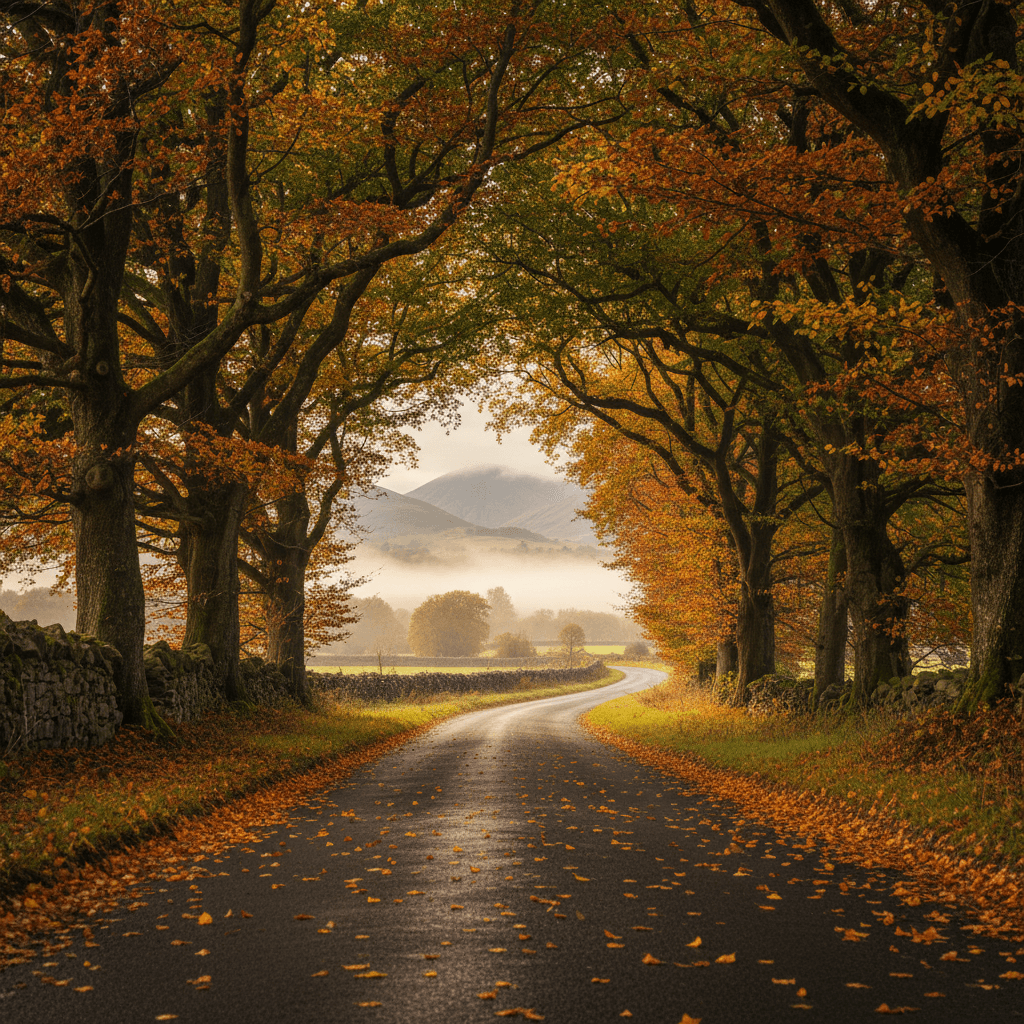
Autumn in Ireland — September, October and November — is the country's quietest, cheapest and arguably most beautiful season. The summer crowds disappear after the August bank holiday and the country empties out. The light goes golden in a way that's hard to describe to anyone who hasn't seen it. Killarney's oak woodlands turn copper. The bog roads in Connemara fade to russet. The midges — and I cannot overstate this — are gone.
If you've been told to come to Ireland in July, you've been told wrong. Come in September or October.
This is what to actually expect, month by month — what the weather does, where the autumn colours peak, why Ireland takes Halloween more seriously than almost anywhere else, and the road trips that are at their best when the rest of Europe has switched off for the season.
What's Autumn Like in Ireland?
The short version: mild, golden, atmospheric, much wetter as the season progresses, and dramatically less busy than summer.
The longer version, in numbers:
| What | September | October | November |
|---|---|---|---|
| Average temperature | 12–17°C | 9–14°C | 6–10°C |
| Daylight hours | 14 → 11 | 11 → 10 (clocks go back) | 9.5 |
| Rainfall | Moderate, often dry | Increasing, changeable | High, persistent |
| Crowd level | Quiet (after first week) | Very quiet | Empty |
| Foliage | Green with hints of turn | Peak colour | Bare branches |
| Best for | Indian summer, hiking, photography | Autumn colours, Halloween, road trips | Cosy pubs, storm watching, ancient sites |
The thing visitors notice first is the light. Irish autumn light sits low in the sky and stretches the golden hour from forty minutes (June) to almost ninety (October). Photographers who come specifically for the light describe it as "softer, slower, sideways". You don't need to set an alarm for 4 am the way you do in summer — sunrise is around 7:30 in October — and the gentle morning mist that hangs in valleys until 10 am is the kind of thing landscape photographers travel years to find.
The other thing to know is that autumn weather is changeable, not bad. Irish autumn rain comes in showers rather than the all-day grey of January. You can plan around it. A wet morning often turns into a sunny afternoon. The fundamental rule of dressing for Irish autumn — layers, with a properly waterproof shell on top — handles every condition you'll face.
Why Autumn?
What You're Trading Summer For
| Factor | Autumn vs Summer |
|---|---|
| Crowds | Down by 60–70% after August |
| Colour | Peak foliage mid-October |
| Light | Long, slow, golden |
| Prices | 20–30% off summer rates |
| Weather | Often surprisingly mild |
| Atmosphere | Turf fires, harvest festivals, empty pubs |
The Real Trade-Offs
It's not all golden light. You should know what you're getting into.
- Daylight shrinks fast. By the end of October you've got 10 hours, by mid-November you're down to 9.
- Weather is genuinely changeable. A morning in Doolin can be sun, rain, hail and rainbow before lunch. Bring layers.
- Some seasonal businesses close for the off-season. Smaller B&Bs in Connemara and Kerry shut from late October.
- The clocks go back on the last Sunday of October — sunset will catch you out if you're not paying attention.
None of this is a deal-breaker. You just plan around it.
Peak Foliage Times
Ireland is milder than most of continental Europe, so the colours come later than visitors expect. If you're chasing peak foliage, here's what I'd plan for:
| Region | Peak Colour |
|---|---|
| Northern Ireland and the Glens of Antrim | Early to mid-October |
| Wicklow and the midlands | Mid-October |
| The west — Connemara, Mayo | Mid to late October |
| Killarney and West Cork | Late October to early November |
Kerry and Cork frequently hold their colour into the first week of November. If you can be flexible on dates, the third week of October is the safest bet for hitting peak colour somewhere in the country.
The Trees That Actually Turn
- Beech — the showstopper. Bronze to gold, holds its leaves longer than most.
- Sessile and English oak — deep reds and tobacco browns. Killarney's National Park is built around them.
- Birch — bright lemon yellow, especially in Wicklow and the Burren
- Rowan (mountain ash) — orange and red leaves with deep red berries that the blackbirds strip in days
- Ash — yellow but drops early. Half the ash trees in Ireland are also dying from ash dieback, so don't expect them to hang around.
Best Autumn Drives
For Fall Colours
Wicklow is the obvious one if you're staying in or near Dublin. It's an hour from the city centre and it concentrates more autumn colour into a small area than anywhere else in the country.
The drive I'd actually do: head south on the M11, exit at Kilmacanogue, take the R755 over to Roundwood, then up to Glendalough. After Glendalough, double back through the Sally Gap and the Military Road. Pull in at Lough Tay (the so-called "Guinness Lake" because of its dark water and white sandy beach), then drop back to Dublin via Enniskerry and Powerscourt.
- Best time: Mid-October
- Don't miss: Glendalough Upper Lake, Lough Tay, the Sally Gap viewpoint, the Powerscourt Estate gardens
The Ring of Kerry in late October is what most people think Ireland in summer looks like. The oak woodlands of Killarney National Park around Muckross House are properly spectacular — the kind of colour that doesn't quite look real.
Skip the standard tour-bus loop and do it slowly. Stop at Torc Waterfall in the morning when the light is still soft, walk the Old Kenmare Road from Torc, take Ladies View around lunchtime when the sun has come around to that side of the lakes.
- Best time: Late October
- Don't miss: Muckross Lake, Torc Waterfall, Ladies View, Moll's Gap
For Atmospheric Drives
Connemara is moor and mountain rather than forest, so it doesn't do "leaf peeping" the way Wicklow or Killarney do. What it does instead is more interesting: the heather goes from purple to russet to bronze, the bogs turn copper, and the Twelve Bens often get their first dusting of snow on the peaks while the valleys are still mild.
Lough Inagh in mid-October with low cloud lifting off the Maumturks is the kind of view photographers travel for years to find.
- Best time: October
- Don't miss: Lough Inagh valley, Kylemore Abbey, Killary Fjord, the Sky Road from Clifden
The Boyne Valley in October has a very specific atmosphere. Newgrange in early-morning mist looks 5,000 years old in a way it doesn't on a sunny July day. The Hill of Tara in autumn — wind across an empty hilltop, the country laid out below — is one of the few places in Ireland where you can still feel what it must have been like to live here a millennium ago.
- Best time: Mid to late October
- Don't miss: Newgrange (book ahead through Brú na Bóinne), Hill of Tara, Slane Castle grounds, Bective Abbey
For Lake Reflections
Yeats country. The poet wrote about this landscape constantly, and in autumn it's obvious why. The lake reflects the gold of the surrounding birch and oak so completely that on still mornings the world looks doubled. Drumcliffe churchyard, where Yeats is buried, is a fifteen-minute drive away.
Lough Derg is the largest lake the River Shannon passes through, and the wooded shores around Mountshannon and Killaloe go full colour in late October. The villages along the shore are quiet in autumn — the boating crowd has packed up, the pubs are back to locals, and the views are just there for you.
Autumn Activities
Walking
Autumn is the best walking season in Ireland by a clear margin. Here's why:
- The temperatures are right — cool enough to walk uphill without melting, warm enough not to need full winter gear
- Midges are gone (they vanish around the first frost — typically late September in the west, mid-October inland)
- Ground is usually still dry-ish from summer
- Visibility is often better than summer once the morning mist burns off
- The colours
Walks I'd recommend in October:
- Glendalough Spinc Walk (Wicklow) — the high boardwalk with the lake below
- Torc Mountain (Killarney) — short, steep, the view from the top is worth every step
- Diamond Hill (Connemara, in Connemara National Park) — under three hours, panoramic views over the Twelve Bens
- Glenariff Forest Park (Antrim) — waterfalls and beech woods, possibly the best autumn forest walk on the island
Photography
Autumn light in Ireland behaves differently. The sun sits lower, the golden hour stretches out for an hour and a half instead of forty minutes, and the angle picks up the colour of the leaves in a way summer light never does.
Practical things photographers should know:
- Sunrise is around 7:30 in October. You don't need to set an alarm for 4 am the way you do in June.
- Morning mist is very common in October, especially near lakes and rivers. It clears around 10 am. Be there before 9.
- A polarising filter is worth packing — it cuts the glare on wet leaves and pulls more colour out of the sky.
- Bring a tripod if you're shooting interiors of pubs, churches, abbeys. Light levels are low.
Harvest Experiences
October is harvest season and the food calendar reflects it:
- Apple picking at orchards across Armagh ("the orchard county") and the south-east
- Farmers' markets in every county with pumpkins, squash, late blackberries, sloes
- The first oysters of the season — September is when the official Irish oyster season starts and the Galway International Oyster Festival kicks it off
- Game appears on restaurant menus — pheasant, venison, sometimes wood pigeon
Ireland Weather in September, October & November
Three different months, three different versions of autumn. Knowing which one you're walking into matters more than visitors realise.
Ireland in September
- Average highs: 12–17°C
- Average lows: 8–11°C
- Daylight: 14 hours (early September) tapering to 11 hours by month's end
- Rainfall: Moderate — often the driest autumn month
- Crowds: School holidays end the first week of September, then it's quiet
September is often the single best month to visit Ireland in the entire calendar. The weather is mostly mild and frequently warm — "Indian summer" weeks are common, especially in the first two weeks. The light is still long enough that you can be out hiking until 7 or 8 pm. Trees are still mostly green but starting to turn at the edges.
What September lacks: peak autumn colour (too early). What September has in abundance: every other reason to visit Ireland, with no crowds and prices already dropping from peak summer.
If I were planning a one-week trip and could pick any week of the year, the second or third week of September is the one I'd choose. Mid-September is the sweet spot.
The first oysters of the season hit Irish menus around the Galway International Oyster Festival in late September — the world's oldest oyster festival, running since 1954.
Ireland in October
- Average highs: 9–14°C
- Average lows: 5–9°C
- Daylight: 11 hours (early October) down to 10 hours after the clocks go back
- Rainfall: Increasing, more changeable
- Crowds: Very quiet outside the half-term week (around the Halloween bank holiday)
October is the headline autumn month — the one most visitors who know what they're doing aim for. Trees go through peak colour roughly mid-October in Wicklow and the midlands, late October in Killarney and West Cork. The weather is genuinely changeable: a morning in Doolin can be sun, rain, hail and rainbow before lunch. But a wet morning often turns into a sunny afternoon, and the dramatic skies are part of the experience.
The clocks go back on the last Sunday of October — at 2 am the clocks shift back to 1 am, so you "gain" an hour but sunset is suddenly an hour earlier the next day. This catches a lot of visitors out. Plan your driving accordingly.
October ends with Halloween, which is celebrated as a major national event in Ireland — see the dedicated Halloween section below.
Ireland in November
- Average highs: 6–10°C
- Average lows: 2–6°C
- Daylight: 9.5 hours and shrinking
- Rainfall: High, more persistent than October
- Crowds: Effectively gone
November is wet, dark and atmospheric. It's not for everyone. Days are short, the weather is genuinely cold by Irish standards, and there's not much daylight to play with. Most autumn colour has dropped from the trees by mid-month.
But for a specific kind of visitor, November is wonderful. Cosy pubs with turf fires lit. Dramatic Atlantic storms hammering the west coast (something locals actually go to watch — Lahinch and Bundoran are storm-chasing destinations). Empty heritage sites. Hot whiskeys and pints by fires. Almost no other tourists.
This is the right month for a trip focused on pubs, music, food and atmosphere rather than long sightseeing days. Pair it with a base in a town with a couple of good pubs (Doolin, Westport, Dingle, Galway) and accept that you'll spend more time indoors than out.
Useful Weather Things to Know Across All Three Months
- Morning fog is common, especially near lakes and along the west coast. It nearly always clears by mid-morning.
- Rain in autumn comes in showers rather than the all-day grey of January. You can plan around it.
- Coastal wind picks up from October. Bring a properly waterproof jacket, not a fashion one.
- Inland frost starts in late October. Not enough to be a driving hazard, but enough that you'll want to scrape the windscreen on a B&B forecourt at 8 am in the midlands.
- November storms arrive with colour-coded warnings, and the colour is the thing to read before an exposed coastal day. What Yellow, Orange and Red actually mean — and why Northern Ireland says Amber — is in the Ireland weather warnings guide.
Best Periods at a Glance
- Early September — often feels like a continuation of summer. School holidays have just ended, prices have dropped, weather is mostly settled.
- The third week of October — peak colour somewhere in the country, weather still reasonable, an honest sweet spot
- Late November — winter is approaching but you can still get bright crisp days with no one else around
Practical Considerations
Daylight Hours
| Date | Sunrise | Sunset | Daylight |
|---|---|---|---|
| Sept 1 | 6:30 am | 8:30 pm | 14 hours |
| Oct 1 | 7:30 am | 7:15 pm | 12 hours |
| Oct 27 (clocks back) | 7:00 am | 5:45 pm | 10.5 hours |
| Nov 1 | 7:30 am | 5:00 pm | 9.5 hours |
The clocks going back at the end of October is the moment that catches visitors most. The Sunday morning the clocks change, sunset is suddenly an hour earlier than it was the day before. Plan your driving accordingly.
Planning Around Light
- Front-load the day's driving into the middle of the day
- Aim to be at your accommodation by 5 pm in late October, by 4:30 in November
- Use evenings for cosy pubs and pints, not for trying to find a B&B in the dark on a country road
- Sunrise photography is possible without setting an inhumane alarm
Accommodation in Autumn
- Availability is dramatically better than summer
- Prices drop after the August bank holiday (the first weekend of August)
- Some seasonal B&Bs close — phone ahead, especially in Connemara and the more remote bits of Kerry
- The places that stay open often have turf fires lit in the evenings, which is half the reason to come in October
Atmospheric Experiences
Cosy Pubs
October is when Irish pubs are properly themselves. The summer tourists are gone. The locals are back at the bar. The fires are lit. The musicians are playing for an audience of twelve people instead of a hundred.
Pubs I'd point you toward:
- Dick Mack's in Dingle, especially on a wet Tuesday
- Tigh Neachtain in Galway city
- Levis's Corner Bar in Ballydehob, West Cork
- The Cobblestone in Smithfield, Dublin, for the trad sessions
- Almost any back-bar pub in any town in Connemara
Heritage Sites
Ireland's ancient sites take on a different quality in autumn. The summer heat haze is gone. The light is sideways. Mist hangs in the morning at the Hill of Tara, at Newgrange, at the stone circles of Beaghmore in Tyrone, at the round towers of Glendalough and Clonmacnoise.
If you've only seen these places in photographs, the photographs will have been taken in October.
Seasonal Food
- Oyster season opens in September (the native flat oyster — Ostrea edulis — comes back for the months with an "r" in the name)
- Wild mushrooms in forests across Wicklow and West Cork. Don't eat any you haven't identified — there are some genuinely dangerous ones in Irish woods.
- Apple season everywhere
- Game on restaurant menus, especially venison from the Wicklow herd
- Stews, chowders, soups — pub food turns wintry in the best way
Halloween in Ireland: The Country That Invented It
Most visitors don't realise this until they get here, but Halloween is Irish.
Not borrowed from America. Not adopted from somewhere else. Halloween originated in Ireland as the Celtic festival of Samhain (pronounced "sow-in"), which marked the end of the harvest and the beginning of winter on the Celtic calendar. The Celts who lived on this island more than 2,000 years ago believed that on the night of October 31st, the boundary between the living and the dead became thin, and spirits could cross into the human world.
Almost everything we now think of as a Halloween tradition comes directly from Samhain:
- Bonfires were lit on hilltops to ward off the spirits crossing over
- Costumes were worn to disguise the living from any malevolent spirits
- Jack-o-lanterns were originally carved from turnips (not pumpkins — those came later in America when the Irish couldn't find turnips and substituted what was available)
- Trick or treat began as the practice of leaving food and drink offerings out for the wandering dead
- Apple bobbing comes from a Celtic divination ritual
Irish emigrants carried these traditions to America in the 19th century, where they evolved into the modern commercial Halloween. The festival came home to its country of origin as a globalised export, but the ancient roots are still here.
The practical implication: Ireland celebrates Halloween more enthusiastically than any country in Europe, and arguably more authentically than the United States. If you're in Ireland in late October, you'll see decorations on every street, costumes in every pub, and bonfires on hillsides on the night of the 31st. The Halloween bank holiday (the closest Monday to October 31st) is one of the busiest weekends of the autumn calendar in Ireland.
The Best Halloween Festivals in Ireland
Three festivals stand out, each worth planning a trip around:
1. Derry Halloween (Banks of the Foyle) — Derry/Londonderry in Northern Ireland hosts what is widely considered the largest Halloween festival in Europe, and the city has been recognised by USA Today as one of the best Halloween destinations in the world. The week-long event includes a major street carnival, fireworks over the River Foyle, ghost tours of the historic walls, and tens of thousands of costumed locals taking over the city centre. If you're picking one Halloween destination in Ireland, this is it.
2. Púca Festival (Trim and Athboy, Co. Meath) — Named after the mischievous shape-shifting spirit of Irish folklore, Púca Festival runs across Trim and Athboy in County Meath — a historically significant area where Samhain was anciently celebrated on the Hill of Ward outside Athboy. The festival blends traditional Irish music, food, fire ceremonies, storytelling and family events into a four-day programme that explicitly connects modern Halloween back to its Samhain roots. More family-friendly and "authentic Celtic" than Derry's full carnival energy.
3. Spirits of Meath / Boyne Valley Festival — The broader Boyne Valley region (which contains Newgrange, the Hill of Tara and many of Ireland's most ancient sites) runs a programme of Halloween events at heritage sites throughout October. Newgrange itself — the 5,000-year-old passage tomb — was built to align with the winter solstice, but its cultural connection to the supernatural makes it an atmospheric place to be in October. Several of the smaller tombs in the area open for evening tours during the Halloween season.
4. Bram Stoker Festival, Dublin — Bram Stoker, the Dublin-born author of Dracula, gets his own four-day festival in his home city every Halloween weekend. Gothic walking tours, performances, talks and a creepy/clever atmosphere across Dublin's historic streets. Better than it sounds.
What Halloween Looks Like Outside the Festivals
If you're in Ireland on October 31st but not at a major festival, you'll still see:
- Bonfires on hillsides in most towns — a centuries-old tradition that the local councils now organise officially for safety
- Fireworks (legal and illegal) all over the country from about a week before Halloween
- Costumed children going door to door for trick or treat — same as the US version
- Pubs decorated with cobwebs, pumpkins and skeletons; some host costume parties
- Barmbrack (a fruit loaf with a ring baked inside it for fortune-telling) sold in every supermarket and bakery — eat a slice with butter, find the ring, you'll be married within the year
Visiting Ireland Around Halloween: Practical Notes
- Book accommodation early. The Halloween bank holiday weekend is one of the busiest weekends of the autumn calendar, especially in Derry (for the festival), Dublin and any town near the Boyne Valley.
- Expect bonfires at night. Some are organised, some aren't — the smell of woodsmoke in the evening from late October is part of the experience.
- Children dressed as ghosts will appear at pub windows asking for treats. Have some sweets in your bag.
- The clocks go back the weekend before Halloween — sunset is around 5 pm on the night itself, so the spooky atmosphere starts early.
Autumn Colours in Ireland: Where to See Them
Ireland isn't New England — the deciduous forests aren't quite as expansive — but the autumn colour at the right places is genuinely spectacular and almost no one outside the country knows about it. Here are the six places to actually go, each with peak timing.
1. Killarney National Park (Co. Kerry)
Peak colour: Late October to early November
Killarney is the headline autumn destination in Ireland. The 26,000-acre national park is built around ancient oak and yew woodlands that turn deep copper and bronze through October, with the trees reflected in three lakes (Lough Leane, Muckross Lake, Upper Lake). Centred on Muckross House and Gardens and Ross Castle, the park is laced with walking trails and the famous "Old Kenmare Road" walk from Torc Waterfall — one of the best autumn walks in Europe.
The Ring of Kerry route circles the park; for a proper colour day, base in Killarney town and walk the woodlands rather than driving the full Ring. Killarney's oak woodlands are part of a global network of remnant temperate rainforests — the colour quality is something genuinely special.
2. Glendalough (Co. Wicklow)
Peak colour: Mid-October
Glendalough — "the Glen of Two Lakes" — is in the Wicklow Mountains National Park about an hour south of Dublin. The 6th-century monastic ruins sit beside the Lower Lake, surrounded by birch and oak forest that turn bright lemon yellow and deep gold through October. The Upper Lake (a 20-minute walk further into the valley) is even more spectacular in autumn, with steep wooded sides reflected in still water on calm mornings.
This is the best autumn destination if you're staying in Dublin — easy day trip, no overnight needed. Pair it with Powerscourt Estate (below) for a full Wicklow autumn day.
3. Powerscourt Estate Gardens (Co. Wicklow)
Peak colour: Mid to late October
If Glendalough is wild Irish woodland, Powerscourt is the formal version. The 18th-century estate gardens just south of Enniskerry contain a deliberately planted autumn arboretum with maples, beeches, oaks and exotic species chosen specifically for their fall colour. The grounds also include the Powerscourt Waterfall, the highest in Ireland, which in autumn is surrounded by golden trees.
Better managed and more "garden" than Glendalough, but with the same drive-time from Dublin.
4. Tollymore Forest Park (Co. Down, Northern Ireland)
Peak colour: Mid-October
The oldest state forest park in Northern Ireland, Tollymore sits at the foot of the Mourne Mountains in County Down. The park includes mature beech avenues, riverside walks along the Shimna River, gothic stone bridges and follies, and one of the most photogenic autumn forest landscapes on the entire island. Game of Thrones fans may recognise it — large parts of the show were filmed here.
If you're combining the Republic with Northern Ireland on your trip, Tollymore is the Northern Ireland autumn destination to add to the itinerary.
5. Glenariff Forest Park (Co. Antrim, Northern Ireland)
Peak colour: Mid-October
Glenariff is in the Glens of Antrim on Northern Ireland's east coast — a glacial valley known as "Queen of the Glens" — with three waterfalls cascading through deep beech and oak woodland. The walking trails take you alongside the river through some of the most colourful autumn woodland on the island. Pair with the Causeway Coastal Route for a full Antrim day in October.
6. The Boyne Valley (Co. Meath)
Peak colour: Late October
Less of a single destination and more of a drive: the Boyne Valley between Slane, Trim and Drogheda is a patchwork of historic estates, medieval monastery sites and ancient stone monuments surrounded by the most cultivated woodland in Ireland. Slane Castle grounds, Bective Abbey, the Hill of Tara and the historic Townley Hall Forest all peak in late October. The light at this latitude in late October — around 11 hours of low sideways sun — is genuinely special for photography.
Honourable Mentions
If you want even more autumn colour beyond the top six:
- Lough Gill and the Ox Mountains (Sligo) — Yeats country, late October
- Mountshannon and Lough Derg (Clare) — wooded lakeshores
- Carriganass Castle and the Glengarriff Woods (West Cork) — temperate rainforest, early November
- Glenveagh National Park (Donegal) — mostly bog and mountain rather than forest, but the rhododendron and oak around the castle turn dramatically
What to Pack for Autumn in Ireland
Irish autumn weather changes hour by hour. The right packing list assumes you'll experience sun, rain, hail, fog and rainbow within the same morning, especially on the west coast. Layers, waterproofs, warm shoes — none of it is optional.
The Essentials
- A properly waterproof jacket with a hood. Not a fashion jacket — a proper waterproof shell with taped seams. Brands like Berghaus, Rab, North Face, Macpac and Páramo are all reliable. Spend the money on this one item; it's the difference between enjoying a wet day and being miserable.
- Layers for under the shell — a thin merino wool or synthetic base layer, a fleece or warm sweater, and a wind-resistant mid-layer if you're heading into the hills. Cotton is the wrong material for Irish autumn — it gets wet and stays wet.
- Walking shoes or boots with proper grip. Smooth-soled trainers will betray you on wet leaves and damp tarmac. If you plan any of the woodland walks at Killarney, Glendalough or Tollymore, walking boots are non-negotiable.
- A small umbrella that fits in a day bag. The wind will turn it inside out occasionally — that's fine.
- Hat and gloves for late October and November. A wool beanie and a pair of light gloves take up no space and dramatically improve cold mornings.
- A neck buff or scarf — adds 2°C of perceived warmth and weighs nothing.
- Sunglasses. Yes, in autumn. The low sun angle in October and November is brutal when driving westbound in the late afternoon.
What NOT to Pack
- A heavy winter parka. You'll overheat indoors. Every Irish B&B has the heating cranked up.
- Cotton hoodies as your warm layer. They get heavy when wet and never dry.
- High heels. Cobbled streets and damp pavements in every Irish town.
- A dressy umbrella. It's going to be wind and rain — get a sturdy one.
For the full version with a proper packing checklist for every season, see our packing guide.
Other Autumn Events
October
- Galway International Oyster Festival — late September, the world's oldest oyster festival
- Cork Jazz Festival — late October bank holiday weekend, takes over the city
- Wexford Festival Opera — runs into November, internationally serious
November
- Belfast International Arts Festival
- Dublin Book Festival
Driving Tips for Autumn
Road Conditions
The autumn-specific things to watch on Irish roads:
- Wet leaves — slippery, especially on the R-roads through forested areas. Wicklow and Killarney are the obvious ones.
- Morning fog — common near rivers and lakes, fades by 10 am
- Frost from late October, especially inland in the midlands. Scrape the windscreen properly before driving.
- Early darkness — adjust journey times. A drive that took 3 hours in July light is the same 3 hours in October but you'll arrive in the dark if you started too late.
Wildlife
Deer are in rut from late September through October. They're more active during the day, more reckless on roads, and in places like Killarney National Park and the Wicklow Mountains they cross roads without looking. Dawn and dusk are the high-risk windows.
Sheep are still everywhere in Connemara and Kerry. They don't move out of the way for cars. Slow down, drive around them, expect them to suddenly decide to cross.
Vehicle Checks
- Tyres in decent condition (wet roads are unforgiving)
- Headlights working — both bulbs and the alignment
- Windscreen wipers in good shape
- Washer fluid topped up
- A blanket and a torch in the boot if you're going late autumn into winter
Quick Autumn Checklist
- Camera and tripod
- Layers, including a proper waterproof
- A warm fleece for evenings
- Walking boots, not trainers, if you plan to do any of the trails
- Accommodation booked (and check seasonal closures)
- Sunrise and sunset times noted for your date range
- A torch for evening walks back from the pub