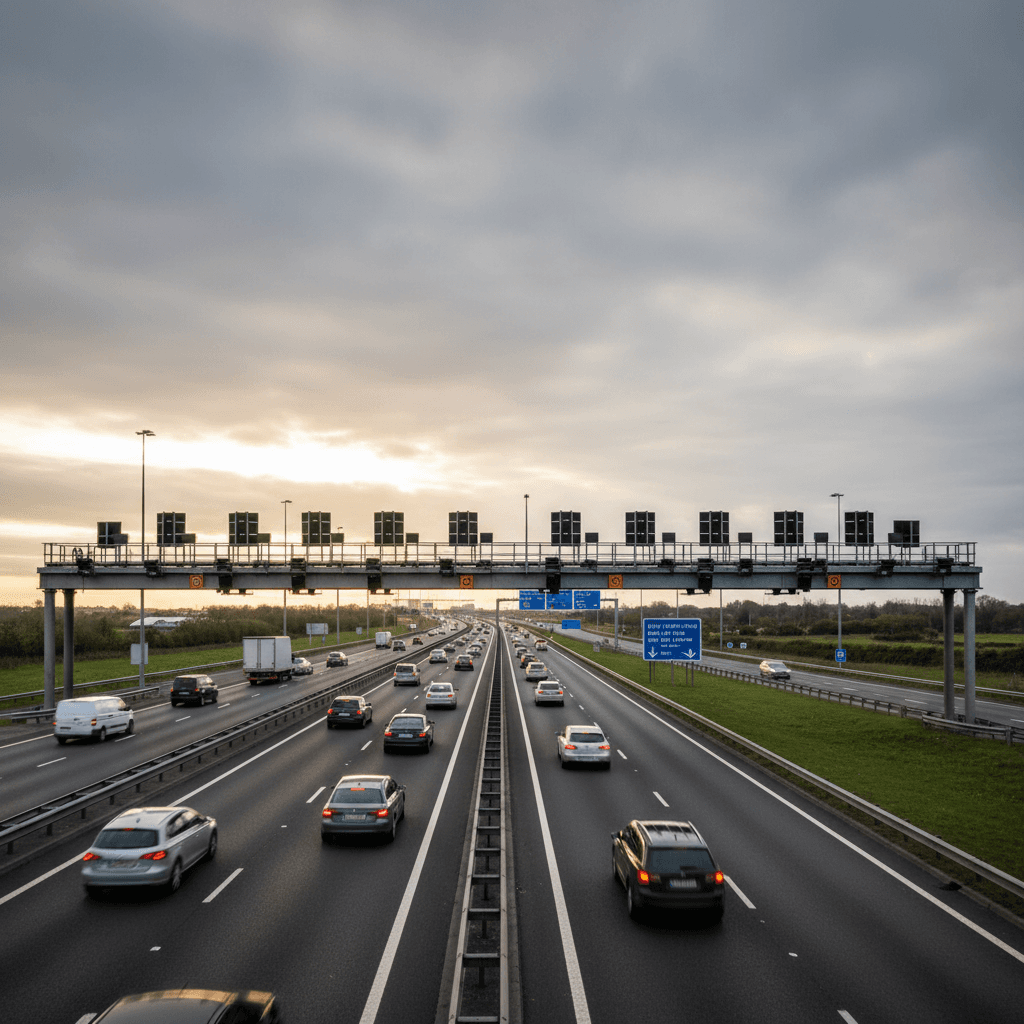
- The M50 toll for a private car is €3.80 unregistered, or €2.60 with an eFlow electronic tag. Rates checked against TII and eFlow in September 2026.
- The M50 is barrier-free — there are no toll booths, and the toll must be paid online, by phone or at a Payzone shop before 8pm the day after you use the road.
- Miss that deadline and eFlow adds a €4.00 late fee, then a further €51.00 if it is still unpaid 14 days later, then €128.00 after 72 days.
- TII lists twelve toll points in the Republic of Ireland, across eleven schemes. Northern Ireland has no toll roads.
Most of Ireland's tolls are simple — you drive up to a booth, you pay €2.30 in coins or tap a card, the barrier lifts, you go. There's nothing to worry about.
Then there's the M50.
The M50 is the orbital motorway around Dublin and it's the one toll road in Ireland that catches almost every visitor out. There are no booths. There are no barriers. There's nothing to stop you, no signal that you've been charged, and no obvious way to pay. You drive under an overhead gantry at 100 km/h, cameras photograph your number plate, and from that moment you have until 8pm the next day to pay €3.80 — or you start collecting fines.
This guide is the version I wish someone had handed me the first time I drove a hire car out of Dublin Airport. The M50 section is the one that matters most. The rest is housekeeping.
Quick Answer: What You Actually Need to Know
If you only read three things in this guide, read these:
- The M50 is barrier-free. No booths. Pay online at eflow.ie by 8pm the day after you drive through, or your rental car company will be billed and they'll add an admin fee to your card.
- All other Irish tolls are at booths. Pay with cash or card on the spot. Nothing to organise in advance.
- Northern Ireland has no tolls at all. Cross the border, drive freely.
That's the whole guide in three sentences. If you want the rest, keep reading.
All Toll Roads in Ireland (2026 Prices)
TII lists twelve toll points across the Republic of Ireland, on eleven separate tolling schemes — the M3 Clonee–Kells scheme charges at two plazas, which is why the road count and the point count differ. Northern Ireland has none.
If you already know the drive you are doing, the toll calculator totals it for you — it uses the same rates as the table below, and it handles the M50 as the barrier-free case it is rather than as another row.
| Toll Road | Location | Type | Car Price |
|---|---|---|---|
| M50 | Dublin orbital (West-Link, J6–J7) | Barrier-free (cameras) | €3.80 unregistered |
| M1 | Gormanston–Monasterboice (Drogheda) | Barrier | €2.30 |
| M3 — Blackbull Plaza (Southern) | Dunboyne–Dunshaughlin | Barrier | €1.80 |
| M3 — Grange Plaza (Northern) | Navan North–Kells | Barrier | €1.80 |
| M4 | Kilcock–Enfield–Kinnegad | Barrier | €3.60 |
| N6 | Galway–Ballinasloe | Barrier | €2.30 |
| M7/M8 | Portlaoise–Castletown / Portlaoise–Cullahill | Barrier | €2.30 |
| N8 | Rathcormac–Fermoy Bypass | Barrier | €2.30 |
| N25 | Waterford City Bypass | Barrier | €2.30 |
| Limerick Tunnel | N18 under the Shannon at Limerick | Barrier | €2.30 |
| Dublin Port Tunnel | M1 to Dublin Port | Barrier | €3.50 off-peak / €14.00 or €12.00 at peak |
| East Link Toll Bridge | Dublin city, over the Liffey at the docks | Barrier | €2.30 |
Private car rates only, taken from each scheme's own page on TII.ie under its "Applicable Tolls 2026" heading, and checked on 1 September 2026. The M50 figures were cross-checked against eFlow. Vans, goods vehicles and motorcycles pay different rates — check TII before assuming. Tolls are revised every January, so treat any figure here as expiring on 31 December 2026.
One caveat we would rather state than hide: TII's East Link page shows €2.30 for private cars under a table headed "Applicable Tolls 2026", but the sentence above that table still reads "the tolls being applied from 1 July to 31 December 2024". TII has not reconciled its own page. €2.30 is what it publishes as the 2026 figure; have small change for a little more if the signage at the bridge disagrees.
A few things to note about that table:
- Dublin Port Tunnel has the wildest pricing in the country, and the peak charge is not the same in both directions. It is €3.50 at all other times and on public holidays, €14.00 southbound between 6am and 10am Monday to Friday, and €12.00 northbound between 4pm and 7pm Monday to Friday. The peak charge exists to keep heavy lorries off the surface streets. Visitors heading to or from the ferry terminal almost always pay the off-peak rate.
- The M50 is the only toll on the table without a barrier. Every other toll has a booth with a person or a card reader.
- There's no toll on the Cork-to-Killarney route, the entire west coast, the Wild Atlantic Way, or anywhere in Donegal. If you're skipping Dublin and heading straight to scenery, you may never see a toll the entire trip.
M50 Toll: Everything You Need to Know
The M50 is the single most important thing on this page. It's the toll that costs visitors money in fines they didn't know they owed, and it's worth understanding properly before you ever pick up a rental car.
What the M50 Actually Is
The M50 is a 45-kilometre motorway that loops around the western and northern edges of Dublin, connecting nearly every other major route into the city: the M1 from the north, the N3 from the northwest, the N4 from the west, the N7 from the southwest, the M11 from the south. If you're driving from Dublin Airport to anywhere except Dublin city centre itself, you're almost certainly going on the M50. If you're returning from a road trip in the west and dropping the car back at Dublin Airport, you're going on the M50.
It is, in practical terms, almost impossible to avoid if you're flying in or out of Dublin and going anywhere outside the city.
Where the Toll Point Is
There is exactly one toll point on the entire M50, and it's on the West-Link Bridge — a long high bridge over the River Liffey valley on the western side of the orbital, between Junction 6 (N3 Blanchardstown) and Junction 7 (N4 Lucan). If you've driven from Dublin Airport toward anywhere in the west — Galway, Limerick, Cork — you've been over it.
You can drive the eastern half of the M50 (J9 in the south, around the south side of the city, up the east) without ever crossing the toll point. But the moment you cross between J6 and J7 in either direction, you've been tolled.
How the Toll Works (No Booths, No Barriers)
There is nothing to stop you. You don't slow down. You don't pull over. There are no toll booths and no person to hand money to.
What's there instead is an overhead gantry spanning all the lanes — a horizontal steel structure bolted to two posts at the side of the motorway, with cameras and sensors mounted along its length. As you pass underneath at full motorway speed, the cameras photograph your front and rear number plates. If you have an eFlow tag mounted on your windscreen, the gantry also reads it and charges your account directly. If you don't, the system files your number plate against a national vehicle database and starts a clock.
You will not see a flash. There is no signal. No alert. The first you'll know you've been tolled is when you check eflow.ie afterwards — or when the rental company bills you a few weeks later.
The 8pm Deadline (This Is the Important Part)
You have until 8pm on the day after you use the M50 to pay your toll. Not 24 hours. 8pm the next calendar day.
If you cross the West-Link at 11pm on a Tuesday, you have until 8pm Wednesday — that's 21 hours. If you cross at 6am on a Tuesday, you have until 8pm Wednesday — that's 38 hours. If you cross at 7pm on a Sunday, you have until 8pm Monday — and the eFlow customer service phone lines aren't open as late on Sundays.
Pay it the same day if you can. There is no upside to waiting.
What Happens If You Miss the Deadline
eFlow publishes the escalation as a series of amounts added on top of each other, not as a single replacement fine. These are its own figures, checked on 1 September 2026:
| Stage | What eFlow adds |
|---|---|
| Paid before 8pm the next day | Nothing — just the €3.80 toll |
| After 8pm the next day | €4.00 late fee per journey, and a First Penalty Notice |
| Still unpaid a further 14 days | an additional €51.00, and a Second Penalty Notice |
| Still unpaid after 72 days | a further €128.00, and the case goes to eFlow's solicitors, Pierse Fitzgibbon LLP |
| Continued non-payment | Legal action |
We have deliberately not printed a running total for the final stage. eFlow's wording is that each amount is "additional" or "a further penalty", and that the full amount must be paid to stop the penalties escalating — but eFlow does not publish a worked total, and we are not going to invent one. Add the stages yourself if you need the worst case, and pay before you ever need to.
This is per crossing. If you crossed the M50 four times during your week in Ireland and forgot to pay any of them, you can be facing four separate penalty escalations.
For visitors, the most common scenario is that the rental company is billed weeks later (because their car is the one registered to the number plate eFlow photographed). The rental company then charges your credit card the toll plus an "administration fee" — typically €5–€20 per toll — and most people have already gone home before they realise. We'll come back to this below.
- eFlow does not send links in text messages. Its standing notice on fraudulent texts says exactly that: "eFlow does not send links in text messages. If you receive one, delete immediately."
- eFlow is not asking anyone to accept new terms. Announcing its terms change on 22 September 2026, eFlow said it was aware of messages asking customers to accept terms and conditions, told customers to ignore those emails and not click any links, and stated that no action is required from customers to accept the new terms.
- Pay a real toll by typing eflow.ie into the browser yourself — or use the eFlow app, the phone line, or a Payzone till. All four are set out in the next section. Never from a link that arrived in a message.
- If you already clicked, contact your bank immediately. eFlow's instruction is to contact your bank, report the message to [email protected], and delete it.
- Getting one does not mean eFlow has your details. eFlow states that its system "has not been compromised or subjected to a data breach."
Both quotes are eFlow's own, checked on its site on 26 September 2026: its "Fraudulent Text Messages" notice, published 1 June 2024, and its customer terms notice of 22 September 2026. We are not going to tell you how many of these are circulating or what they have cost, because eFlow does not publish either figure.
How to Pay the M50 Toll
There are five ways to pay. Pick whichever is easiest for you while you're sitting in your accommodation that evening.
1. Online at eFlow.ie
The official website is eflow.ie. From the homepage, click "Pay Toll" or "Pay as You Go". You'll need:
- Your vehicle registration number (the front and back number plate of the rental — written on your rental contract)
- A debit or credit card (Visa or Mastercard work; Amex is hit-and-miss)
The whole process takes about two minutes. You'll get an email confirmation. Keep it.
This is the method I'd recommend for most visitors. It works on any phone or laptop, you don't need to call anyone, and you have proof of payment in writing.
2. eFlow App
Download the eFlow app from the iOS App Store or Google Play. Once installed, you can pay a toll in under 30 seconds — type the registration, tap the card, done. The app also lets you save the car so you can re-pay future tolls without re-typing the plate.
For a one-week trip with the same rental car, the app is the fastest option after the first payment.
3. By Phone
Call 0818 50 10 50 from within Ireland, or +353 1 4610122 from anywhere else (use this number if you're trying to pay before you fly home). Customer service operates Monday to Friday 8am–9pm and weekends 10am–6:30pm. Outside those hours there's an automated payment line on the same number that handles toll payments 24/7.
This is the fallback option if you're not comfortable paying online or if you're already at the airport about to fly out and you want it sorted.
4. At a Payzone Outlet
Payzone is a payment service operated through over 2,000 retail outlets across Ireland. Most Spar, Centra, Mace, Daybreak and Costcutter convenience shops have a Payzone terminal at the till. So do many petrol stations.
Walk in. Tell the till assistant: "I'd like to pay an M50 toll." Hand them your number plate written on a piece of paper or shown on your phone. Pay with cash or card. Keep the receipt.
This is the option for people who don't want to put a card detail into a website, or for anyone who happens to be in a Spar anyway and would rather sort it in person.
5. Let the Rental Company Handle It (Read the Small Print First)
Many of the major rental companies — Hertz, Enterprise, Europcar, Avis, Sixt, Dooley — have arrangements with eFlow where any unpaid M50 tolls on their vehicles are automatically billed back to the renter. The toll itself is the same €3.80, but the rental company adds an administration fee which is typically:
- €3–€5 per toll at the more reasonable companies
- €10–€20 per toll at the companies that treat this as a profit centre
- A flat daily charge of €5–€10 for the duration of your rental at companies that bundle a "tolling package" into your contract whether you wanted one or not
Read your rental agreement. Search the document for "toll" or "eFlow" before you sign. If the language is vague or talks about "administration charges to be advised", that's a warning sign.
For some visitors this is fine — the convenience of "I don't have to think about it" is worth €5 a toll. For others (especially anyone who crosses the M50 multiple times during their trip), it's significantly cheaper to pay it yourself.
There is no "right" answer. Pick whichever matches your tolerance for hassle versus your tolerance for being upsold.
Toll Tag Ireland (eFlow Tag)
The eFlow tag is a small electronic transponder you mount on the inside of your windscreen. As you pass through any Irish toll point — barrier or barrier-free — the tag is automatically detected and the toll is debited from a linked bank account. You don't need cash, you don't need to roll the window down, you don't need to remember to pay anything afterwards.
For Irish residents who use the M50 every week, it's a no-brainer. For visitors on a short trip, it's almost never worth the setup hassle.
What an eFlow Tag Costs (2026)
| Charge | Amount |
|---|---|
| Tag activation | Free |
| Monthly tag rental | €1.00 plus VAT — €1.23 |
| M50 crossing with tag | €2.60 (saves €1.20 vs. unregistered) |
| Other Irish toll roads | Same price as cash, but no need to stop |
eFlow states the monthly charge as "€1 (plus VAT) monthly rental fee per tag", checked 1 September 2026. It is a per-tag rental, so two tags is two fees.
The tag is free to set up. There's a small monthly rental. Each M50 crossing with the tag is €2.60 versus €3.80 unregistered — a saving of €1.20 per crossing. For someone who uses the M50 daily (commuters, delivery drivers), this pays for itself quickly. For a visitor crossing the M50 maybe two or three times in a week, the maths doesn't work — you're paying a monthly fee for two trips.
Why Visitors Should Skip It
Three reasons:
- Setup time. An eFlow tag has to be ordered through their website, posted to a verified address, registered to a specific number plate and linked to a bank account. None of that is fast, and it's not designed for a tourist who's only here for ten days.
- Wrong number plate. The tag is registered to your rental car's plate. If the rental company gives you a different car at pickup (it happens — your booked Polo turns into a Yaris), the tag is registered to the wrong vehicle.
- Account closure. After your trip you have to actively close the account, return the tag, and stop the monthly fee. Forget that step and you're being charged €1.23 a month forever.
The exception: if you're spending more than three weeks in Ireland with the same rental car AND you'll be in and out of Dublin frequently, the tag starts to make sense. For a typical one or two-week visit, just pay online the day after each crossing.
Tag Compatibility With Other Toll Roads
One thing that confuses people: the eFlow tag also works at the barrier toll roads. M1, M3, M4, N6, M7/M8, N8, N25, Limerick Tunnel, the Dublin Port Tunnel and the East Link — when you approach the booth in a tag-equipped lane, the barrier reads your tag and lifts automatically. You don't pay the booth a different amount, but you skip the queue.
Tag lanes are usually marked with yellow signs and an "e" symbol. Cash and card lanes are clearly separate. Don't accidentally drive into a tag lane without one — there's no booth attendant and you'll be stuck.
There are three tag operators in Ireland — eFlow, eToll (Easytrip) and Quickpay. All three tags are interoperable across all 12 toll points. You only need one.
Standard Booth Tolls (The Easy Ones)
Everything except the M50 is a traditional barrier toll. You drive up, the barrier is down, you pay, the barrier lifts, you drive off.
How to Pay at the Booths
- Cash: Euro coins and notes. Most booths give change. Have €5 or smaller notes ready — staff don't love handing back €47.70 of change for a €2.30 toll on a €50 note.
- Contactless card: Tap and go. The dedicated card lanes process payments in two seconds.
- Chip and PIN card: Slightly slower but works at every booth. Foreign cards (US, UK, EU) all work fine.
- Toll tag: Drive into the tag lane (marked with yellow signage), the barrier reads the tag automatically.
Most booths have multiple lanes — one for cash, one for cards, one for tags. Pick the right one before you arrive and you'll save thirty seconds.
Practical Tips for Booth Tolls
- Keep coins handy in the door pocket if you'd rather pay cash. Most booth tolls are €2.30, so a €2 coin and a 50c will cover it with 20c back.
- Have your card ready if you're paying contactless. The contactless lanes process so fast that fumbling for a wallet adds visible delays for the cars behind you.
- Don't queue in the wrong lane. There's nothing more annoying — for everyone — than reaching the front of the cash lane and realising you only have a card.
- Receipts are not automatic. If you want one for expenses, ask the cash booth attendant or look for a "receipt" button on the card terminal.
Tips for Avoiding Toll Surprises
Most visitors get caught out by the same handful of things. Avoid these and you won't have any problems.
1. Find out your rental company's M50 policy at pickup. Don't sign the rental contract without knowing whether the company will pre-pay tolls and bill you with an admin fee, or whether they expect you to pay yourself. The cheapest answer is almost always "pay yourself" — but only if you'll actually remember to do it.
2. Set a phone reminder. As soon as you cross the M50 toll point — you'll know because you'll see the gantry overhead — pull up your phone at the next opportunity and set an alarm for 6pm the next day. Use the eFlow app or eflow.ie when the alarm goes off. Two minutes' work, no fines.
3. Keep the receipts. Whether you pay online, by app or at a Payzone outlet, save the confirmation. eFlow occasionally has system glitches where a payment doesn't register against a number plate. Having the receipt is the only proof you have.
4. Don't avoid tolls just to save money. It's tempting to set Google Maps or Waze to "avoid tolls" to save €3.80. The catch is that the alternative routes around Dublin can add 45 minutes to a journey, and the alternative routes through Portlaoise can add an hour. Your time is worth more than €3.80.
5. The exception: avoid the Dublin Port Tunnel at peak hours. €14.00 southbound before 10am, or €12.00 northbound between 4pm and 7pm, is genuinely a lot for a five-minute drive. If you're heading to the Dublin ferry port at 7am or away from it at 5pm, it might be worth taking the surface route instead. At any other time, and on public holidays, the tunnel is €3.50 and worth it.
6. Photograph the rental at pickup including the front and rear plates. If there's ever a dispute about which tolls were yours, photographic proof of the registration number you actually drove is useful.
7. Check eflow.ie before you fly home. Even if you think you've paid every toll, log in once and search by your rental's number plate. If a toll was missed — or if you forgot one without realising — you can clear it before the rental company bills you with admin fees.
8. Type the address yourself — a text or email about an unpaid toll is a scam. eFlow does not send links in text messages, and it is not asking anyone to accept new terms and conditions. If one reaches you, do not tap it; go and check eflow.ie the way tip 7 describes instead. The warning further up this page has eFlow's own wording, and what to do if you already clicked.
Motorway Service Stations & Rest Stops
Tolls and rest stops aren't directly related, but if you're driving toll roads in Ireland you'll be on the same routes that have the country's main service stations. Worth knowing what's actually good and where the public toilets are along the way.
The Big Names
Barack Obama Plaza — On the M7 at Moneygall, halfway between Dublin and Limerick (and about 10 km north of the M7/M8 toll). It's named after Obama because Moneygall is his ancestral village; he visited in 2011, the plaza was built shortly after. Inside there's a large Supermac's, a Papa John's, an Insomnia coffee, an Applegreen forecourt, a small Obama exhibition (genuinely interesting), and the cleanest motorway-stop public toilets in the country. Open 24/7. The single best service stop on the Dublin–Cork or Dublin–Limerick run, and almost everybody uses it.
Junction 14 Mayfield (M7) — Just south of Portlaoise, an Applegreen-branded service area with a Burger King, a Costa, a Subway and a forecourt. Always busy. Useful as a halfway stop if you're not stopping at Obama Plaza.
Lusk Plaza (M1) — Northbound only on the M1 between Dublin and the border, around junction 5. Applegreen forecourt, Costa, Burger King, decent toilets.
Castlebellingham (M1) — Southbound on the M1, north of Drogheda. Big Applegreen, Subway, Insomnia. The southbound counterpart to Lusk.
Junction 11 Topaz (M50) — One of the few service stops actually accessible from the M50 itself, on the western side. Useful if you've just come off the M50 toll and want to grab a coffee before pushing west.
Galway Plaza (M6) — Roughly halfway between Athlone and Galway, an Applegreen with a Supermac's and a Costa. The cleanest toilets between Dublin and the west coast.
Birdhill (M7/M8 split) — A cluster of stops at Birdhill including a long-standing Spar/Maxol garage and an Applegreen, near where the Limerick and Cork motorways diverge. Slightly old school. Reliable.
What Locals Actually Use
Honestly: Obama Plaza for the long Dublin–Munster runs, Galway Plaza for the Dublin–west coast run, and any Applegreen for everything else. Applegreen has the best coffee on Irish motorways (it's Lavazza), the cleanest toilets, and the most consistent food options.
Avoid the small unbranded rural petrol stops on motorway exits unless you're desperate — the toilets are often locked, the coffee is variable, and the forecourt prices are usually 8–10 cents higher than the supermarket and Applegreen sites.
For more on motorway fuel pricing and where to fill up, see the fuel guide.
Avoiding Tolls Entirely
If you'd rather not pay tolls at all, every navigation app supports it.
- Google Maps: Tap the route, then the three dots, "Route options", check "Avoid tolls"
- Waze: Settings → Navigation → Avoid toll roads
- Apple Maps: Tap "Driving Options" before starting, toggle "Avoid Tolls"
This works fine for short journeys but be realistic about what you're trading. The free alternative to the M50 around Dublin is the surface road network through suburbs, which can easily add 30–60 minutes in traffic. The free alternative to the M7/M8 toll at Portlaoise is the old N7 — slower, narrower, full of small towns. The free alternative to the M4 toll at Kilcock is the old N4 through Maynooth and Kinnegad.
In every case the free route is genuinely scenic in a way the motorway isn't, but it's also genuinely slower. If you're on holiday and not in a rush, the free routes are often better. If you're trying to make a flight, take the toll road and pay the €3.80.
Toll Roads by Region (Where You'll Encounter Them)
Dublin Area
The big one. The M50 circles Dublin and the West-Link toll point catches anyone driving between the airport and any destination west of the city. The Dublin Port Tunnel is on the route between the M1 and the Dublin ferry terminals — important if you're catching the boat to Holyhead. The East Link Toll Bridge (€2.30) crosses the Liffey at the docks and is the one most visitors never plan for, because it is a city bridge rather than a motorway toll; it is operated by Egis rather than by a motorway concession, but it is on TII's list all the same.
If you're doing the Dublin Bay & Howth route, the entire loop avoids tolls — it's all surface roads on the coast.
North of Dublin
The M1 toll (Gormanston–Monasterboice, near Drogheda) applies on the route from Dublin to the border, including any trip to the Boyne Valley, the Cooley Peninsula or onward to Belfast. The M3 tolls apply if you're heading northwest toward Cavan or onward to Enniskillen — there are two plazas on the M3, Blackbull (Southern) near Dunboyne and Grange (Northern) near Kells, and you pay €1.80 at each.
West of Dublin
The M4 toll at Kilcock–Enfield–Kinnegad applies if you're heading west via the M4/N4 route toward Sligo, Leitrim or the northwest, and at €3.60 it is the most expensive booth toll in the country. The N6 toll between Galway and Ballinasloe applies on the Dublin–Galway route. The fastest route to Galway from Dublin includes the M50, the M4 and the N6.
Cork Area
Two toll points on the routes to and from Cork: M7/M8 at Portlaoise (on the southern half of the Dublin–Cork run) and the N8 Rathcormac–Fermoy Bypass (on the final approach into Cork city). A full Dublin to Cork drive on the motorway typically goes M50 → M7/M8 Portlaoise → N8 Rathcormac–Fermoy: €3.80 + €2.30 + €2.30 = €8.40 in tolls each way.
Limerick
The Limerick Tunnel (N18) cuts under the River Shannon at the western edge of Limerick city and saves a long detour. €2.30.
Waterford
The N25 Waterford City Bypass toll applies if you're driving from Cork or Wexford and bypassing Waterford city centre. €2.30.
Galway, Mayo, the West Coast
Apart from the M4 and N6 tolls on the approach from Dublin, the entire Wild Atlantic Way is toll-free. So is Connemara, the Burren, Mayo, Sligo and Donegal. If you're flying into Shannon or Knock instead of Dublin, you may not encounter a single toll the entire trip.
Northern Ireland
No tolls anywhere. The Causeway Coast, the Antrim coast road, the Mourne Mountains, Belfast and Derry are all toll-free. Cross the border from the Republic without slowing down.
The Bottom Line
Most visitors will encounter the M50 at minimum and probably one or two booth tolls during a typical Irish road trip. At 2026 rates that puts total toll spend for a one-week trip at roughly €10–€25. Two M50 crossings on their own are €7.60; a Dublin–Cork round trip on the motorway is €8.40 each way. Criss-cross the country and you can pass €25.
The single most important habit: set a reminder to pay the M50 by 8pm the day after you cross it. Everything else is housekeeping.
For more practical driving advice, see:
- Best Navigation Apps for Ireland — including how to set up "avoid tolls" routing
- Fuel Costs and Where to Fill Up — the same Applegreen and Maxol stations referenced above
- Driving Rules and Road Signs — the rules of the road covering motorways and approach speeds
- Parking in Ireland — the other charge that finds you after you have driven away, and the €125 clamp