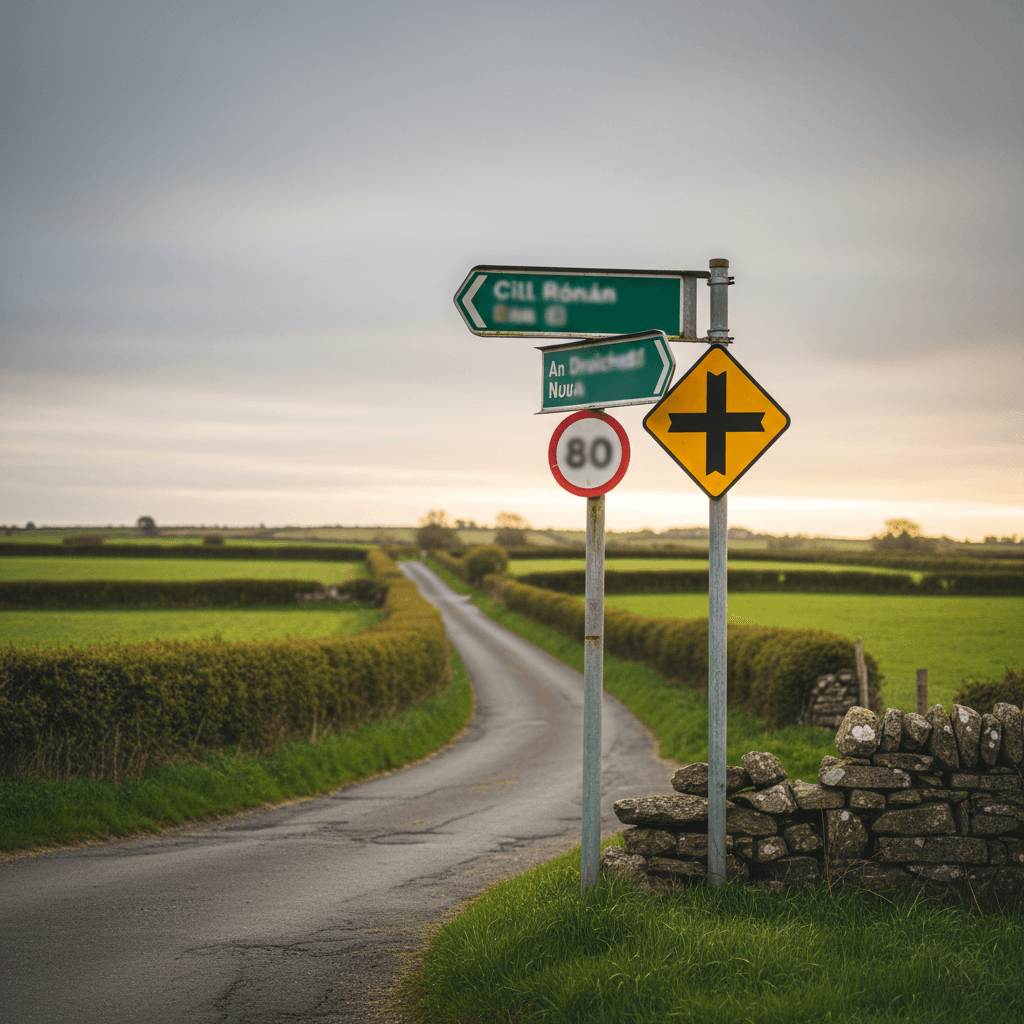
Driving in Ireland is straightforward once you understand the basics. Yes, we drive on the left—but that's just the beginning. This guide covers everything you need to know about Irish road rules, signs, and the unwritten codes of the road.
The Fundamentals
Driving on the Left
Ireland drives on the left side of the road, with the steering wheel on the right. This takes adjustment if you're used to driving on the right, but most visitors adapt within an hour or two.
Tips for adjusting:
- Your position in the car should be towards the centre of the road
- The gear stick will be on your left (if driving manual)
- Look right first at junctions, then left
- Take your first few junctions slowly
- Roundabouts go clockwise (not counter-clockwise)
Speed Limits
All speed limits in Ireland are in kilometres per hour (km/h):
| Road Type | Speed Limit |
|---|---|
| Urban areas | 50 km/h |
| School zones | 30 km/h |
| Rural local roads (L and unnumbered) | 60 km/h |
| Regional roads (R) | 80 km/h |
| National roads (N) | 100 km/h |
| Motorways (M) | 120 km/h |
The full picture — including what is changing, and Northern Ireland in mph — is in the Irish speed limits guide.
The two rural tiers are easy to confuse, and the lower one changed recently. On 7 February 2025 the default limit on rural local roads — the L-numbered and unnumbered lanes, roughly 82,000 km of the network — dropped from 80 km/h to 60 km/h. Regional roads, the R-numbered ones, stayed at 80 km/h. If the road has no number on it at all, assume 60.
Every limit is a maximum, not a target. On a boreen with grass up the middle and no sightline round the bend, 60 km/h is far too fast, and the law still requires a speed appropriate to the conditions. (Sources: Department of Transport and RSA, checked August 2026.)
Road Signs Decoded
Irish road signs follow European conventions, with some uniquely Irish additions.
Warning Signs (Yellow Diamond)
Yellow diamond-shaped signs with diagonal black stripes warn of hazards ahead:
- Curves, junctions, pedestrian crossings
- Livestock crossing areas
- Road works zones
Regulatory Signs (Circular)
- Red circle: Prohibition (no entry, no overtaking)
- Blue circle: Mandatory action (must turn left, minimum speed)
- Speed limits: Red circle with number
- Rural speed limit: White circle, five black diagonals, no number — 60 km/h
Information Signs (Blue Rectangle)
- Direction signs on motorways
- Service area locations
- Tourist attraction pointers (brown background)
Bilingual Signs
Many signs display text in both English and Irish (Gaeilge). On some Western roads, you'll see Irish-only signs. Key words to know:
| Irish | English |
|---|---|
| Stad | Stop |
| Géill Slí | Yield |
| Teorainn Luais | Speed Limit |
| Leithreas | Toilets |
| Lár (an Bhaile) | Town Centre |
Road Markings
Centre Lines
- Single broken white line: Overtaking permitted when safe
- Single continuous white line: No overtaking
- Double continuous white lines: Absolutely no overtaking
Edge Markings
- Yellow lines (at kerb): No parking restrictions
- Single yellow: No parking at certain times
- Double yellow: No parking at any time
- White hatching: Do not enter this area
Motorway Junctions, and Going the Wrong Way
Irish motorway junctions are grade-separated, and the entry and exit slip roads sit close together on the same side of the carriageway. Read one for the other and you are on the motorway facing traffic doing 120 km/h. It is rare, and it is the worst thing that can happen to you on an Irish road.
It is also becoming less rare. Transport Infrastructure Ireland's Motorway Operations Control Centre recorded 62 wrong-way driving incidents in 2026 up to 24 August, against 47 in the same period of 2025 — a 32% rise. The whole of 2025 produced 85. Seven of the 2026 detections came in the first two and a half weeks of August alone. Five teenagers were killed in a head-on collision on the M9 in Co. Kildare on 16 August 2026. TII says no single time of year trends higher, but its monthly averages over the last seven years peak in March, June and September.
The RSA, TII and An Garda Síochána run a joint motorway safety campaign, and its advice on junctions is short:
- Familiarise yourself with the rules for joining and leaving a motorway before you set out, and note the exit number of the junction you intend to leave by. Deciding at the last moment is how people end up turning or reversing — neither of which you may do on a motorway.
- Drive in the left lane for normal driving. The right-hand lane is for overtaking, and you move back left as soon as it is safe.
- You may only drive forwards. No stopping or parking on any part of the motorway either, unless you break down or a Garda signals you to stop.
If you realise you are going the wrong way
TII's instruction is specific, and it is not what instinct will tell you:
Pull in immediately to the hard shoulder and stop. Contact the Gardaí by dialling 999 or 112. Do not attempt to turn your vehicle. Wait for help in a safe place.
Turning round is the reflex, and it is the thing that kills people. Stop, get out of the live lanes, and let the Gardaí come to you. The first physical action is the same as a breakdown, but this is not a breakdown and it will not wait. For the breakdown case, see roadside emergencies.
If you meet one coming at you
When a wrong-way driver is reported, TII's control centre logs it and its system automatically posts a warning on the relevant motorway signs. A message on a gantry telling you there may be an oncoming vehicle ahead is a live warning, not a test. The control centre also liaises directly with the Gardaí. The RSA's advice to everyone else on the road is to pay close attention to motorway signs and markings, particularly at junctions and service areas, and to contact the emergency services — when it is safe to do so — if you become aware of a vehicle travelling in the wrong direction.
On 28 August 2026 the Minister of State for Road Safety, Seán Canney, said officials would begin drafting legislation to toughen the penalties for wrong-way motorway driving — the act is already an offence — and that he wanted it in place by the end of 2026. He also said AI analysis of the existing road camera network was being examined as a way of detecting incidents faster. Both are proposals. Neither is law or in service today, and Canney did not say what the tougher penalty would be, so there is no figure to quote.
(Sources: the joint RSA / TII / An Garda Síochána motorway safety campaign page on tii.ie for the junction and wrong-way advice — an undated evergreen advice page, confirmed live September 2026; TII's incident figures, the M9 collision and the RSA statement as reported by RTÉ News, 24 August 2026; the drafting timeline as reported by RTÉ News, 28 August 2026.)
Dublin City Centre: The Quays Bus Gates
Dublin has one restriction that catches visiting drivers the same way the M50 does: there is no barrier, nobody stops you, and the consequence arrives afterwards. Since 25 August 2024 Dublin City Council has run timed bus gates on the Liffey quays either side of O'Connell Bridge. If you collect a hire car at the airport and drive into or across the city, this is the one city-centre rule to know.
Where they are. Each is signed as a timed prohibition with an exception plate reading Except Buses, Taxis and Bicycles. In a hire car, none of those exceptions apply to you.
- Bachelors Walk at O'Connell Street (north quays, heading east) — no straight ahead. You cannot continue onto Eden Quay.
- Burgh Quay at O'Connell Street (south quays, heading west) — no straight ahead. You cannot continue onto Aston Quay.
- Westmoreland Street into Aston Quay, and Westmoreland Street into Fleet Street — no left turn.
The hours are 7am to 7pm, Monday to Sunday, and that is the whole of it. Outside those hours the restrictions do not operate and every vehicle travels as before. An 8pm drive along the quays is completely unaffected, and there is no reason to plan your evenings around this.
Crossing the river is not what is restricted
This is the part worth getting straight, because getting it backwards would send you the wrong way. The plan did not change north–south or south–north access to any Liffey bridge. What it blocks is the east–west run along the quays past O'Connell Bridge.
- Heading west along Burgh Quay, you can still turn right onto O'Connell Bridge and cross the river, exactly as before, and you can still turn left into D'Olier Street. You simply cannot go straight on to Aston Quay.
- Heading east along Bachelors Walk, your one move at O'Connell Street is left, up O'Connell Street. There is no straight ahead and no right turn. The right turn from Bachelors Walk onto O'Connell Bridge is buses, taxis and bicycles only — but that one is not new and was not introduced by these measures; it was already the case beforehand.
- Access to Eden Quay was preserved by opening the right turn from O'Connell Bridge onto Eden Quay to general traffic, which had been public transport only.
Disabled bays, loading bays and taxi ranks are unchanged, and every other route on the quays and in the city remains the same.
If you drive through one
There is no barrier, and unlike the M50 there is no toll account to settle afterwards. It is a signed traffic restriction, and passing the sign inside the restricted hours is a traffic offence. We have not found a penalty figure published by the council or the State for these particular gates, so we are not going to quote one at you.
The practical defence is simpler than the rule. If a satnav routes you along the quays through O'Connell Bridge between 7am and 7pm, it may be sending you into the restriction. Read the sign at the junction and take the turn it leaves you — more on that in the navigation apps guide.
Westland Row and Pearse Street
A separate measure applies at the Westland Row and Pearse Street junction, beside Pearse Station. The left turn from Westland Row into Pearse Street is closed to general traffic — the council's order describes a bus-only left turn — and unlike the quay gates it operates 24 hours a day. General traffic turns right instead, onto the stretch of Pearse Street between Westland Row and Sandwith Street, which was made two-way for the purpose. It has been in force since May 2025.
(Sources: Dublin City Council traffic order ET/1205/2024 and the council's City Centre Transport Plan FAQs, plus the National Transport Authority notice of the changes. Checked August 2026.)
Roundabouts
Ireland has an exceptional number of roundabouts—rumour has it we have the highest per-capita in Europe.
The Rules
- Always give way to traffic already on the roundabout (coming from your right)
- Travel clockwise around the roundabout
- Signal left when exiting (after passing the exit before yours)
- Choose your lane based on your exit:
- Left lane: First exit (left) or straight
- Right lane: Later exits or going full circle
Multi-Lane Roundabouts
Larger roundabouts may have 2-3 lanes:
- Left lane: First or second exit
- Middle lane: Straight ahead
- Right lane: Third exit onwards or U-turn
Check out our detailed guide to the roundabout rules in Ireland for lane-by-lane scenarios.
Mandatory Requirements
Seatbelts
All occupants must wear seatbelts. This is strictly enforced.
- Front seats: Always required
- Rear seats: Required for all passengers
- Children under 150cm or 36kg: Appropriate child restraint required
Mobile Phones
Using a hand-held phone while driving is illegal. This includes:
- Making calls
- Texting
- Checking messages
- Any physical interaction with the phone
Hands-free devices are permitted, but pulling over for calls is safest.
Drink Driving
Ireland has strict drink-driving laws, and the limit is not the same on both sides of the border. In the Republic it is 50mg of alcohol per 100ml of blood for a fully licensed driver and 20mg for a learner, novice or professional driver. In Northern Ireland it is 80mg, and nothing at the border tells you the number has changed.
The fines, the disqualification you cannot pay your way out of, and the penalties in the north are in the drink-driving limits guide.
The safest approach: don't drink and drive at all.
L, N and R Plates: What the Car in Front Is Telling You
None of this changes what you may do. If you hold a full licence issued outside Ireland, no plate rule on either side of the border applies to you, and nothing in this section touches your hire car. It is about the cars around you: what the letter on the plate means, and why the driver ahead might be doing something you did not expect.
The two jurisdictions use different letters, and the letters mean different things.
In the Republic: L and N
- L plate — a learner permit holder. They must display L plates at all times on any vehicle they drive, and they may only drive accompanied by an approved driving instructor or by someone who has held a full licence in the same category for more than two years. The RSA's list of what a learner permit holder may not do covers motorways, carrying passengers for reward, towing a trailer, and carrying a pillion passenger on a motorcycle. A lower speed limit is not on that list.
- N plate — a novice driver, in the first two years after a first full licence. N plates stay on the car for those two years. A novice driver has a 20 mg blood-alcohol limit rather than 50 mg, a lower disqualification threshold of seven penalty points, and may not act as the accompanying driver for a learner.
You will not meet an L plate on a motorway in the Republic. An N plate you may meet anywhere.
In Northern Ireland: L and R
Northern Ireland has no N plate. It has an R plate, and — until 30 September 2026 — a speed limit comes with it.
- L plate — a learner. The speed limit for a vehicle displaying L plates is 45 mph (72 km/h), except for goods vehicles, buses and coaches on a motorway. A learner must be accompanied by someone aged 21 or over who has held a full car licence for at least three years, issued in Northern Ireland, Great Britain or an EU country.
- R plate — a restricted driver, for one year from the date they passed the test. The plates are amber. The maximum permitted speed for a car or an A1 motorcycle displaying R plates is 45 mph (72 km/h), and that limit attaches to the vehicle whether or not the restricted driver is the one driving it.
That last figure is the one to carry with you. On a 70 mph stretch of the M1 or M2, a car showing amber R plates is capped at 45 mph. That is not a nervous driver holding you up. That is the law, and it changes on 1 October 2026.
Graduated Driver Licensing in Northern Ireland, from 1 October 2026
It does not change what a visiting driver may do. Graduated Driver Licensing (GDL) governs how people in Northern Ireland learn to drive, and what applies to them in their first two years after passing. If you are driving on a full licence issued elsewhere, it has no bearing on your licence, your hire car, your speed or who you may carry. It is on this page for one reason: it changes what the plate on the car in front of you means.
This is a Northern Ireland change, made by the Department for Infrastructure under Northern Ireland regulations. Nothing about learner or novice drivers in the Republic changes on 1 October.
The part that matters on the road
From 1 October 2026 the 45 mph restriction on learners and newly qualified drivers is removed. The Assembly's explanatory memorandum puts it plainly: the removal "will allow lessons to be taken up to the posted speed limits including, where appropriate, on a motorway."
So the arithmetic flips overnight. Until 30 September, a plated car ahead of you on a 70 mph road is capped at 45 and you can expect to be passing it. From 1 October, that same car may be travelling at the posted limit — and may be on a motorway where it could not have been the week before.
The R plate becomes two plates
The restricted period doubles, from 12 months to 24 months, and the plate changes appearance partway through:
| Period after passing | Plate | What it signals |
|---|---|---|
| First 6 months | Blue R on a white background | Passenger and night-time restrictions apply |
| The following 18 months | White R on a blue background | Those restrictions have ended |
The amber R plate belongs to the current 12-month system. Blue is the new one.
A night-time passenger restriction
For the first six months after passing, a new driver under 24 may not carry more than one passenger aged 14 to 20 between 23:00 and 06:00.
Two exemptions apply: immediate family members, and any case where a person aged 21 or over who has held a full driving licence for three years is in the front passenger seat. The restriction applies to drivers only, not to motorcyclists.
Six months of learning, minimum
A category B learner cannot sit the practical test until at least six months after their provisional entitlement began, and must complete a Programme of Training recorded in a Logbook, signed by an approved driving instructor or a qualified driver. This does not apply to motorcyclists.
The transitional period, to 31 March 2027
Anyone whose provisional entitlement started before 1 October 2026 has until 31 March 2027 to book and pass the practical test under the current system. After that date, they come under GDL.
One thing we cannot tell you: the Department has not published a clear statement of how drivers who passed before 1 October are treated on the 45 mph question during that transitional window. Until it does, treat any R plate as a car that may be travelling well below the limit, and do not assume it will keep up.
(Sources: Department for Infrastructure, "Green light for Graduated Driver Licensing from October", 23 June 2026, and its GDL FAQs; nidirect; the draft explanatory memorandum to the Motor Vehicles (Driving Licences) (Amendment) Regulations (Northern Ireland) 2026, laid before the Northern Ireland Assembly; and the RSA for the Republic. Checked September 2026.)
Northern Ireland Differences
If your road trip includes Northern Ireland routes, note these differences:
- Speed limits are in miles per hour (mph) — 30 in built-up areas, 60 on single carriageways, 70 on dual carriageways and motorways. See the speed limits guide.
- Distance signs are in miles
- Currency changes to pounds sterling
- Learner and new-driver plates differ — amber R plates instead of N plates, and a 45 mph cap that lifts on 1 October 2026 (see above)
- The drink-driving limit is higher: 80mg per 100ml of blood, against 50mg in the Republic, and there is no lower limit for new drivers. See the drink-driving limits guide
- Otherwise, road rules are virtually identical
There are no border checkpoints—you may not even notice crossing.
Unwritten Rules of Irish Roads
The "Thank You" Wave
When another driver lets you pass on a narrow road, pulls in to give you space, or shows any courtesy, a quick wave or flash of hazard lights is the standard acknowledgment. It's not mandatory, but it's very much expected.
Narrow Road Etiquette
On single-track lanes (common in scenic areas):
- Whoever is closer to a passing place should use it
- If the passing place is on your right, stop opposite it—don't cross to the other side
- Sometimes reversing to a passing place is necessary
- Take your time; rushing leads to scraped mirrors
Flashing Headlights
A quick flash of headlights usually means:
- "I'm letting you go first"
- Warning of a hazard (or speed check) ahead
Context matters—use your judgment.
Emergency Information
Emergency Number
999 or 112 for all emergencies (police, ambulance, fire)
Breakdowns
- Move to a safe location if possible
- Use hazard lights
- Wear a high-visibility vest if leaving the vehicle
- Contact your rental company's breakdown service
Garda (Police)
Irish police are called the Gardaí (singular: Garda). They're generally helpful and approachable if you need assistance.
Before You Drive
Preparation Checklist
- Familiarise yourself with the vehicle's controls
- Adjust mirrors for left-side driving
- Know where lights, wipers, and hazards are
- Download offline maps for your route
- Check weather conditions
Your First Drive
- Start with quieter roads, not motorways
- Give yourself extra time at junctions
- Don't be afraid to pull over and reset if needed
- Most drivers are patient with visitors
Ready for the Road?
With these rules in mind, you're ready to explore Ireland safely. Start with an easier route like the Boyne Valley before tackling challenging drives like Connemara.
For more practical advice, check out our guides on: