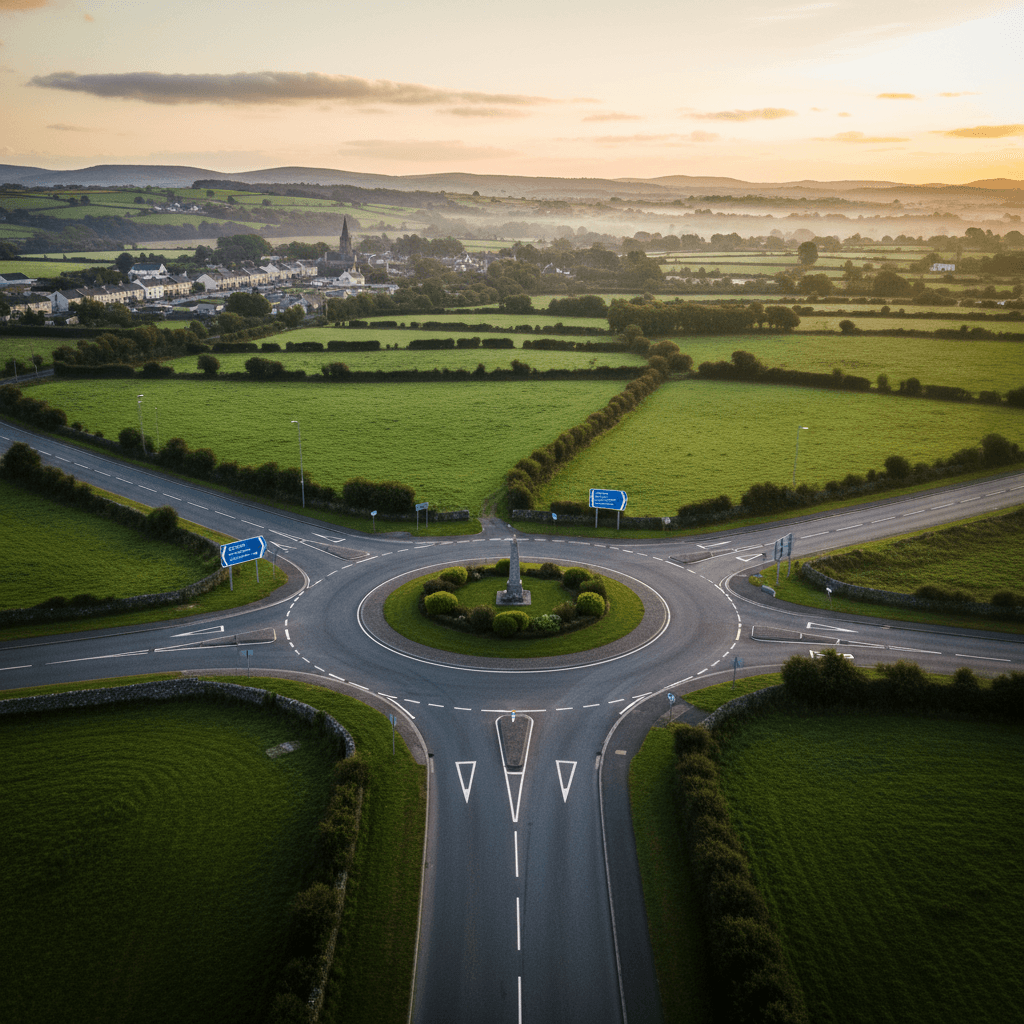
- Ireland has more than 2,000 roundabouts — roughly 400 per million people.
- At an Irish roundabout you give way to traffic coming from your right and travel clockwise around the island.
- On a 2-lane Irish roundabout, use the left lane for the 1st and 2nd exits and the right lane for the 3rd exit or later.
- Signal left as you pass the exit before the one you want.
Give way to traffic coming from your right — cars already on the roundabout have priority. Drive clockwise around the island. Signal left as you pass the exit before the one you want, and stay in your lane until you're off.
I've been teaching visiting friends how to handle Irish roundabouts for over fifteen years now, and there's a pattern. They're terrified on the first one, cautious on the second, confused by the third when they end up in the wrong lane, and by the end of the first afternoon they've stopped thinking about it.
If you've never driven a roundabout before — or you're used to American traffic circles that go the other way — this guide is the one that should live on your phone for your first day in Ireland.
The Basic Rules (In Order of Importance)
Four rules. Memorise these and you're 90% of the way there.
- Give way to traffic on your right. Cars already on the roundabout have priority.
- Travel clockwise. Always. Clockwise.
- Signal LEFT as you exit. Start the left indicator as you pass the exit before the one you want.
- Stay in your lane. Don't change lanes on the roundabout unless you absolutely have to.
Everything else is detail.
Before You Enter
As you approach a roundabout in Ireland, in order:
- Slow down. The approach speed on a typical Irish roundabout is 30–50 km/h.
- Look to your RIGHT. This is where oncoming traffic comes from.
- Choose your lane based on the exit you want. We'll cover this in detail below.
- Wait for a gap. You do not need to stop if there's no traffic — just ease in. But if there is traffic, wait. Do not force your way in.
Cars already circulating on the roundabout always have priority. Because Ireland drives on the left, that traffic is always coming from your right. Look right first, then left, then right again before crossing the give-way line.
The "Give Way to the Right" Rule
This rule deserves its own section because it's the rule that gets reversed between different countries and it's the one that matters most.
Traffic already on the roundabout has priority over traffic waiting to enter.
In Ireland, that traffic always comes from your RIGHT. This is because you're driving on the left side of the road, so the roundabout flows clockwise, and the cars coming toward you on the circle are coming from your right.
If you're from continental Europe, this is the same as home — European roundabouts work the same way in terms of "yield to traffic already circulating", even though they flow the other direction.
If you're from the United States: this is the opposite of what you'd do at a US traffic circle. US traffic circles flow counter-clockwise, so oncoming circulating traffic comes from your LEFT. In Ireland it comes from your RIGHT. Train yourself before you drive.
In Practice
At every roundabout entry in Ireland, there's a white give-way line painted on the road — two broken lines parallel to each other, like a dashed stop line. This is where you must give way.
Before crossing the give-way line, look RIGHT for traffic. Not left first, not straight ahead first. Right first, always.
If there's a car, a bus, a motorcycle or a tractor coming from your right, you wait. If there's nothing, you go — you don't have to stop if the road is clear, which is why experienced drivers can often flow through a quiet roundabout without touching the brake pedal.
Exceptions?
There are essentially no exceptions to the give-way rule on Irish roundabouts. The only thing to watch out for is emergency vehicles (Garda cars, ambulances, fire engines) with their lights and sirens on — they have priority over everyone, even on a roundabout.
2-Lane Roundabout Rules in Ireland
This is the section most visitors actually need. Single-lane roundabouts are straightforward — you enter, you go around, you leave. The 2-lane roundabout is where people get into trouble, and it's the reason most of the driving school panic stories exist.
Let's go through it properly.
Use this for earlier exits.
- ↰ 1st exit — turning left
- ↑ 2nd exit — going straight
Use this for later exits.
- ↱ 3rd exit — turning right
- ↻ 4th exit — full U-turn
Irish roundabouts flow clockwise. Painted arrows on the approach override these defaults — always read the road.
When to Use the Left Lane vs the Right Lane
The default rule is simple: left lane for earlier exits, right lane for later exits. For a typical 2-lane 4-exit roundabout on the outskirts of an Irish town, here's what that means in practice:
| Your Exit | Which Lane | What You're Doing |
|---|---|---|
| 1st exit | Left lane | Turning left off the main road |
| 2nd exit | Left lane (usually) | Going straight ahead |
| 3rd exit | Right lane | Turning right off the main road |
| 4th exit (U-turn) | Right lane | Going back the way you came |
The "usually" on the 2nd exit is important. On most 2-lane roundabouts in Ireland, the left lane is for the 1st and 2nd exits, and the right lane is for the 3rd and 4th. But — and this is the important bit — the painted arrows on the approach road override this default.
Always look at the road markings. If the left-lane arrow points straight ahead AND right, the left lane serves both the 2nd exit (straight) and the 3rd exit (right). In that case, the right lane is for the 3rd exit only. This is common at larger roundabouts around Dublin and on the M50 interchanges.
The quick rule: read the road before you enter.
Lane Selection by Direction
Here's the same information structured by where you're trying to go:
Turning left (1st exit from the bottom-six-o'clock entry):
- Approach in the LEFT lane
- Signal LEFT before you reach the give-way line
- Keep your left indicator on through the entire maneuver
- Exit at the 1st exit and turn off the roundabout
Going straight (2nd exit from the bottom entry):
- Approach in the LEFT lane (unless the painted arrows tell you differently)
- Do not signal on the approach
- Enter the roundabout when safe, stay in the left lane
- As you pass the 1st exit on your left, switch on your LEFT indicator
- Exit at the 2nd exit
Turning right (3rd exit from the bottom entry):
- Approach in the RIGHT lane
- Signal RIGHT on the approach (this is recommended but not legally required in every case — the key is that you're in the correct lane)
- Enter the roundabout when safe, stay in the right lane
- Keep your right indicator on as you go around the circle, passing the 1st and 2nd exits on your left
- As you pass the 2nd exit, switch to a LEFT indicator to show you're about to leave
- Move to the left lane if you can do so safely, and exit at the 3rd exit
Going back the way you came (4th exit / U-turn):
- Approach in the RIGHT lane
- Signal RIGHT on the approach
- Stay in the right lane as you go around, passing three exits
- As you pass the 3rd exit, switch to LEFT indicator
- Exit at the 4th exit — which puts you back on the road you came in on, heading the opposite direction
Signalling Rules in Detail
Signalling on roundabouts confuses visitors more than anything else. The rules are actually simple but they're different from normal junctions.
Two things to remember:
On the approach (before you enter the roundabout):
- Signal LEFT if you're taking the 1st exit
- Signal RIGHT if you're going past 12 o'clock — the 3rd exit or later
- No signal if you're going straight ahead (2nd exit)
On the roundabout (as you circulate):
- Always signal LEFT as you pass the exit BEFORE the one you want
- This is your "I'm leaving at the next exit" signal
- Keep it on until you've left the roundabout
The reason to signal as you pass the previous exit (rather than when you're already leaving) is to give other drivers time to react. Drivers waiting to enter the roundabout from the exit you're passing will see your signal and know they can go.
Common 2-Lane Roundabout Mistakes
These are the six mistakes that catch visitors out. Avoid these and you'll be fine.
1. Approaching in the wrong lane. The single most common mistake. You're in the left lane, you've committed, and then you realise you wanted the 3rd exit. Don't try to change lanes on the roundabout — just take the 2nd exit and loop back.
2. Not signalling at all. Irish drivers rely on each other's signals to know who's doing what. A car with no indicators is a puzzle, and the car waiting at the next entry has to assume the worst and not move. Signal even if you're not sure you're doing it exactly right.
3. Stopping unnecessarily on the roundabout. Once you're on the roundabout, keep moving. Do not stop to check your satnav, to let another car in, or because you got confused. The only reason to stop on the roundabout is to avoid an accident.
4. Hesitating too long at the entry. Irish drivers expect you to enter as soon as there's a gap. If you sit at the give-way line with a clear gap in front of you, the car behind you is going to get impatient. Have the courage to go.
5. Cutting across lanes to reach your exit. If you're in the right (inner) lane and you need to exit at the 3rd exit, you need to move to the left lane BEFORE you exit — but only when safe. Check your mirrors, check for a car in the left lane beside you, and move smoothly. If there's a car in your way, keep going and do another lap.
6. Forgetting to signal left on exit. Every Irish driving instructor's most common correction. Signal left as you pass the exit before yours. Every time. Without exception.
What to Do If You End Up in the Wrong Lane
This happens to almost everyone at least once. Here's the drill:
- Do not try to change lanes across traffic. This is how accidents happen.
- Take whichever exit you can reach safely from the lane you're in.
- Navigate back to the roundabout from whatever side road you end up on.
- Try again. You'll get it right this time.
Going around an Irish roundabout two or three times to get your bearings is completely normal and absolutely no one will care. I've done it myself on a roundabout I drive through every week, just because my brain was elsewhere.
Mini Roundabouts
A mini roundabout in Ireland is a very small roundabout marked only by a painted white circle on the road surface, usually at a minor junction in a residential area or a small town. There's no raised grass island in the middle — just the painted circle.
The rules are identical to a full-sized roundabout:
- Give way to the right
- Travel clockwise around the painted circle
- Signal left when you're about to exit
The one practical difference: trucks, buses and other large vehicles are allowed to drive OVER the painted circle if they physically can't go around it. This is legal and expected. If you see a lorry appearing to drive straight across a mini roundabout, they're not breaking the rules.
You'll find mini roundabouts most commonly in:
- Older town centres that were retrofitted with roundabouts (Galway's Salthill, parts of Ennis)
- Quiet residential estates
- Industrial estates
Treat them exactly like any other roundabout. Don't dismiss them because they look small — the give-way rule still applies and other drivers will expect you to follow it.
Step-by-Step: Your First Roundabout
Let's walk through a specific scenario. You're driving out of Dublin Airport in a hire car for the first time. You're heading toward Galway. You'll encounter your first roundabout within ten minutes of leaving the car rental lot. Tap each step to expand it.
1 Read the sign ▼
2 Pick your lane early ▼
3 Signal on approach ▼
4 Look right, then enter ▼
5 Stay in the right lane, signal left as you pass exit 2 ▼
6 Check left mirror, move to the left lane ▼
7 Exit and cancel the indicator ▼
That whole sequence takes about six or seven seconds in real driving. It sounds complicated written down but becomes automatic almost immediately.
How Many Roundabouts Are in Ireland?
Ireland has more than 2,000 roundabouts across the country, making it one of the most roundabout-dense nations on earth. Some context for how unusual that is:
- Roughly 400 roundabouts per million people — placing Ireland in the top five countries in the world for roundabouts per capita
- More roundabouts per person than the United Kingdom, Germany, France or the United States
- Outside of Dublin, Cork, Galway and Belfast city centres, roundabouts are far more common than traffic lights — most junctions between main roads in rural Ireland are handled by a roundabout rather than lights
The practical implication for visitors: you will encounter a roundabout within ten minutes of leaving any airport, and then you'll hit another one every few kilometres for the rest of your trip.
Towns with the Most Roundabouts
A handful of Irish midlands towns are genuinely famous (locally) for their roundabout counts. Each of the following has more than 20 roundabouts within the town boundaries:
- Mullingar, Co. Westmeath — frequently cited as Ireland's roundabout capital
- Athlone, Co. Westmeath — built around the N6 motorway corridor
- Tullamore, Co. Offaly
- Portlaoise, Co. Laois — a major junction town where the M7 and M8 motorways split
I've driven through Mullingar countless times and I still sometimes forget which roundabout I'm on by the third one. It's fine. Everybody does.
Why Does Ireland Have So Many?
Most of Ireland's roundabouts were built during the Celtic Tiger road-building boom between 1998 and 2008, when the motorway network was massively expanded. Roundabouts were favoured over traffic-light junctions because they:
- Cost dramatically less to build and maintain (no electrical signals, no backup power)
- Reduce serious accidents by up to 80% compared to signalised junctions, according to TII data
- Keep traffic flowing during off-peak hours without unnecessary stops
- Use less land than equivalent four-way intersections
Why American Drivers Find Them Hardest
US visitors consistently find Irish roundabouts the single most intimidating thing about driving here. There are three specific reasons:
- Traffic circles are genuinely rare in most of the US. Unless you're from Massachusetts, New Jersey, Washington DC or parts of Vermont, you may have driven past one but never actually used one.
- The direction is inverted. US traffic circles flow counter-clockwise (because the US drives on the right). Irish roundabouts flow clockwise. This confuses muscle memory.
- The frequency is unexpected. A US driver might use one traffic circle a year. An Irish driver uses several every single day.
Everything in this guide assumes you might never have driven one before. Start from the top if you're in that boat.
Roundabout Etiquette in Ireland
The written rules are one thing. The unwritten etiquette is what separates a visitor from someone who actually understands how to drive here. None of this is in the Rules of the Road, but all of it is real.
Don't Hesitate Too Long
If there's a clear gap in the traffic, you're expected to go. Irish drivers rely on each other to keep the roundabout flowing, and a driver who sits motionless at a give-way line with a clear road ahead is going to cause a queue behind them, which is going to cause frustration.
The threshold for "there's a gap I should take" is slightly shorter than most American drivers are comfortable with. If you're coming from a place where you'd wait for a bigger window, Irish roundabouts will feel frenetic at first. Match the rhythm of the cars around you and you'll be fine.
That said: do not force your way in. The line between "taking a reasonable gap" and "forcing in and causing someone to brake" is something you develop a feel for. When in doubt, wait.
The Wave of Thanks
If another driver lets you in — pauses to give you a gap that wasn't technically theirs to give — you raise a hand off the top of the steering wheel in acknowledgement. Not a wave, not a salute, just a quick lifted palm.
This is universal on Irish roads and costs nothing. Skip it and you'll be mentally filed as "rude" by every driver behind you. Do it without thinking about it and you'll blend in instantly.
Trucks Need Extra Room
Lorries, articulated trucks and buses often need to use both lanes on a 2-lane roundabout to get around the corner. They'll appear to be in the right lane when you expect them in the left, or vice versa. Give them space. Don't try to squeeze past one that's mid-manoeuvre.
The old rule from driving schools: if you can't see the truck driver's mirrors, the truck driver can't see you. Hang back.
Tractors on Rural Roundabouts
On country roads in Mayo, Kerry, Tipperary or anywhere else in rural Ireland, you will encounter tractors at roundabouts. They're slow, they have limited visibility, and they're usually towing trailers or farm machinery.
Give them loads of space. Don't try to rush around them. Don't honk. If a tractor is on a roundabout, just wait — the farmer has been driving these roads for decades and they'll be off it in under a minute.
Don't Honk
Almost no one honks on Irish roundabouts. Honking is reserved for actual danger — someone about to reverse into you, someone pulling out without looking. Honking because a driver is slow or hesitant is considered aggressive and the other driver (and everyone within earshot) will judge you for it.
If you're behind a visitor who's clearly struggling with their first roundabout, the polite Irish response is to wait patiently and maybe flash them with a quick reminder that you're there. Not a honk.
Roundabouts for American and European Drivers
Different home countries, different mental adjustments. Pick the section that applies to you.
🇺🇸
For American Drivers
The biggest mental adjustment of your trip — but only for the first hour
▼
If you're coming from anywhere in the US outside of Massachusetts, New Jersey or Washington DC, you've probably never driven through a roundabout. Here's what I'd tell an American friend on their first Irish road trip:
For the complete first-timer's guide to driving in Ireland including all the things that aren't roundabout-specific, see our left-hand driving guide.
🇪🇺
For European Drivers
90% identical to home — just one direction to flip
▼
If you've driven in France, Germany, Italy, Spain, Belgium or anywhere else on the continent, the rules are almost identical. The only meaningful difference is the direction.
Common Mistakes to Avoid
The ten mistakes that catch visitors most often. Tap each one to see why it happens and how to avoid it.
1 Looking left instead of right ▼
2 Going counter-clockwise ▼
3 Approaching in the wrong lane ▼
4 Failing to signal left on exit ▼
5 Stopping on the roundabout ▼
6 Hesitating too long ▼
7 Forcing your way in ▼
8 Changing lanes on the roundabout ▼
9 Dismissing a mini roundabout ▼
10 Honking ▼
Practice Locations
If you want to build confidence before you hit the M50 or a Galway rush hour, there are quiet places to practice.
- Any Irish midlands town on a weekday morning — Mullingar, Athlone, Portlaoise, Navan, Naas, Nenagh. All have multiple roundabouts and light traffic.
- Industrial estates on a Sunday morning are usually empty. Most Irish industrial estates have a 2-lane roundabout or two at the entrance.
- Suburban residential estates around small towns — Celtic Tiger-era housing developments nearly always have a roundabout at the main junction.
Do three or four practice laps in one of these places on your first morning and you'll feel dramatically more confident on the bigger roundabouts later in the day.
Roundabouts on Popular Routes
A few things to know if you're heading out on one of the classic Irish road trip routes.
Dublin Area
The M50 orbital motorway has several major interchange roundabouts where it meets the national routes. These are large, 3-lane, and busy — not where you want to learn. The Dublin Bay & Howth coastal route largely avoids them entirely by staying on surface roads along the coast.
If you're heading west from Dublin Airport, you'll cross the M50 on the M1 and then briefly on the M50 itself before joining the M4. The roundabouts on that route are at the major junctions off the motorway, so you're entering them at lower speeds and they're well-signposted.
Cork
Cork's busiest roundabouts are on the N40 south ring road. These can be intimidating if you're coming out of the airport at rush hour. The West Cork Coast route bypasses the N40 entirely, heading west via Kinsale instead.
Galway
The N6 approach to Galway has multi-lane roundabouts at each of the three main motorway junctions (J18, J19, J20). At peak times they can be genuinely busy. The Galway Bay & Burren route eases you in from the south via quieter roads. The city roundabouts around Salthill are smaller and less intimidating.
Limerick
Limerick has a ring of roundabouts on the Limerick City & Shannon route. If you're coming from Shannon Airport, the roundabouts on the N18 into the city are well-marked and calmer than Galway or Cork equivalents.
Quick Reference Card
If you want to screenshot one thing from this guide for your trip:
Before the roundabout:
- Slow down
- Look for the sign showing exits
- Choose your lane (left for 1st/2nd exit, right for 3rd/4th)
- Look RIGHT for traffic
- Signal if turning left (1st exit) or right (3rd+ exit)
On the roundabout:
- Give way to traffic on your right
- Travel CLOCKWISE
- Stay in your lane
- Keep moving
Exiting:
- Signal LEFT as you pass the exit before yours
- Check mirrors
- Exit smoothly
- Switch indicator off once you're on the exit road
If you panic:
- Stay in the left lane
- Take any exit you can safely reach
- Navigate back and try again
- Nobody will care. Everybody has done it.
Final Thoughts
Irish roundabouts are the thing visitors worry about most and the thing they stop thinking about fastest. By the end of your first day in Ireland, you'll be handling them without conscious effort. By the end of your first week, you'll be mildly annoyed by countries that use traffic lights for everything.
The country built more than 2,000 of these because they genuinely work. They move traffic efficiently, they're statistically safer than the alternatives, and once you understand the rules they become — honestly — satisfying to drive. There's a small pleasure in timing a busy roundabout perfectly and flowing through without touching the brake.
Start slow. Look right. Go clockwise. Signal left when you leave. That's the whole thing.
For the rest of what you need to know about driving in Ireland, see:
- Left-Hand Driving: Complete Guide for Visitors — the broader guide to driving on the left, including country roads and the first hour in a rental car
- Irish Driving Rules and Road Signs — speed limits, road signs, priority rules and the Rules of the Road
- Best Navigation Apps for Ireland — set up before you drive so you know which exit you want before you see the sign