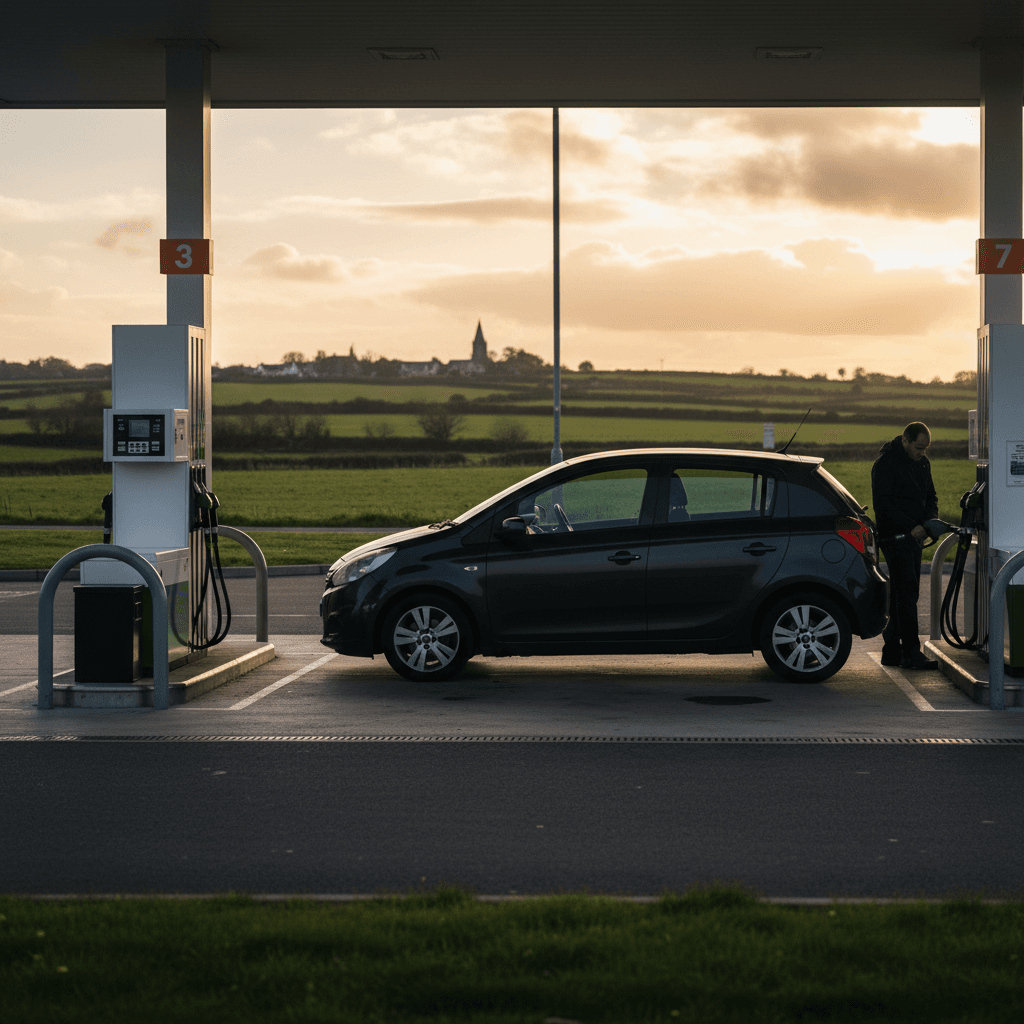
- Petrol in Ireland costs €1.65 to €1.85 per litre, national average €1.75 (AA Ireland, July 2026, checked August 2026).
- Diesel in Ireland costs €1.60 to €1.80 per litre, national average €1.73 — only about 2 cent below petrol, not the 5–10 cent gap of previous years.
- Excise reductions worth 27c a litre on petrol and 32c on diesel are scheduled to be restored between November 2026 and February 2027 — see the Budget 2027 fuel cost guide.
- Standard Irish petrol is 95 octane, sold as E10 and dispensed from the green pump nozzle; diesel is the black nozzle.
- In Ireland, “gas” means cooking gas — automotive fuel is called petrol.
Fuel in Ireland costs more than visitors expect, and the way it works is just unfamiliar enough to catch people out. The pumps look different. The grades are different. Half the rentals are diesel and the rest are petrol, and putting the wrong one in is the single most expensive mistake you can make on an Irish road trip.
This is the version a local would give you if you asked them at a Maxol shop on the way out of Dublin Airport.
"Gas" or "Petrol"? A Quick Note for American Visitors
If you've landed here by typing "gas price Ireland" into Google, you're an American visitor — welcome. Two terminology notes before we go any further.
In Ireland, what you'd call gas at home is called petrol. The word "gas" in Ireland means the kind of cooking gas that comes in a Calor cylinder for a barbecue or a camping stove. If you walk into a forecourt asking for gas, the shop staff will assume you want a propane bottle and you'll have a confused conversation. Use the word petrol for the green pump and diesel for the black pump — same product, different name.
The other thing: Irish petrol is sold by the litre, not the gallon. One US gallon is about 3.78 litres. So when you see €1.75 per litre on the pump, that's roughly $7.20 per US gallon at current exchange rates. Yes, it's more expensive than what you're used to. No, there's nothing you can do about it. Welcome to European fuel pricing.
The good news is that Irish driving distances are short and rental cars are fuel-efficient by American standards. A one-week road trip from Dublin to Galway, the Cliffs of Moher, Killarney, Cork and back — about 1,500 km — typically uses €115–€145 of fuel total in a small diesel rental. Less than the cost of a single tank in many American SUVs.
So when you read "gas" anywhere in this guide, mentally translate it to "petrol". When you see "petrol" in a Pumps.ie listing or on a forecourt sign, that's what you came for.
Fuel Types in Ireland
Petrol
Call it petrol, not gas. "Gas" in Ireland means cooking gas, the kind that comes in a Calor cylinder. Walk into a forecourt asking for gas and you'll get a confused look.
- The standard grade is 95 octane, sold as E10 since the 2024 changeover
- The green pump nozzle is petrol on every Irish forecourt I've ever used
- Premium 98 octane is available at Applegreen and Circle K, badged as "V-Power", "Synergy" or just "Premium 98". You don't need it unless your owner's manual specifically calls for it.
Diesel
Diesel is more common in Ireland than in many countries, and the majority of rental cars in the small-to-mid sized class are still diesel.
- The black pump nozzle is diesel
- Marked as "Diesel", "Auto Diesel" or sometimes just "Heavy Oil" on older country pumps
- Diesel rentals are usually 15–20% more fuel-efficient than the equivalent petrol car, which adds up over a long trip
There's no longer a separate "agricultural diesel" pump on most modern forecourts, but if you do see a green nozzle on what looks like a diesel pump in a rural co-op, that's marked "green diesel" — it's dyed for farm use, illegal for road cars, and don't touch it.
How to Tell What Your Car Needs
The single most important thing you do on day one is confirm what fuel the car takes.
- Open the fuel cap. There's almost always a sticker. "Petrol Only" or "Diesel Only".
- Check the rental contract. Fuel type is on the same line as the registration plate.
- Ask the desk agent at pickup. They have to confirm it as part of handover anyway.
- Listen to it. Diesel engines have a distinct rattle at idle, especially when cold.
If you have any doubt at all, don't guess. A rental Volkswagen Polo could be petrol or diesel depending on the trim. Same with a Hyundai i10, a Renault Clio, a Ford Focus. Check the cap.
Diesel Fuel in Ireland: A Closer Look
Diesel is the dominant fuel for rental cars in Ireland and worth understanding properly before you collect a hire car at Dublin Airport. Most visitors arrive expecting their rental to be petrol because that's what they drive at home. Roughly 60–70% of the rental fleet in the small-to-mid sized class is actually diesel.
Why Most Irish Rental Cars Are Diesel
Three reasons, in rough order of importance.
Fuel economy on long drives. Diesel engines are roughly 15–25% more fuel-efficient than equivalent petrol engines, and Irish driving is mostly long-distance country roads rather than short city trips. A diesel Volkswagen Golf returns about 4.5–5.5 litres per 100 km in real-world Irish driving; the petrol version uses 5.5–6.5. Over a 1,500 km road trip that's the difference between about €130 of fuel and about €158 — meaningful for both rental fleets and customers.
Diesel has historically been cheaper per litre in Ireland. It used to run 5–10 cents per litre below petrol at most forecourts. That gap has now all but closed: the AA Ireland national averages for July 2026 were €1.75 for petrol and €1.73 for diesel, 2 cent apart, checked August 2026. The fuel economy advantage is what still makes a diesel rental cheaper to operate — the price per litre barely does.
Better for highway driving. Diesel engines produce more low-end torque, which is genuinely nicer on Ireland's hilly secondary roads — climbing the Healy Pass or the Conor Pass in a small petrol hire car is more strained than in the diesel equivalent. Rental fleets buy diesels because their customers come back happier.
The exception to the diesel rule is the smallest economy class. Cars like the Hyundai i10, Kia Picanto, Toyota Aygo and the smallest Renault Clio trims are usually petrol. If you've booked the cheapest "economy car" category, expect petrol.
Current Diesel Prices in Ireland (2026)
The number to start from is the national average: €1.73 a litre for diesel in the AA Ireland survey of July 2026, down 15 cent on June. Checked August 2026.
What the forecourt type does to that average is more durable than any absolute figure, because the average moves weekly and the spread doesn't:
| Forecourt Type | Against the national average |
|---|---|
| Supermarket forecourts (Tesco, Lidl-attached, Dunnes) | 5–10 cent below |
| Standalone Applegreen, Circle K, Maxol | around the average |
| Rural forecourts in Connemara, West Cork, Donegal | about 5 cent above |
| Motorway service stations | 10–15 cent above |
Prices fluctuate weekly with global oil markets and government excise rates. The €1.60–€1.80 range has been the working band for most of 2026. One scheduled change is already known: the temporary excise reductions are due to be restored in four steps between November 2026 and the end of February 2027, which the Government puts at 32 cent a litre on diesel. See the Budget 2027 fuel cost guide for what is confirmed and what is not.
Diesel vs Petrol: Real Cost Comparison
For a typical 1,500 km Irish road trip in a compact car:
| Petrol Compact | Diesel Compact | |
|---|---|---|
| Fuel economy | 6 L/100 km | 5 L/100 km |
| Fuel needed | 90 litres | 75 litres |
| Price per litre | €1.75 | €1.73 |
| Total fuel cost | €157.50 | €129.75 |
Prices are the AA Ireland national averages for July 2026, checked August 2026.
Diesel saves about €28 over a one-week road trip in this example. Almost all of that is fuel economy, not price — at 2 cent a litre, the price difference on 75 litres is €1.50. The reason to prefer a diesel rental is that it burns less, not that it costs less to fill.
Where to Find the Cheapest Diesel
The price variation between forecourts in Ireland is significant — easily 15–20 cents per litre between the cheapest and most expensive. On a 60-litre tank that's a €9–€12 difference, which adds up over a one-week trip.
In rough order from cheapest to most expensive:
- Tesco forecourts — generally the cheapest reliable option, especially with a Tesco Clubcard. Located on the outskirts of most Irish towns of any size.
- Lidl-attached Applegreen forecourts — Lidl partnered with Applegreen on a number of forecourts, and these typically run a few cents below the standalone Applegreen sites.
- Dunnes Stores forecourts — fewer locations than Tesco but often comparable pricing.
- SuperValu forecourts — slightly above Tesco but still consistently cheaper than the standalone forecourts.
- Standalone Applegreen and Circle K — middle of the range. Reliable, well-distributed, decent shops, but not the cheapest.
- Maxol — generally similar to Applegreen and Circle K.
- Independent rural forecourts — variable. Some are competitively priced, others are notably above national average because of haulage costs.
- Motorway service station forecourts — the most expensive fuel you can buy in Ireland, typically 10–15 cents above standalone city forecourts. Avoid the M1 Lusk, the M7 Mayfield and the M50 Junction 7 stations if you have any other option. See the toll roads guide for more on motorway service stops and which to actually use.
Diesel Grades: Regular vs Premium
You will see two diesel options at most modern Applegreen and Circle K forecourts:
- Regular diesel (also called "Auto Diesel") — the standard product, suitable for every modern diesel car including all rentals
- Premium diesel (badged as "Diesel Extra", "V-Power Diesel", "Excellium Diesel" or similar) — typically 8–12 cents per litre more expensive
For a rental car, regular diesel is fine. Premium diesel contains additional cleaning additives and is marketed at owners of high-mileage premium cars that they want to look after. For a hire car you'll return in a week, the additives have no meaningful benefit. Save the money.
The one exception: if you're driving a high-end rental SUV (BMW X5, Range Rover, Audi Q7 etc.) and the rental contract specifically requires premium diesel, follow the contract.
Don't Confuse Diesel with "Green Diesel"
In rural co-ops and some older country forecourts you may see a green-coloured pump nozzle on what looks like a diesel pump. This is green diesel (also called marked gas oil or agricultural diesel). It's dyed green and sold at a heavily reduced price for use in tractors, generators and farm machinery — and it's illegal to use in road vehicles.
Putting green diesel in a rental car is a serious offence in Ireland. The Revenue Commissioners have automated number-plate readers at random checkpoints and the dye stays in the fuel system for months — a single green diesel fill-up is detectable for the rest of the rental period and the fines are substantial. Don't touch it.
If you're at a rural forecourt and the only diesel pump appears to be green, walk into the shop and ask. They'll have the road-legal diesel on a different pump, usually black-nozzled.
Petrol vs Diesel: Which Will Your Rental Car Be?
This is the most important thing you can confirm on day one. The same model rental car can be either petrol or diesel depending on the trim level, and the consequences of guessing wrong are expensive enough to warrant a 30-second check.
How to Find Out Before You Drive Away
In order of reliability:
-
Open the fuel cap. This is the gold standard. There's almost always a sticker on the inside of the flap or near the filler neck reading "Petrol Only" or "Diesel Only". Sometimes it's written in multiple languages. If the sticker says "Diesel" you have a diesel; if it says "Petrol", "Unleaded" or "Sans Plomb 95", it's petrol.
-
Check the rental contract. When you sign the rental agreement at the desk, the fuel type is printed on the same line as the registration plate, vehicle make and vehicle model. It might be a single-letter code (P for petrol, D for diesel) or spelled out. If you can't see it, ask the agent to point at it.
-
Ask the desk agent at pickup. They have to confirm the fuel type as part of the handover anyway. The question to use is: "Is this a petrol or a diesel?" — they'll answer in two seconds. Don't ask "what fuel does it take" because you might get a vague answer like "the green one".
-
Listen to the engine. Diesel engines make a distinctive rattle at idle, especially when they're cold. If you start the car at the rental return and it sounds like a sewing machine on caffeine, it's a diesel. If it's smooth and quiet, it's a petrol. This isn't reliable for the most modern diesels (which are very quiet) but it's a useful tiebreaker on older rentals.
Common Models and What They Usually Are
| Model | Usually... |
|---|---|
| Hyundai i10, Kia Picanto, Toyota Aygo | Petrol |
| VW Polo, Hyundai i20, Renault Clio | Either — check |
| VW Golf, Ford Focus, Skoda Octavia | Diesel (mostly) |
| VW Passat, Skoda Superb, Toyota Avensis | Diesel |
| Hyundai Tucson, VW Tiguan, Ford Kuga | Diesel |
| Ford Galaxy, VW Sharan (7-seaters) | Diesel |
| BMW, Audi, Mercedes | Diesel |
| Tesla Model 3, VW ID.3, Hyundai Kona Electric | Electric (no fuel — see EV guide) |
These are tendencies, not rules. Every model on the list above has petrol and diesel variants and rental fleets mix and match. Always check the cap.
What If There's No Sticker?
Some older rental cars have a fuel cap with no sticker, or the sticker has faded to the point of being unreadable. In that case:
- Check the rental paperwork (should be definitive)
- Ask the rental company — call the number on your contract
- As a last resort, look up the registration plate at the Cartell.ie check service or similar — it'll return the official fuel type registered with the Department of Transport
Don't guess. The cost of a single misfuelling event (covered below) is more than every other mistake on an Irish road trip combined.
Current Fuel Prices
National averages in the AA Ireland survey of July 2026 were €1.75 for petrol and €1.73 for diesel, checked August 2026. Around those, expect roughly:
| Fuel Type | Price Range |
|---|---|
| Petrol (E10) | €1.65 – €1.85/litre |
| Diesel | €1.60 – €1.80/litre |
| Premium Petrol (98) | €1.80 – €2.00/litre |
Prices change weekly, and there is a scheduled increase on top of that: excise reductions worth 27 cent a litre on petrol and 32 cent on diesel are due to be restored in four steps between November 2026 and the end of February 2027. The Budget 2027 fuel cost guide has the timetable, the tax on a litre today, and what it does to a week's driving. The site Irish drivers actually check is Pumps.ie — it crowdsources prices from forecourts across the country, and you can usually save 10–15 cents a litre by driving to a station two minutes off your route.
Where you fill up matters more than people think:
- Motorway service stations — the most expensive fuel you can buy in Ireland. Avoid the M1 Lusk, the M7 Mayfield and the M50 Junction 7 stations if you have any other option.
- Supermarket forecourts — the cheapest, by a clear margin. Tesco, Lidl-attached Applegreens and SuperValu stations all run 5–10 cents below the standalone forecourts.
- Rural Connemara, Donegal, West Cork stations — often 5 cents above national average because of haulage costs
- Dublin city forecourts — middle of the range, but often the only option if you're returning a car to the airport
Where to Check Live Fuel Prices in Ireland
Irish fuel prices change weekly — sometimes daily during volatile periods — so the figures in any guide are a guideline rather than a number you should trust to the cent. There are four sources Irish drivers actually use to find the cheapest fuel near them in real time.
Pumps.ie
The main one. Pumps.ie crowdsources fuel prices from hundreds of forecourts across Ireland and updates daily. You can search by town, by fuel type, and by station brand. The site is free, no signup required, and works on phone browsers without an app install.
The prices on Pumps.ie are user-submitted, so the data is best in cities and busy towns where there are enough contributors. Rural Donegal, West Cork and the Beara Peninsula have thinner data — but the pattern (supermarket forecourts cheaper than standalones, motorway stations dearest) holds country-wide.
Worth checking before any long drive. A two-minute look at Pumps.ie can save you €5–€10 on a single fill-up if there's a cheaper forecourt a couple of kilometres off your route.
AA Ireland Fuel Price Monitor
The AA Ireland fuel price monitor publishes monthly average prices for petrol and diesel across Ireland. It's the source most Irish news outlets and radio stations quote when they report on fuel price changes. The data is averaged at a national level rather than station-by-station, so it's more useful for understanding the broader trend than for finding the cheapest pump in your area.
AA Ireland also publishes commentary on what's driving price changes — global oil markets, government excise rates, exchange rates — which is genuinely interesting if you want context.
Waze
Waze shows fuel prices live on its map where users have reported them. Tap any forecourt icon and you'll see the most recently submitted price for petrol and diesel, with a timestamp showing when it was last updated.
In urban areas this is remarkably useful. In rural Ireland it's much patchier — fewer Waze users means fewer price submissions — and you'll often see "no recent data" on rural forecourts. For more on Waze's limitations in rural Ireland, see the navigation apps guide.
Supermarket Apps
The Tesco, Lidl and SuperValu apps all show fuel pricing at their own forecourts, often with member-only discounts (a few cents per litre off if you scan a Clubcard or member account at the pump). For repeat visitors and longer trips, signing up for one of these is worth the few minutes.
What I Actually Do
Honestly? I check Pumps.ie if I'm filling up in a town I don't know. I rely on the local-knowledge rule (Tesco cheapest, motorway dearest) everywhere else. The €1–€2 saving from finding the absolute cheapest forecourt isn't worth a 15-minute detour. The €8 saving from avoiding a motorway service station is.
Calculating Trip Fuel Costs
A Realistic Week-Long Example
For a 1,500 km loop — say Dublin to Galway, down through Clare and Kerry, back up via Cork — in a typical compact:
| Factor | Value |
|---|---|
| Distance | 1,500 km |
| Fuel economy (small diesel) | 5 L/100 km |
| Fuel needed | 75 litres |
| Price | €1.73/litre |
| Total cost | ~€130 |
Switch the diesel for a petrol of the same class — 6 L/100 km at €1.75 — and you're closer to €158. Switch to a 7-seater Ford Galaxy and you're past €230. Vehicle choice matters more than route choice for fuel cost.
Fuel Economy by Vehicle Type
| Vehicle | Real-World Consumption |
|---|---|
| Small petrol (VW Polo, Hyundai i20) | 5.5 – 6.5 L/100 km |
| Compact diesel (VW Golf, Ford Focus) | 4.5 – 5.5 L/100 km |
| Mid-size petrol (Toyota Corolla, Mazda 3) | 6.5 – 8 L/100 km |
| SUV / 7-seater (VW Touran, Hyundai Tucson) | 7 – 9 L/100 km |
| Big SUV (Ford Galaxy, VW Sharan) | 9 – 12 L/100 km |
These are real-world numbers, not the official combined figures the rental company quotes. Real-world consumption in Ireland is usually 15–20% higher than the manufacturer's number because of the hills, the wind, and the fact that you're stopping every few kilometres for another viewpoint.
Finding Fuel Stations
In Cities and Towns
You'll trip over them. Every town of any size has at least one Applegreen or Circle K, usually with a Spar or Centra attached. Larger towns have several, and the supermarkets usually have their own forecourts too.
In Rural Areas
This is where it pays to think ahead. The rule I've used for fifteen years of driving the west coast is: fill up when the gauge drops below half a tank if you're heading into:
- The Inishowen 100 — once you're past Buncrana, options are thin and the few stations close early
- The Donegal Highlands — the loop through Glenveagh and Gweedore has long fuel-free stretches
- The Sheep's Head Peninsula — Bantry is your last reliable stop
- Connemara, especially the Sky Road and the Killary Fjord loop
- The Dingle Peninsula past Slea Head
- Anywhere on a Sunday in west Mayo
Last summer I watched a rental Ford Fiesta with German plates roll into Glenties on fumes — the driver had assumed there'd be a petrol station "in the next town" for about 40 km. There isn't always.
Finding Stations on the Road
- Google Maps — search "petrol station". Most stations are listed.
- Waze — shows fuel prices live, where users have reported them. Useful in urban areas, less so in rural ones.
- Pumps.ie — the price comparison site. Works on phone browsers.
- The major brands have apps: Circle K and Applegreen both have apps that show you nearest stations and let you pay from the phone.
Opening Hours
- 24-hour stations — common on motorways and on the M50 ring around Dublin. Look for Circle K or Applegreen with the bigger forecourts.
- Rural stations — often close at 9 pm and are shut on Sundays after lunch. Some don't open Sundays at all.
- Pay-at-pump — most modern Irish forecourts now have card readers at the pump itself, so you can fill up at 2 am even if the shop is shut. Older rural stations don't.
Misfuelling: The Expensive Mistake
Putting the wrong fuel in your car is the single most expensive mistake you can make at an Irish forecourt. The AA estimates it happens to a driver in Ireland roughly every three minutes, which is a startling number until you realise how easy it is when you're tired, jet-lagged and standing at a pump for the first time after picking up a car at Dublin Airport.
Consequences
| Mistake | Severity | Repair Cost |
|---|---|---|
| Petrol in a diesel | Severe | €200 – €6,500 |
| Diesel in a petrol | Less severe | €200 – €500 |
Petrol in diesel is the bad one. Petrol acts as a solvent on the fuel pump and injectors of a diesel engine. If you start the car after misfuelling, the petrol gets pushed through the entire fuel system in about thirty seconds and you're looking at a full fuel system rebuild. Modern common-rail diesels are particularly expensive — a new fuel pump for a Volkswagen TDI runs €1,500 on its own, and that's before injectors and labour.
Why It Happens to Visitors
A few reasons it catches non-Irish drivers in particular:
- US visitors don't see diesel cars often at home, so they default to "regular" without thinking
- The pump nozzle colour convention is the opposite of some countries
- "Auto Diesel" sounds like it might be premium petrol if you've never seen the word in this context
- Rental cars all look broadly similar from the driver's seat
Prevention
- Check the fuel cap every single time. Make it a habit before you uncap.
- Read the pump signage. It's always clearly marked.
- Check the nozzle colour. Green = petrol, black = diesel, on every modern Irish forecourt.
- Don't multitask. This is the one moment of the trip not to be looking at your phone.
- If you're not 100% sure, ask. The shop staff have answered this question a thousand times.
If You Do Misfuel
Don't start the engine. This is the only thing that matters in the first thirty seconds.
If you've already started the engine and driven away, stop. Now. Don't try to drive it home, don't try to drive it to a garage. Stopping early limits the damage.
Step by step:
- Stop the pump
- Don't put the keys in the ignition
- Push the car clear of the pump (rental cars are light enough — it's a two-person job)
- Phone the rental company's emergency number (it's on the keyring)
- Phone a misfuel recovery service if the rental company doesn't dispatch one
Misfuel recovery services in Ireland include Wrong Fuel Ireland, Fuel Fixer and Misfuel Direct. They'll come to you, drain the tank, flush the fuel lines, and refill with the correct fuel. The bill is €200–€350 for petrol-in-diesel caught early. Cheap, compared to the alternative.
The rental company may have a preferred provider — ask them first.
The Cost Breakdown by Scenario
Here's what you're actually looking at depending on what happened:
| Scenario | Repair Cost | Notes |
|---|---|---|
| Wrong fuel detected before starting the engine | €200 – €350 | Tank drain and flush. The cheap outcome. |
| Engine started, immediately stopped | €500 – €1,500 | Some fuel circulated; injectors may be salvageable |
| Driven a short distance on wrong fuel | €1,500 – €3,500 | Fuel pump replacement likely |
| Driven any meaningful distance | €3,000 – €6,500+ | Full fuel system rebuild — pump, injectors, filters, lines |
| High-end car (BMW, Audi, Mercedes diesel) | add 30–50% to all of the above | Premium parts and labour |
Note that diesel-in-petrol is genuinely the less catastrophic of the two — same approach applies but the typical repair is €200–€500 for a tank drain and flush, and modern petrol engines tolerate the contamination much better. Petrol-in-diesel is the one to fear.
Insurance Does NOT Cover Misfuelling
This is the part most visitors don't know, and it's the part that makes misfuelling genuinely scary.
Almost no rental car insurance covers misfuelling. It's classed as "driver error" or "negligence" and is explicitly excluded from:
- The standard CDW (Collision Damage Waiver) bundled into your base rental rate
- The rental company's Super CDW upsell, even at €25–€30 per day
- Most third-party rental excess insurance policies (iCarhireinsurance, Insurance4carhire, Questor, WorldwideInsure) — read the policy wording carefully, exclusion is nearly universal
- Your travel insurance medical/incident cover
- Your credit card rental insurance (in the rare cases that even works in Ireland — see the car insurance guide on credit card coverage)
The only time misfuelling is covered is if you've specifically bought a misfuelling rider as a separate add-on, which is uncommon and usually only available on annual policies for frequent renters.
What this means in practice: if you put petrol in a diesel rental at Dublin Airport on day one of your trip and start the engine, the entire repair bill is on your credit card. €3,000 minimum, often more. There's no protection. The only protection is to not make the mistake in the first place — and that means checking the fuel cap every single time you pull up to a pump.
This is also why almost every misfuel recovery service in Ireland operates 24/7 and answers their phones immediately. They make their money on the difference between "caught it before starting the engine" (€300) and "drove it onto the M50" (€6,000). Worth it for them. Worth it for you to phone them the moment you realise.
Rental Car Fuel Policies
Three policies you'll see at the desk. Two are fine, one is a rip-off.
Full-to-Full
You collect the car with a full tank. You return it with a full tank. This is the only fair option and it's what you should request.
If you return slightly under, you'll be billed at the rental company's per-litre rate, which is significantly above pump prices. So fill up at a forecourt within five minutes of the airport — not at the rental return. There's an Applegreen on the Old Airport Road and a Maxol on the R132 that catch most Dublin Airport returns.
Full-to-Empty (Pre-Paid Fuel)
You pay for a full tank at pickup at an inflated rate. You return with the tank as empty as you can manage. There's no refund for fuel left in the tank.
This always sounds convenient and is almost never a good deal. Unless you happen to drive exactly one tank during your rental — which never happens — you're paying for fuel you don't use, at a price 20–30% above pump.
Decline it.
Fuel Service Charge
The rental company offers to refuel for you when you bring the car back. The "service" is at a markup so steep it's effectively a fine for not filling up yourself. Skip it.
Money-Saving Tips
Loyalty and Discount Apps
- Circle K Play or Park — the Circle K app gives a few cents off per litre for app payment, not a huge saving but free
- Applegreen Loyalty — points on every fill, redeemable in their shops
- Tesco Clubcard — fuel discounts at Tesco forecourts when you've spent a certain amount in store
For a one-week visitor, none of these are worth the signup hassle. For a longer trip or repeat visitor, the Tesco Clubcard pays for itself.
Driving Efficiently
The biggest fuel savings come from how you drive, not where you fill up:
- Steady speeds. 80–100 km/h is the sweet spot for most modern cars in Ireland.
- No aggressive acceleration. The Irish road network rewards patience — you'll be passing the same Mercedes ten minutes later anyway.
- Roof boxes off if you're not using them. They cost 10% in fuel even empty.
- Tyre pressures right. Rentals are often under-inflated — 5 minutes at the air pump on day one saves a noticeable amount over a week.
Route Planning
Motorways use less fuel than winding country roads, but that's not why you're here. The N59 through Connemara is going to cost you a few extra litres compared to the M6, and it's still one of the best drives in Europe. Balance the budget against the bit you actually came for.
Fill Up Before Returning
When you bring the car back to the rental return:
- Find a forecourt within ten minutes of the depot. I've listed two for Dublin Airport above.
- Fill to the first click and stop. Don't try to top off — modern fuel filler necks have vapour traps that don't like it.
- Keep the receipt. Show it to the agent at return. Date and time on the receipt is your proof.
- Photograph the fuel gauge before you hand over the keys. Same time stamp, same evidence.
Rental companies absolutely will charge you a "refuelling fee" if you return with less than full and you can't prove otherwise.
Quick Reference
Before You Fill
- Confirm the fuel type from the cap
- Check the nozzle colour
- Know how many litres you need
At the Pump
- Pull the cap, hang it on the hook
- Insert the nozzle fully
- Squeeze, stop at the first click
- Replace the cap
After Filling
- Keep the receipt
- Cross-check the fuel gauge has actually moved
- Note the cost if you're tracking your budget
Related Guides
- Car Rental Guide — full version of fuel policy and rental upsell advice
- Car Rental Hub — compare the ways to get a car in Ireland
- Toll Roads & the M50 — including which motorway service stations to actually stop at
- Best Navigation Apps for Ireland — Waze fuel pricing and where to find Pumps.ie
- Budget Road Trip Tips — money-saving guide including fuel
- Budget 2027 and Fuel Costs — the excise restoration timetable to February 2027
- Electric Vehicle Guide — if you're renting an EV instead