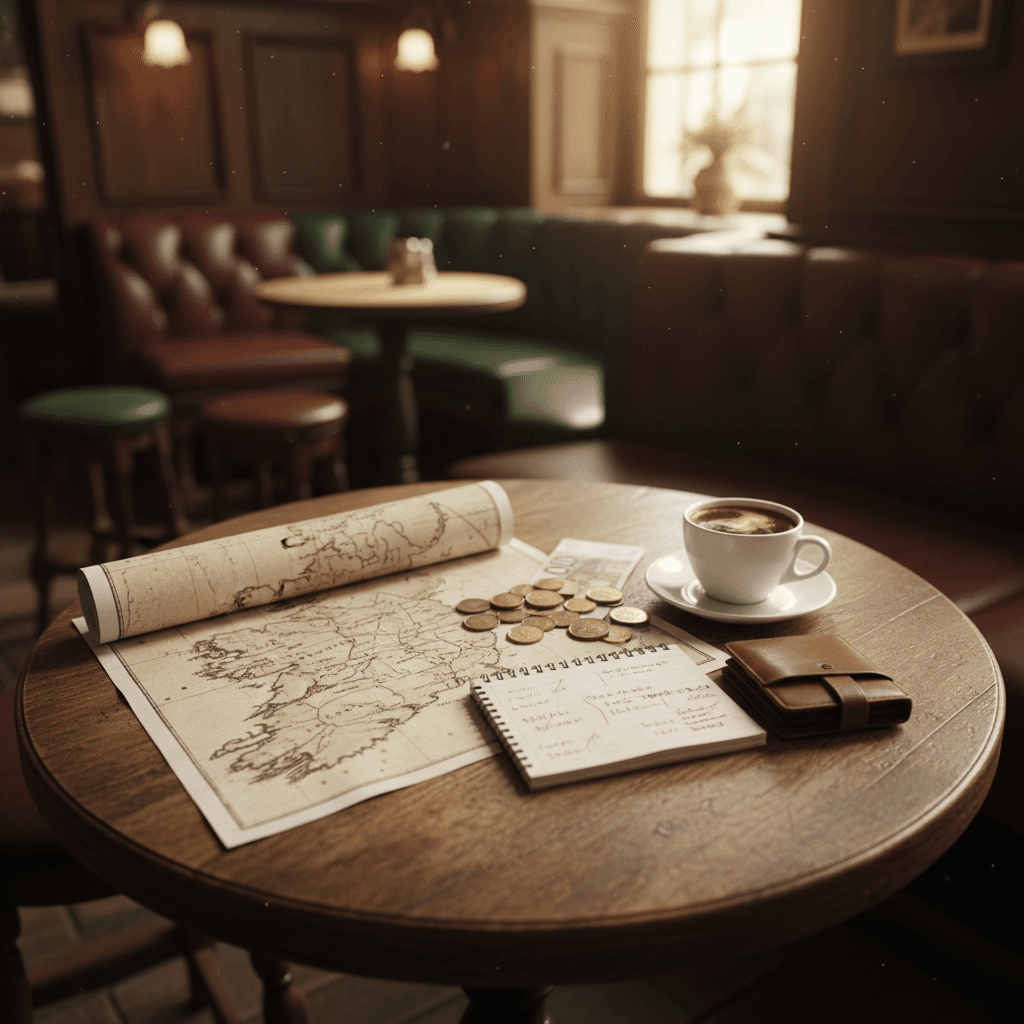
Ireland has a reputation for being expensive. Some of that's earned — Dublin pints have crossed €7, Killarney B&Bs in July are not what they used to be — and some of it is just visitors not knowing where the money actually goes.
You can do a brilliant week here on €500 a head if you're willing to camp, cook a few meals and drink your coffee in petrol stations instead of cafés. You can do an even better week on €800 with a bit more comfort. The spend that ruins most budgets isn't accommodation or fuel — it's small daily decisions and a few avoidable mistakes at the airport.
Here's what locals know.
Realistic Budget Expectations
Daily Spending (Per Person)
| Category | Budget | Mid-Range | Comfortable |
|---|---|---|---|
| Accommodation | €15–€25 | €40–€60 | €80–€120 |
| Food | €25–€35 | €40–€60 | €70–€100 |
| Fuel (share of car) | €15–€20 | €15–€20 | €15–€20 |
| Activities | €10–€20 | €25–€40 | €50–€80 |
| Daily Total | €65–€100 | €120–€180 | €215–€320 |
Weekly Budget Summary
| Style | Per Person | Per Couple |
|---|---|---|
| Budget | €450–€700 | €600–€900 |
| Mid-Range | €850–€1,250 | €1,200–€1,800 |
| Comfortable | €1,500–€2,200 | €2,000–€3,000 |
Excludes car rental and flights.
The numbers above hold up if you're roughly evenly split between Dublin/Galway/Cork (where things are dearer) and the rest of the country (where they're not). A week spent entirely in West Cork, Connemara or Donegal can come in 20% cheaper than the table suggests. A week spent entirely in Dublin can cost 30% more.
Saving on Accommodation
Hostels
€15–€30 a bed in a dorm, €50–€80 for a private room in the same hostel. Most have kitchens, which is half the point. Generation Hostel in Dublin, Sleepzone Galway, Black Sheep Hostel in Killarney — all solid, all clean, all in the right part of town for getting around.
Hostels in Ireland are not the bunk-bed-and-questionable-shower experience some people remember. They've genuinely raised their game. The good ones now compete with three-star hotels on cleanliness and location.
Camping
€20–€35 a night for a powered pitch at a registered site. Cheaper if you're tent-only, sometimes free at remote spots. The campsites along the Wild Atlantic Way — Pure Camping in Clare, Mannix Point in Cahersiveen, Sleepy Hollows in Connemara — are some of the most scenic places I've ever pitched a tent anywhere in Europe.
Wild camping in the Republic exists in a grey area. It's tolerated in plenty of places, illegal-but-ignored in others, and properly forbidden in national parks. Ask in the nearest pub, and if the answer is "ah you're grand, just don't light a fire," you have your answer.
B&Bs and Guesthouses
The B&B is still the best mid-range value in Ireland. €40–€70 per person sharing, breakfast included, and the breakfast is usually the kind that means you can skip lunch.
Two things to know:
- Book direct. Phone the B&B or use their own website. Booking.com and Expedia take a 15–18% cut, and the B&B will sometimes offer you a small discount if you ring them direct, because they're keeping the difference.
- The county matters more than the price. A €50 B&B in Donegal will be larger, friendlier and more welcoming than a €70 one in central Dublin. Where you sleep affects the trip more than what you pay.
Budget Tips for Accommodation
- Book ahead in summer, especially around Galway Race Week and the August bank holiday. Prices double in tourist towns and the cheap beds vanish first.
- Stay 10 minutes outside the popular town. A B&B in Dingle is dear. A B&B in Lispole, four kilometres up the road, is half the price and the same view.
- Sunday to Thursday is cheaper. Weekend rates in Killarney and Galway run 30% above weekdays in peak season.
- Ask about long-stay rates. Most B&Bs will knock 10–15% off if you stay three nights or more.
- Filter Airbnb for "Superhost" with a kitchen. The kitchen is the budget hack — see below.
Saving on Food
Self-Catering
Self-catering is the single biggest money-saver on an Irish road trip. Not because eating out is unaffordable, but because eating out three times a day is.
A picnic from a Lidl or Aldi:
- A loaf of soda bread or a French stick: €1.50–€2.50
- Local cheese (Coolea, Cashel Blue, anything from Sheridans): €4–€6
- Sliced ham or smoked mackerel: €3–€5
- Tomatoes, cucumber, an apple: €3
- A packet of Tayto crisps because you have to: €1.20
That's €13 for two people, eaten on a cliff somewhere with the sea below you. The same lunch in a café is €30.
Where to shop, in order of price:
- Aldi and Lidl — the cheapest by a clear margin, almost identical to each other, present in every town of any size
- Dunnes Stores — slightly more expensive, decent own-brand range, found everywhere
- Tesco — broad range, Clubcard prices if you can be bothered to sign up
- SuperValu — slightly pricier, but the local range is genuinely good (especially in Cork and Kerry stores)
- Centra and Spar — convenience prices, fine for a loaf of bread or a litre of milk, expensive for a weekly shop
Eating Out Affordably
The trick to eating out cheaply in Ireland is the carvery lunch. Most pubs that serve food do a carvery — roast meat, potatoes (always two kinds), vegetables, gravy — between roughly 12:30 and 2:30. It's €10–€14, it's enormous, and it's often the best meal you'll eat all day.
Other ways to eat well without spending mid-range money:
- Lunch menus. Many restaurants run a lunch set at €15–€20 that uses the same ingredients as the €30 dinner. Same kitchen, same chef, two-thirds the bill.
- Pub food. Fish and chips, Irish stew, a burger, the carvery. €12–€16 for a real meal.
- The chipper. Every town has at least one. €8–€12 for fish and chips. The good ones are always the ones with a queue at 8 pm on a Friday.
- Early bird menus. Restaurants that do them usually run 5–7 pm at 25–30% off the dinner menu.
Coffee
Avoid the "I'll just grab a cappuccino" trap. Café coffee in Ireland runs €3.50–€4.50 a cup, and it adds up to €60 a week per person without you noticing. Petrol station coffee in Ireland is genuinely fine — Applegreen and Circle K both run halfway-decent espresso machines for €2–€2.50, and the local cult favourite is the Insomnia coffee stands inside Spar shops. It's not Italian, but it does the job for half the price of a café.
Saving on Fuel
Driving Efficiently
Steady speeds save fuel. 80–100 km/h on national routes is the sweet spot. Anything above 110 burns noticeably more. Sit behind a slow-moving farm trailer for 20 km and you'll come out the other end with the fuel needle barely moved.
Other small things that add up:
- Check tyre pressures at the first petrol station. Rentals are often under-inflated.
- Take the roof box off if you're not using it.
- Don't leave the car idling at every viewpoint.
Finding Cheap Fuel
Supermarket stations are cheaper. Tesco, Applegreen when it's attached to a Lidl, the Lidl stations themselves where they exist — all 5–10 cents a litre cheaper than the standalone forecourts.
The most expensive fuel you'll buy in Ireland is on a motorway service area. Avoid the M1, M7 and M50 service stations if you have the option of pulling off into a town instead.
Pumps.ie is the local fuel price comparison site. Worth a 30-second check before a long drive.
Always fill up before heading into Connemara, the Inishowen 100, the Ring of Kerry early in the day, or the Sheep's Head — rural stations close early on Sundays and the choices are thin.
See our Fuel Guide for the full version.
Budget a Little Extra for Winter and Spring 2027
The fuel line above is based on national averages of €1.75 a litre for petrol and €1.73 for diesel (AA Ireland, July 2026, checked August 2026). There is a known increase scheduled on top of that: the temporary excise reductions, worth 27 cent a litre on petrol and 32 cent on diesel, are due to be restored in four steps between 1 November 2026 and the end of February 2027.
If that happens as planned, a 1,500 km week at 7 L/100 km costs roughly €28 to €34 more in fuel than the same week costs today. Budget for it if you are travelling after Christmas. The Budget 2027 fuel cost guide sets out what is confirmed, what is still undecided, and the arithmetic.
Saving on Attractions
Free Attractions
The best of Ireland is free. Genuinely, almost all of it.
Coast and countryside:
- Every beach in the country is free. There are over 600 of them.
- Mountain walks, forest parks, bog roads, the Wild Atlantic Way itself
- Scenic viewpoints on every coastal route
Historic sites:
- Most ruined castles can be approached for free
- Church ruins, monastic settlements, round towers
- Neolithic sites that aren't fenced — Poulnabrone in the Burren, Drombeg in Cork, Beaghmore in Tyrone
- Most graveyards (which sounds odd until you've stood in Drumcliffe in the rain reading Yeats's headstone)
Towns and music:
- Every Saturday market in every town
- Free walking tours run on a tip basis in Dublin, Galway, Cork, Belfast and Limerick
- Trad music sessions in pubs. You buy a pint, you sit, you listen. No cover charge anywhere I've ever been.
The Cliffs of Moher Are Not Free
This is the most common budgeting mistake on the Wild Atlantic Way, and this guide used to make it. The Cliffs of Moher Experience charges a per-person admission, not a parking fee. Parking is included in that admission, and there is no separate parking ticket to buy.
Parking everywhere else is a real line in the budget, and there is no national rate — town-centre parking is set council by council, and a clamp is €125. See our parking guide for what each system costs and how to avoid the expensive version.
Gate rates, checked 30 August 2026:
- Adult €15.00
- Student €12.00
- Senior 65+ €12.00
- Family, 2 adults and 2 children under 12, €30.00
- Children under 12 free with a paying adult, up to four
Booking online costs less than arriving at the gate. The operator's own wording is that without an online booking "you will be subject to the full gate rate admission charge". A booking is for a timed slot — off-peak 8am–11am, peak 11am–4pm, off-peak 4pm to close — so it fixes the shape of your driving day, and you are asked to arrive within 15 minutes of the time on the confirmation. Rates and slots from cliffsofmoher.ie.
You can no longer walk in for free. That was once true and is not now. The Cliffs of Moher Coastal Walk is closed from Liscannor and Hags Head all the way to the visitor centre, and the Doolin section is open only as far as Surfers Path, with no through access to the Experience. The closures are stated by the operator and by Sport Ireland's trail listing. Doolin out to Surfers Path and back is still a free cliff walk worth doing — it is just not a way into the visitor centre.
The OPW Heritage Card
If you're planning to visit even four or five of the bigger paid heritage sites, the Heritage Card pays for itself.
- €40 adult, €30 senior, €10 child
- Covers 45+ sites for a year
- Includes Kilmainham Gaol (which you'll otherwise queue 2 hours for), Rock of Cashel, Clonmacnoise, the Skellig Experience, Newgrange tours, Glendalough, the Brú na Bóinne visitor centre and dozens more
Bought at any OPW site on day one of your trip, it pays for itself by the end of the week.
Discount Strategies
- Book online ahead. Most sites charge 10–20% less for advance online tickets.
- Family tickets are nearly always cheaper than buying individual tickets for the same group.
- Bring student or senior ID if you have it.
- Look for combo tickets — Dublin's Book of Kells has one with the Castle, Killarney has one with the Jaunting Cars.
- Tourist offices sometimes have discount vouchers for the smaller sites in their area. They're free to walk into.
Saving on Car Rental
Booking Smart
- Book 2–3 months ahead. Irish rental prices are seasonal and book up faster than visitors expect.
- Compare at least three sites, then check direct. AutoEurope and Discover Cars are usually the cheapest aggregators; Hertz, Enterprise and Dooley sometimes match on direct bookings.
- Pickup at Dublin Airport is sometimes cheaper than the city. Sometimes the opposite. Check both for your dates.
- Rent the smallest car you can live with. A VW Polo costs less to hire, less to fuel, and is dramatically easier to drive on a road like the Healy Pass than a SUV.
Avoiding Extra Costs at the Counter
This is where most of the budget actually leaks. The base rental rate isn't where they make their margin — the margin is everything they upsell at the desk.
- Skip the GPS — your phone is better and free. See the Navigation Apps Guide.
- Skip the Super CDW — buy excess insurance online before you fly for a quarter of the price. See the Car Insurance Guide for exactly how this works and why.
- Skip the additional driver fee unless you genuinely need someone else to drive
- Skip the Personal Accident Insurance — your travel insurance already covers it
- Always return the car with a full tank — fill up at a Maxol or Applegreen on the way to the airport. Their refuelling charge is brutal.
For the full version of this, see the Car Rental Guide.
Consider Car Sharing
If you're based in Dublin and only need wheels for a day or two of excursions, you don't necessarily need a traditional rental at all. GoCar has hundreds of cars parked across Dublin (and a smaller fleet in Cork, Galway and Limerick) that you can book by the hour — see GoCar locations in Dublin, Cork and Galway. Insurance is included, fuel's included up to 50 km, and there's no airport queue.
For a single Saturday trip out to Glendalough, GoCar costs about €60–€80 all-in. A traditional one-day hire from the airport will run €100+ before you've factored in the bus to the rental desk.
Use GoCar promo code 31k65h when registering to get €25 off your first trip.
Best Travel Credit Cards for Ireland (Quick Version)
Bring a card with no foreign transaction fees and you'll save €40–€60 over a typical one-week Ireland trip. The standard 2.5–3% fee on every card transaction adds up faster than visitors expect.
The short version of which card to bring:
- US visitors: Chase Sapphire (Preferred or Reserve), Capital One Venture, or Bank of America Travel Rewards. Amex Gold/Platinum works too but acceptance is patchy in rural Ireland — bring a Visa or Mastercard as your primary.
- UK visitors: Most modern UK cards work fine in Ireland. Chase UK, Halifax Clarity, Revolut, Monzo, Starling are all excellent.
- Everyone else: Open a Revolut or Wise account before you fly. Both are dramatically better than traditional bank cards and work in every Irish ATM and terminal.
Two universal rules at the card terminal:
- Always pay in euros, never in your home currency. The "Dynamic Currency Conversion" the terminal offers is 4–7% worse than your bank's rate.
- Withdraw cash only at bank ATMs (AIB, Bank of Ireland, Permanent TSB, Ulster Bank). Avoid the standalone Euronet ATMs at airports and tourist spots — they have steep fees and bad rates.
For the full version — including which cards include car rental insurance for Ireland (the answer is: probably not yours), how chip-and-PIN and contactless work in Ireland, the best cards for ATM withdrawals, a deeper comparison of Revolut vs Wise, and how much cash you actually need — see our dedicated Best Travel Credit Cards for Ireland guide.
Free and Cheap Experiences by Route
Wild Atlantic Way - Clare
- Cliffs of Moher Coastal Walk from Doolin as far as Surfers Path (free, and the only section still open — it does not reach the visitor centre)
- The Burren — drive it, park anywhere, walk on the limestone (free)
- Trad sessions in O'Connor's pub in Doolin (free, buy a pint)
- Loop Head lighthouse loop drive (free)
Wicklow Mountains
- Glendalough Upper Lake walk (free, parking €4)
- The Wicklow Way (free)
- Sally Gap and the Military Road (free, one of the best drives in Ireland)
- Powerscourt Waterfall (€6.50)
Boyne Valley
- Hill of Tara (free, OPW heritage site)
- Trim Castle exterior walk (free)
- Newgrange exterior viewing platform (free)
- Battle of the Boyne grounds (free)
Timing Your Trip
Off-Season (October–April)
- Accommodation: 25–40% cheaper
- Attractions: empty
- Car rental: significantly cheaper
- Weather: unpredictable but often grand
The trade-off is daylight. November to February you get 8–9 hours, which is enough for a day's sightseeing but means an early start.
Shoulder Season (May, September)
The sweet spot. Better weather than the depths of winter, fewer crowds than summer, prices roughly 15% below July. May in particular is magic — long days, flowers in the hedgerows, B&Bs not yet jammed with families.
Peak Season (June–August)
Book everything in advance. Prices peak. But the days are 17 hours long and the chance of sunshine is highest.
Money Management Tips
Currency
- The Republic uses the Euro (€)
- Northern Ireland uses British Pounds (£), since it's part of the UK
- ATMs are everywhere
- Card payments are accepted nearly everywhere
If your trip crosses the border (Donegal to Derry, Dublin to Belfast), you'll need both. Most card payments handle the switch automatically.
Daily Tracking
I budget by setting a rough weekly cap, withdrawing a third of it in cash, and putting everything else on the no-fee card. At the end of each day a quick glance at the banking app tells me whether I'm on track. No spreadsheets, no apps — just a habit.
Always keep a 10–15% buffer. There's always one extra ferry, one extra round of pints, one unexpected toll.
Sample Budget Itinerary
7-Day Budget Trip (€500–€600 per person)
- Day 1–2: Dublin — hostel bed, free walking tour, picnic lunches from Lidl, one cheap dinner in a pub
- Day 3–4: Wicklow and Glendalough — campsite or hostel, hiking, self-catered, Sally Gap drive
- Day 5–6: Galway and the Cliffs of Moher — Sleepzone hostel, pub trad sessions, the free Doolin cliff walk, and cliffs admission booked online for a timed slot if you want the visitor centre
- Day 7: Back to Dublin — picnic on the road, return the car, fly out
Rough Breakdown (per person)
- Accommodation: €180 (mix of hostel and camping)
- Food: €175 (mostly self-catered with two or three pub meals)
- Fuel: €70 (your share of about 1,000 km)
- Car rental: €100 (a €300 small car split three ways)
- Attractions: €50 (one or two paid sites, the rest free)
The Bottom Line
Ireland is doable on a tight budget if you cook a few meals, sleep in hostels and B&Bs, and refuse the upsells at the rental desk. The most expensive things in Ireland are the things you don't have to pay for — landscapes, music, conversation, the long evenings in summer when the sun finally sets at half-ten.
Bring a card with no foreign fees. Pay in euros every time. Buy a Heritage Card on day one if you're hitting the bigger sites. Eat the carvery lunch. Skip the rental GPS. Drink the petrol-station coffee at least some of the time.
That's how locals would tell you to do it.