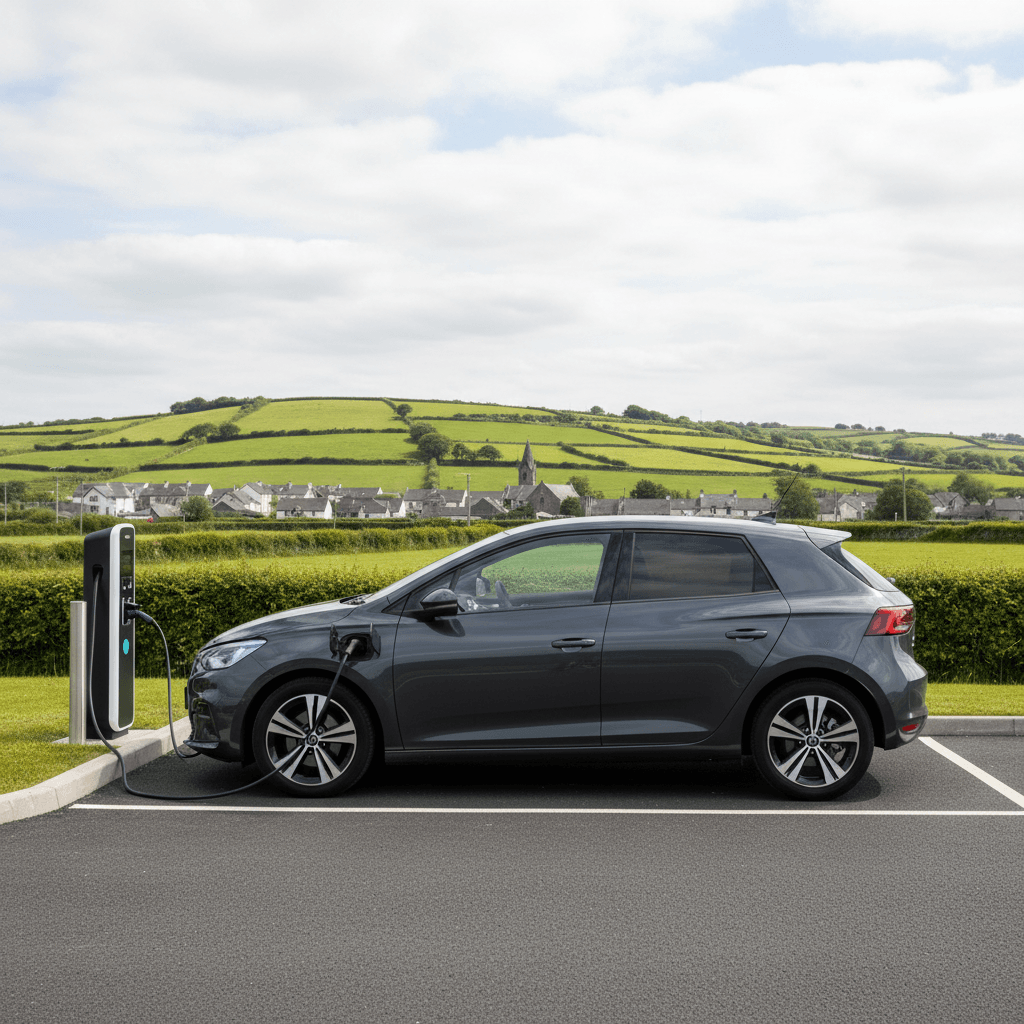
Electric vehicles are increasingly available for rent in Ireland, and the charging infrastructure is growing rapidly. But EV road trips require different planning than traditional cars. Here's everything you need to know.
Ireland's EV Charging Network
Current Infrastructure
ESB ecars operates the largest public network on the island, and its figures are the only ones we publish here because they are the only ones the operator states itself. Checked against ESB in August 2026:
- ESB describes a network that "can support 1,400 EVs charging at any one time across the island of Ireland"
- Three tiers: AC up to 22kW, DC from 50kW to 100kW, and high power at 150kW and above
- ESB said in June 2026 that it runs more than 60 high power charging hubs nationwide, with more planned through 2026
Northern Ireland is behind the Republic on the fastest tier. ESB's Northern Ireland programme is set to double the existing number of rapid chargers there and to bring high power charging to Northern Ireland for the first time, through five 200kW hubs. Those are announced, not open. Plan a 2026 trip on what is running today.
360kW High Power Hubs
The fastest public chargers on the island, and three of them sit on drives covered here. Specifications below are as published by ESB — we have not used these chargers ourselves.
| Hub | Location | Chargers | EVs at once | Opened |
|---|---|---|---|---|
| Bunratty | Bunratty Castle Hotel, V95 DW9N, Co. Clare | 4 × 360kW | 8 | 10 June 2026 |
| Brittas Bay | Jack White's Inn, M11, Co. Wicklow | 4 × 360kW | 8 | March 2026 |
| Arklow | Bridgewater Shopping Centre, Co. Wicklow | 2 × 360kW | 4 | March 2026 |
Bunratty is on the N18 between Shannon Airport, Limerick and Ennis, so it is the first realistic high-power stop for anyone collecting a hire car at Shannon and heading for Clare.
Sources: ESB, 10 June 2026 and ESB, 20 March 2026. ESB operates other high power hubs across the island; the three above are the ones that sit on drives covered here. Where ESB has announced a site without publishing its charger count or power rating, we leave it out rather than guess.
Main Charging Networks
| Network | Coverage | Speed | Payment |
|---|---|---|---|
| ESB ecars | Nationwide, island-wide | AC 22kW, DC 50–100kW, high power 150kW+ (360kW at the newest hubs) | App/Card |
| Weev | Northern Ireland, and the border counties of the Republic — not nationwide | AC 7–11kW, rapid 24–60kW, ultra rapid above 100kW | App/Contactless |
| Ionity | Motorways | Ultra-fast (350kW) | App/Card |
| Applegreen Fast Charge | Applegreen forecourts in Ireland, the UK and the USA — no Ireland-only count published | Ultra-fast, up to 400kW | Tap/App/RFID |
| EasyGo | Nationwide | Standard & Fast | App/RFID |
| Tesla Supercharger | Select locations | Fast | Tesla app |
| Destination chargers | Hotels, attractions | Standard | Often free |
Applegreen Fast Charge, and the Network That Will Not Quote You
Applegreen Electric now trades as Applegreen Fast Charge. The old domain
applegreenelectric.com 301-redirects to applegreenfastcharge.com, so a
bookmark or an older guide still using the previous name is pointing at the
same operator. The app is still listed under the Applegreen name in both app
stores.
What the operator states about the hardware, checked 8 September 2026 on Applegreen Fast Charge:
- Chargers deliver up to 400kW, which the operator describes as about 100 miles of range in around 15 minutes.
- Payment by tap-to-pay at the charger (Visa, Mastercard, Apple Pay, Google Pay), by app, or by RFID. There is no membership requirement.
We give no site or charger count for Ireland, because the operator does not publish one. The figures on its network page count Ireland, the UK and the USA together, and the Irish share of them is not stated anywhere. A combined number presented as an Irish one would tell you nothing useful about whether there is a charger where you are going. Use the operator's own map, which does have an Ireland view.
Weev, and the Border Counties
ESB is the network most visitors meet. In the north and along the border it is not the only one, and often not the nearest one. Weev is a Northern Ireland-based operator charging on both sides of the border, and like ESB it publishes a flat per-kWh rate in pounds and in euro rather than telling you to check the app. That means we can give you the price before you plug in.
What it covers, from Weev's and the funders' own announcements:
- Northern Ireland. Weev has been appointed under the Office for Zero Emission Vehicles' On Street Residential Charge Point Scheme to deliver more than 250 charge points across nine council areas, on street and in council-owned car parks. These are residential charge points aimed at people without a driveway, not motorway rapids — useful if you are parked overnight in town, not a substitute for planning a rapid stop.
- The border counties of the Republic. Under the INTERREG VA FASTER project, funded with €6.4 million of EU money, Weev was appointed to deliver 25 rapid charge points across Donegal, Sligo, Leitrim, Monaghan, Cavan, Louth and Meath — the project describes the span as Navan, Co. Meath to Buncrana, Co. Donegal.
- Roscommon. A €200,000 ZEVI and Transport Infrastructure Ireland pilot at Áras an Chontae, Roscommon, opened on 15 June 2026, combining AC and DC charging on the building's existing electrical connection.
Weev does not publish a charger count or a power rating per site, so we do not list individual sites here — the same rule we apply to ESB. Check the operator's own map for what is live on the day you travel.
This is the network to know about on our border and northern drives: Carrick-on-Shannon & the Waterways and Leitrim Hills & Glencar in Leitrim, the Cooley Peninsula and Louth Monastic Trail in Louth, Cavan Lakelands and Monaghan Drumlin Country, Boyne Valley and Loughcrew in Meath, Yeats Country in Sligo, and the Donegal drives including Inishowen 100. On the Northern Ireland side — the Causeway Coast, Mourne Coastal Route, Sperrins, Ring of Gullion, Fermanagh Lakelands and Derry to Downhill — a Weev charger bills you in sterling at the Northern Ireland rates below, not the euro ones. Same operator, same app, different currency and a different price.
Geographic Reality
Good coverage:
- Dublin and surrounding counties
- Cork city and suburbs
- Galway city
- Major motorways (M1, M4, M6, M7, M8)
- The M11 Dublin–Wexford corridor, with 360kW hubs at Brittas Bay and Arklow
- The N18 Shannon–Limerick–Ennis corridor, with a 360kW hub at Bunratty
- Main tourist routes
Limited coverage:
- Rural West (parts of Mayo, Galway, Clare)
- Northwest Donegal
- Remote peninsulas
- Mountain areas
For routes like the Wild Atlantic Way or Inishowen 100, careful planning is essential.
Understanding EV Range
Advertised vs Real-World Range
Manufacturer range figures are optimistic. Real-world factors reduce range significantly:
| Factor | Range Impact |
|---|---|
| Cold weather | -10% to -30% |
| Heating/AC use | -10% to -20% |
| Hilly terrain | -10% to -25% |
| High-speed driving | -15% to -25% |
| Rain/wet roads | -5% to -10% |
Practical Range Examples
| Vehicle | Advertised | Realistic Ireland |
|---|---|---|
| Nissan Leaf (40kWh) | 270km | 180-220km |
| Hyundai Kona Electric | 484km | 350-400km |
| Tesla Model 3 Long Range | 580km | 450-500km |
| VW ID.4 | 520km | 380-420km |
Rule of thumb: Plan for 70% of advertised range in Irish conditions.
Planning Your EV Road Trip
Before You Go
- Map charging points along your route
- Identify backup chargers in case primary is occupied/broken
- Download charging apps (see below)
- Check charger status is "available" before relying on it
- Plan meal/activity stops at charging locations
The 80% Rule
- Charge to 80% for fastest charging (last 20% is slow)
- Aim to arrive at chargers with 20%+ remaining
- Never let battery drop below 10% if avoidable
Recommended Apps
For finding chargers:
- ESB EV - Ireland's largest network
- EasyGo - Good coverage, easy payment
- Zap-Map - Comprehensive map of all chargers
- PlugShare - Community reviews and real-time status
For route planning:
- A Better Route Planner (ABRP) - Best EV route planner
- Google Maps - Now shows EV chargers
- Waze - Limited EV features but good navigation
Sample Route Plan: Dublin to Galway (210km)
Without charging stop: Possible in most modern EVs with good range
With charging stop (recommended):
- Depart Dublin with 100% charge
- Drive to Athlone (120km) - arrive ~60% battery
- Fast charge at Athlone (20 mins to 80%)
- Continue to Galway (90km) - arrive ~50% battery
This provides comfortable buffer and a rest break.
Charging Types Explained
Standard AC Charging (3-22kW)
- Time: 4-8 hours for full charge
- Where: Homes, hotels, car parks, some public points
- Best for: Overnight charging, long stops
Fast DC Charging (50kW)
- Time: 30-45 minutes to 80%
- Where: Service stations, dedicated charging hubs
- Best for: Road trip top-ups
High Power DC Charging (150kW and above)
- Time: 15-25 minutes to 80%
- Where: ESB high power hubs, now up to 360kW; Ionity stations (350kW); select other locations
- Best for: Quick stops on motorways and touring corridors
- Note: Not all EVs can accept high power charging. The car, not the charger, usually sets the ceiling — a 360kW hub does not make a 50kW car charge any faster
Costs
Public Charging
ESB ecars runs the largest public network on the island and sets the price most visitors end up paying. It restructured its tariffs on 1 July 2026: the old 50–150kW and 150kW-plus DC bands were merged into a single rate for everything above 50kW, and every rate went up. The figures below come from ESB's own price plans page and were checked in August 2026.
Republic of Ireland (€ per kWh)
| Plan | Standard AC (up to 50kW) | Fast & High Power DC (50kW+) |
|---|---|---|
| Pay as you go | €0.60 | €0.72 |
| Contactless card | €0.61 | €0.73 |
| Membership (€4.79/month, 12-month minimum) | €0.55 | €0.67 |
Northern Ireland (£ per kWh)
| Plan | Fast AC (up to 50kW) | Rapid & High Power DC (50kW+) |
|---|---|---|
| Pay as you go | £0.60 | £0.74 |
| Contactless card | £0.61 | £0.75 |
| Membership (£4.99/month, 12-month minimum) | £0.57 | £0.70 |
Two things visitors get caught by. The membership plans carry a 12-month minimum term, so they almost never pay for themselves on a two-week holiday. And contactless is the most expensive way to charge — it is also the only one that works without an app or an account, which is why most visitors use it.
Weev (€ and £ per kWh)
Weev publishes its rates the same way, and they are the ones that apply on much of the border and northern ground above. There is no membership tier and no monthly fee: you pay the app rate through My Weev, or exactly 5c / 5p more per kWh on every tier by tapping a contactless card. Both sets of figures come from Weev's own tariffs page and were checked in September 2026.
Republic of Ireland (€ per kWh)
| Charger | Speeds | My Weev app | Contactless |
|---|---|---|---|
| AC | 7kW, 11kW | €0.55 | €0.60 |
| Rapid | 24kW, 50kW, 60kW | €0.66 | €0.71 |
| Ultra rapid | above 100kW | €0.66 | €0.71 |
Northern Ireland (£ per kWh)
| Charger | Speeds | My Weev app | Contactless |
|---|---|---|---|
| AC | 7kW, 11kW | £0.44 | £0.49 |
| Rapid | 24kW, 50kW, 60kW | £0.59 | £0.64 |
| Ultra rapid | above 100kW | £0.69 | £0.74 |
That is not a typo in the euro table. In the Republic, Weev charges the same rate for ultra rapid as for rapid — €0.66 on the app, €0.71 contactless — so the fastest charger it has costs you nothing extra per kWh. In Northern Ireland it does step up, to £0.69 and £0.74. So on the Republic side, given a choice between two Weev units, take the faster one — it is the same price.
The hold is the thing that catches visitors out. Charging through the app takes a €1 / £1 pre-authorisation. Tapping a contactless card instead means your bank places a €50 / £50 holding fee, which Weev says is refunded within seven working days. That is a real block on a holiday card at a roadside charger, and it is the single best argument for installing the app before you need it.
Applegreen Fast Charge publishes no per-kWh price for Ireland at all. ESB
and Weev both put a tariff table on their own sites, which is why we can
reproduce them above. Applegreen does not. Its
pricing page sets out the
model — you pay per kWh, the app rate is lower than the tap-to-pay rate, no
membership needed — and gives no figure for either. The old
applegreenelectric.com/pricing-overview address, which some guides still link
to, now redirects to a page that does not exist. Checked 8 September 2026.
Other people will quote you a number for Applegreen. We are not going to, because the operator has not published one, and a price we cannot trace to the operator is not a price we will put in your budget.
So find it yourself, before you commit: open the app or read the charger screen and confirm the rate per kWh before you plug in, not after. On a network that prices in the app, that is a thirty-second check that is the difference between a known cost and a surprise. Budget an Applegreen stop at the top of the range you have seen elsewhere on this page until the screen tells you otherwise.
Applegreen's hold is the opposite shape to Weev's, and it changes at the border. Its terms set the pre-authorisation taken before each transaction at €0.01 for customers in Ireland and £45 for customers in the UK — one cent in the Republic, forty-five pounds in Northern Ireland, on the same account. Registering a card carries a £1 test transaction for UK customers and no test transaction at all in Ireland. So the advice above — install the app, because the card route holds €50 — is Weev's advice and does not transfer here. On Applegreen the app is not what saves you the hold; the jurisdiction you are standing in is. Drive north on a card with little headroom on it and the £45 lands where a cent landed the day before. From Applegreen's terms and conditions, clause 13.3, checked 15 September 2026.
Other networks (Ionity, EasyGo, Tesla) set their own tariffs, so check in the app before you plug in. Destination chargers at hotels and attractions are a different matter again: often free or included in the room rate, and on a road trip that is where the money is actually saved.
Overstay Fees
Leaving the car plugged in after it has finished charging is billed by the minute — and the clock is set by the operator, not by the country. There is no island-wide overstay rule. Learn the number for the network you are actually plugged into.
On ESB ecars, an overstay costs €0.50 / £0.50 per minute, capped at €22.50 / £22.50. The clock starts:
- After 45 minutes on a DC charger above 50kW (ESB calls these "Fast & High Power" in the Republic, "Rapid & High Power" in Northern Ireland)
- After 10 hours on an AC charger up to 50kW ("Standard" in the Republic, "Fast" in Northern Ireland)
On Weev, the rate is the same €0.50 / £0.50 per minute, but the clock is 65 minutes on rapid and ultra rapid chargers, or 4 hours on the night rate. Weev does not publish a cap. Checked on Weev's tariffs page in September 2026.
On Applegreen Fast Charge, the clock matches ESB's exactly — 45 minutes, then €0.50 / £0.50 per minute, rounded up to the nearest minute, in euro in the Republic and in pounds in Northern Ireland. Two things the operator's own wording does not let us round off. It applies "at specified Charging Locations", not stated as network-wide, and the fee "may be charged" rather than will be. The terms also say the rate for each location can change and that the current one is shown in the map pin in the app. No cap is published, so unlike ESB's €22.50 there is no stated ceiling on what an overstay can reach. From Applegreen's terms and conditions, clause 14.1, checked 15 September 2026.
Forty-five minutes — ESB's number, and Applegreen's — is shorter than a sit-down lunch: a rapid charge to 80% takes 30 to 45 of those minutes. Move the car before you eat, not after. Weev's extra twenty minutes is real, but it is Weev's — do not carry it back to an ESB hub, and do not assume ESB's 45 covers you on a Weev one.
Cost Comparison: EV vs Petrol
For a 200km journey, at 18kWh/100km in the EV and 7L/100km in the petrol car:
| How you fuel it | Cost for 200km |
|---|---|
| Petrol at €1.75/litre (AA Ireland national average, July 2026) | 14 litres = €24.50 |
| Public DC above 50kW, pay as you go at €0.72/kWh | 36kWh = €25.92 |
| Public DC above 50kW, membership at €0.67/kWh | 36kWh = €24.12 |
| Public AC up to 50kW, pay as you go at €0.60/kWh | 36kWh = €21.60 |
| Overnight at accommodation where charging is included | €0 |
On public rapid charging, an EV is no longer cheaper than petrol in Ireland. At the pay-as-you-go DC rate the same 200km costs about €1.40 more in the EV than in the petrol car, and takes longer. Membership brings it level with petrol, but only if you sign up for twelve months.
The EV case on an Irish road trip now rests on where you sleep. Book accommodation with a charger and the running cost collapses to almost nothing. Plan on topping up at motorway rapid chargers and you will pay slightly more than the petrol car beside you, and wait while you do it.
Renting an EV in Ireland
Availability
EVs are still a small percentage of rental fleets but growing:
- Most major rental companies offer EVs
- Book well in advance—limited stock
- Expect premium pricing (10-30% more than equivalent petrol)
- Tesla available through some specialist providers
What to Ask
- What's the realistic range?
- Which charging networks work with the car?
- Is a charging cable included?
- Are charging costs included or separate?
- What happens if I run out of charge?
EV-Specific Rental Tips
- Get a full orientation on charging the specific model
- Test the charging process before leaving the depot
- Save emergency breakdown number—EV recovery is specialized
- Return with agreed charge level (usually 80%)
Route Suggestions for EVs
Easy EV Routes (good charging coverage)
- Dublin Bay & Howth - Short, urban charging available
- Wicklow Coastal Drive - 360kW hubs on the M11 at Brittas Bay and Arklow
- Wicklow Mountains - Chargers in Bray, Wicklow town; the M11 hubs are the fast option on the way in or out
- Boyne Valley - Flat terrain, motorway chargers nearby
Moderate EV Routes (plan carefully)
- Cork Harbour & Kinsale - Cork has good charging
- Wild Atlantic Way - Clare - 360kW hub at Bunratty on the N18 approach from Shannon and Limerick; thin once you are west of Ennis
- Galway Bay & Burren - Galway chargers, limited in Burren
- Causeway Coast - Belfast has chargers, less on coast
Challenging EV Routes (experienced only)
- Dingle Peninsula - Very limited charging
- Connemara Loop - Remote, few chargers
- Donegal Highlands - Sparse infrastructure
For challenging routes, ensure your EV has sufficient range to complete without charging, or have a concrete backup plan.
Troubleshooting
Charger Not Working
Common issues and solutions:
- App showing "available" but won't start - Try different payment method
- Cable won't connect - Check you're using correct connector type
- Charging very slow - May be shared power, try different unit
- Payment declined - Have backup payment app ready
Running Low on Charge
- Reduce speed - 80km/h uses significantly less power than 120km/h
- Turn off heating/AC - Use seat heaters instead
- Find nearest charger - Even a slow charger helps
- Call breakdown service - They can transport you to a charger
Breakdown Service
Ensure your rental includes EV-specific breakdown cover. Standard tow trucks can damage EVs if not handled correctly.
Environmental Impact
Driving an EV in Ireland is genuinely greener:
- Ireland's grid is ~40% renewable (and growing)
- EVs produce zero direct emissions
- Even with grid mix, EVs emit ~50% less CO2 than petrol cars
The Future
Ireland has ambitious EV targets:
- 936,000 EVs on roads by 2030
- Major charging infrastructure investment
- New developments require charger installation
- More rental EVs coming to market
Quick Tips
- Charge overnight when staying at hotels with chargers
- Top up whenever you see a fast charger on your route
- Plan B always—have an alternative charger identified
- Weather affects range—add buffer on cold or wet days
- Motorways drain batteries—high speed reduces range significantly
- Regenerative braking is your friend on mountain descents
Related Guides
- Navigation Apps
- Fuel Guide (for comparison)
- Budget Road Trip Tips