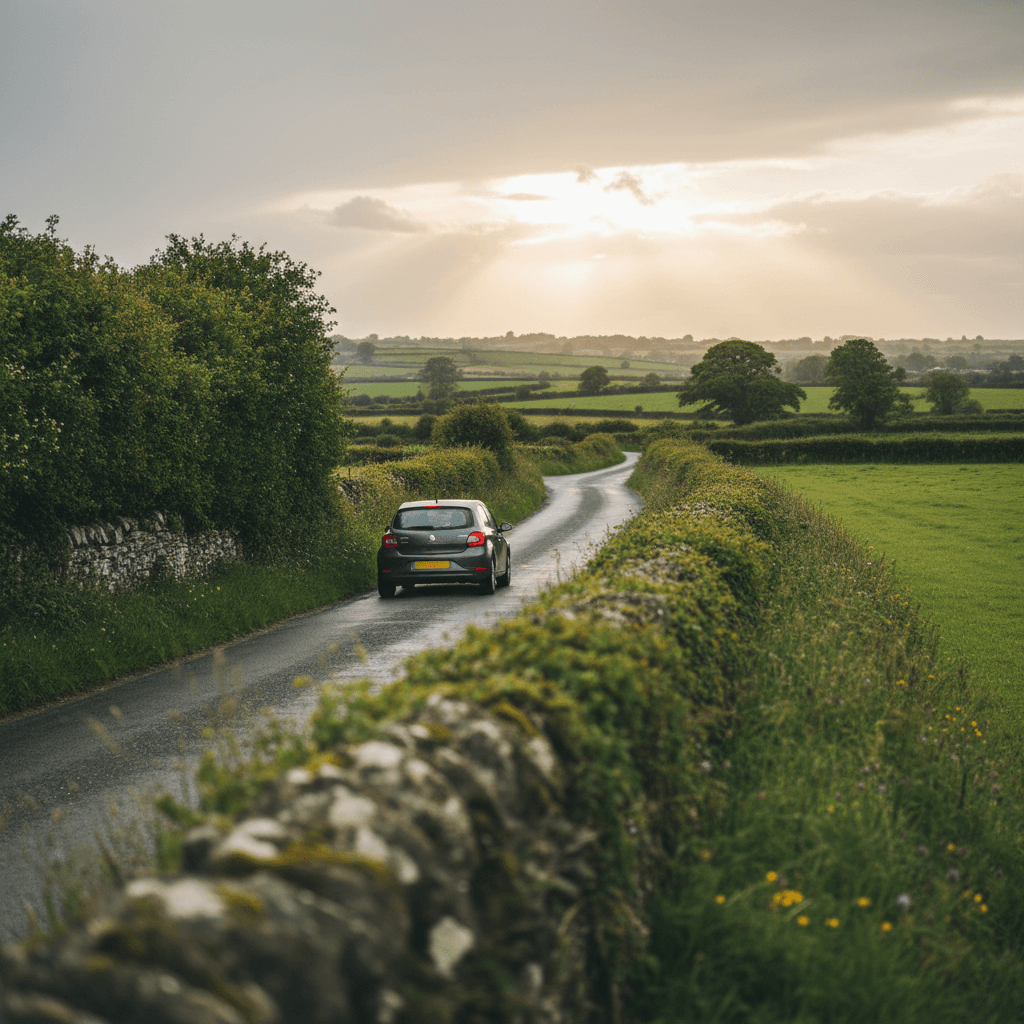
- Ireland drives on the left. This applies to both the Republic of Ireland and Northern Ireland.
- Irish cars are right-hand drive: the steering wheel is on the right side of the vehicle, closest to the centre line.
- Irish roundabouts flow clockwise, and you give way to traffic coming from your right.
- Visitors from the US, Canada, Australia and New Zealand may drive in Ireland on their national licence for up to 12 months.
Ireland drives on the LEFT side of the road. The steering wheel in your rental car will be on the right side of the vehicle. This is true everywhere on the island — both the Republic of Ireland and Northern Ireland — and it has been the law here since long before motor cars existed.
If you're coming from continental Europe or North America, this is the opposite of what you're used to, and it will feel deeply weird for the first half hour. Then it stops feeling weird and starts feeling normal. I've watched hundreds of nervous American visitors collect a hire car at Dublin Airport, white-knuckle the steering wheel for the first ten minutes on the M1, and by the time they reach Drogheda they've forgotten there was ever any other way to drive.
This guide is everything I wish someone had told me the first time I drove on the "wrong" side of the road myself. (I learned in Ireland, so for me it was the right side — I had the same experience in reverse the first time I drove in France.)
Why Does Ireland Drive on the Left?
Ireland drives on the left because the British did, and Ireland was part of the United Kingdom when motor cars were first introduced. By the time the Irish Free State was established in 1922, every road sign, every traffic regulation and every horse and cart in the country was already set up for left-hand traffic. Changing it would have been chaos.
The deeper history is older than cars. Most of the world drove on the left for centuries — when most travellers were on horseback and most riders were right-handed, keeping to the left meant your sword arm was facing oncoming traffic. Mainland Europe shifted to the right during the Napoleonic period, then later under various 19th and 20th century reforms, but Britain and its colonies kept the left-hand convention. Ireland is part of that heritage.
So today, Ireland sits in a small but consistent group: the UK, Ireland, Australia, New Zealand, India, Pakistan, Japan, South Africa, Cyprus, Malta, and a scattering of others. About a third of the world's population drives on the left, even though only about a quarter of the world's roads are left-hand traffic.
There's no plan to change. Ireland is staying on the left.
What This Means for Visitors
The actual mechanics are simple: stay on the left, overtake on the right, give way to traffic on your right at roundabouts and junctions. It's the automatic instincts that catch people out.
If you've spent your whole life looking left first when crossing a road, you will instinctively look left when stepping off an Irish footpath — and the car that's about to hit you is coming from your right. This is the single most common way visitors get hurt in Ireland, and it has nothing to do with driving. It's about walking.
For drivers specifically, the things that catch people out are:
Drifting to the right. Your body has muscle memory for centring yourself in the lane, and that memory was built around the steering wheel being on the left. With the wheel on the right, your sense of "centre" pulls you to the right of the lane — which on Irish roads means scraping the wing mirror against hedges or stone walls. The fix is to consciously aim slightly further left than feels natural for the first day. After that, your brain recalibrates.
Looking the wrong way at junctions. When you stop at a T-junction, your default is to look left first. In Ireland the immediate threat is from your right — that's where the car you need to give way to is coming from. Train yourself to look right first, then left, then right again.
Roundabout panic. Roundabouts in Ireland flow clockwise, which is the opposite of every roundabout you've ever used in the United States, France, Germany or anywhere else with right-hand traffic. You enter to the left, you go around to the right, and you exit to the left. We have a full guide to the roundabout rules in Ireland — it's worth reading before you fly.
Reaching for the wrong gear stick. If you've rented a manual (and please don't, see below), the gear stick is to your left, where your handbrake usually was. The first hour is full of comedy moments where you reach for fifth gear and grab the door handle.
Wipers and indicators swapped. On most rental cars in Ireland the indicator stalk is on the right of the steering wheel and the wipers are on the left — the opposite of US cars. You will indicate a right turn by accidentally turning on the wipers approximately 40 times in your first day. Everyone does. It's harmless and faintly embarrassing.
Tips for Your First Time Driving on the Left
The first 30 minutes are the worst. Plan accordingly.
Don't pick up your car at Dublin Airport and immediately drive into Dublin city centre. I cannot say this strongly enough. The city centre is the worst possible place to learn left-hand driving — narrow streets, buses, cyclists, one-way systems, trams, no margin for error. Pick up at the airport and drive straight out via the M1 or M50, where the lanes are wide and there's no drama.
Better still: pick up the car somewhere quieter. Some visitors fly into Shannon or Cork instead of Dublin specifically because the airport-to-countryside route is more forgiving. If you're heading west anyway, this is a real option.
Take the first 20 minutes slow. You don't need to keep up with motorway traffic on day one. Stay in the left lane on the M50, sit at 100 km/h, let the BMWs blast past you on the right. Nobody cares.
Roundabouts are the test. Ireland has more roundabouts per capita than almost anywhere on earth — more than 2,000 across the country — and you'll hit your first one within ten minutes of leaving any airport. The roundabout rules in Ireland are simple but they require some active thinking the first few times: give way to traffic coming from your right, drive clockwise around the island, signal left as you exit. If you panic and freeze, just go around again. Nobody will mind.
On motorways, overtake on the right. Same as the UK and continental Europe. The left lane is for cruising, the right lane is for overtaking. Don't sit in the right-hand lane on the M7 — you'll hold up traffic and get flashed at.
Read the slip roads twice. This is the one place where a right-hand-drive habit can put you in real danger. At an Irish motorway junction the entry and exit slips are close together on the same side of the carriageway, and they are mirrored from what your instincts expect — the arrangement you have driven past a thousand times at home, flipped. Take the wrong one and you are on the motorway against the flow. Know which exit number you want before you get near it, and never guess at the last second. The Irish driving rules guide has the full junction section, including what TII says to do if you realise you are going the wrong way — pull in, stop, call 999 or 112, and do not turn round.
Parking takes practice. The driver's door is on the right side, which means the curb is on the passenger side when you parallel park on the left side of the road. Aiming for the curb is harder than it looks. Take your time, use the mirrors, and don't be embarrassed to back out and try again.
Use a phone mount. Get a navigation app set up before you drive a single metre — see our navigation apps guide for which app to choose and how to download offline maps. Trying to figure out the satnav while also adjusting to left-hand driving is asking too much of your brain at once.
Is Northern Ireland the Same?
Yes. Both parts of the island drive on the left. You can cross the border between the Republic and the North without changing sides of the road, without slowing down, without even necessarily noticing — there's no border post, no checkpoint, just a quiet change in the road surface and the road signs.
There are a few differences once you cross:
- Speed limits switch from km/h to mph. The Republic uses kilometres per hour. Northern Ireland uses miles per hour, like the rest of the UK. Your rental car's speedometer will usually show both, but check before you cross.
- Currency switches from euro to pound sterling. Most petrol stations and tolls in the North take cards from anywhere, so it's not a practical issue, but if you're paying cash you'll need pounds.
- Road sign distances change to miles in the North. "Belfast 30" in Donegal means 30 km. "Belfast 30" in Armagh means 30 miles. Almost a 60% difference.
- The M-routes and A-routes use the UK numbering convention rather than the Irish N-route system
What doesn't change is which side of the road you drive on. Left, the whole way around the island.
Renting a Car for Left-Hand Driving
A few practical things specific to renting a right-hand-drive car in Ireland.
Automatic, not manual. I know manual gearboxes are more common in Europe and many visitors are perfectly comfortable with them at home. But adapting to left-hand driving + right-hand-drive car + Irish narrow roads + an unfamiliar rental + a manual gearbox is asking too much for the first day. Pay the extra €5–€10 a day for an automatic. It removes one of the variables and lets your brain focus on the things that actually matter.
If you do insist on a manual, the gear stick will be to your left, operated with your left hand. The gear pattern is the same as continental Europe (1st upper-left, 5th upper-right, reverse usually pulled up or pushed down depending on the car). The clutch is still on the left foot. The accelerator is still on the right foot. So mechanically it's not different — it's just the spatial muscle memory that has to adjust.
Smaller is easier. A small hatchback — VW Polo, Hyundai i20, Ford Fiesta, Renault Clio — is dramatically easier to handle on Irish roads than a midsize SUV. The roads were laid out long before cars existed and they're often barely wide enough for two cars to pass each other. Width matters more than horsepower.
Get the rental at a quiet time of day. The desk queues at Dublin Airport are notoriously brutal at 7 am when the morning UK flights land. If you can, fly in mid-morning or mid-afternoon when the desk is calmer and the staff have time to walk you around the car properly.
Walk around the car at pickup. Photograph every panel, the wheels, the bumpers, the roof. The desk agent should do this with you anyway, but having your own time-stamped record is the best protection against post-rental damage charges.
For the full version of all of this, see our car rental guide and the car rental hub.
Country Roads: The Real Challenge
The motorways are easy. The N-routes are mostly fine. The thing that catches visitors out — and the thing this guide really exists to prepare you for — is the Irish country road.
Let me describe one specifically. You're somewhere on the Beara Peninsula in West Cork. You've turned off the main R-road onto a local lane heading toward a cove the satnav promises is two kilometres away. The lane is single-track tarmac. There are tall fuchsia hedges on both sides, well above the roof of your car. You can't see around the next bend. The road is just wide enough for one car. There's grass growing in a strip down the middle.
Then you come around a corner and there's another car coming the other way.
This is the moment everyone needs to know what to do.
Passing Places
Most Irish single-track lanes have small pull-in spots called passing places at intervals — typically a widened bit of verge or a small lay-by cut into the hedge. The convention is that whoever is closest to a passing place reverses to it, and the other car waits.
If you're on a hill, the car going uphill has right of way. The car going downhill reverses if necessary. This isn't a written rule, it's just how it works, and locals will expect you to know it.
Reversing
You may have to reverse 50 or 100 metres on a country lane to find a passing place. This is normal. Don't panic.
Reversing in a right-hand-drive car looks like this: turn your body to look over your left shoulder (the passenger shoulder), use the door mirrors heavily, and go slowly. Don't try to do it at speed. The other driver isn't in a rush — they're locals, this happens to them every day, and they will wait.
If you genuinely cannot reverse — too narrow, sharp bend, hedges in the way — wave at the other driver and they'll usually find a way past. Worst case, they get out of their car and walk over to talk to you. This happened to me in the Comeragh Mountains last summer. It took about 90 seconds to sort out and we both laughed about it.
Hedgerows and Wing Mirrors
Hedgerows in Ireland are not gentle suggestions. They are dense, often have hawthorn and brambles in them, and they can take a wing mirror clean off if you brush too close.
The trick is to trust the mirror, not your sense of width. The passenger-side mirror is the one closest to the hedge, and it sticks out further than you think. Watch it constantly and adjust. If the leaves start brushing the mirror, you're as close as you should ever get.
If you do scrape a wing mirror, see our car insurance guide — this is the most common rental car damage in Ireland and there's a smart way to be insured against it.
Sheep, Cows and Tractors
Rural Ireland has a population of sheep that significantly exceeds the population of humans. You will encounter sheep on roads. Sometimes one or two crossing the lane, sometimes a flock of forty being moved between fields by a farmer on a quad bike.
What to do: stop. Wait. Don't honk. The sheep will move when they're ready, the farmer will wave you through, and the whole thing takes two minutes. Honking your horn is the single most foreign-tourist thing you can do in rural Ireland and it makes everyone, including the sheep, less cooperative.
Tractors are slower than you. Overtake only on a long straight with full visibility. Most tractor drivers will pull into a gateway to let a queue past if they can — give them a wave when they do.
Stone Walls
The west coast — Connemara, the Burren, parts of Mayo and Donegal — has dry stone walls instead of hedges. These do not give. Hit a wing mirror against a stone wall and the wing mirror loses, every time. Treat them with respect, especially on the Wild Atlantic Way and the smaller R-roads through the Burren limestone country.
A Final Word
Driving on the left in Ireland is one of those things that sounds harder than it actually is. The physical mechanics are easy. The mental adjustment takes one good drive. The only real challenges are the country lanes, and even those are mostly a matter of slowing down, watching the wing mirrors, and being patient with whoever you meet.
Almost every visitor I've ever met has been nervous on day one and totally relaxed on day three. You'll be the same. The country was built for these roads, and the roads were built for these cars, and within a couple of days you'll be driving the same way you drive at home — except now you're doing it past stone-walled cottages, sheep-spotted hills and the Atlantic ocean coming around every other bend.
Welcome to driving on the left. You're going to be grand.