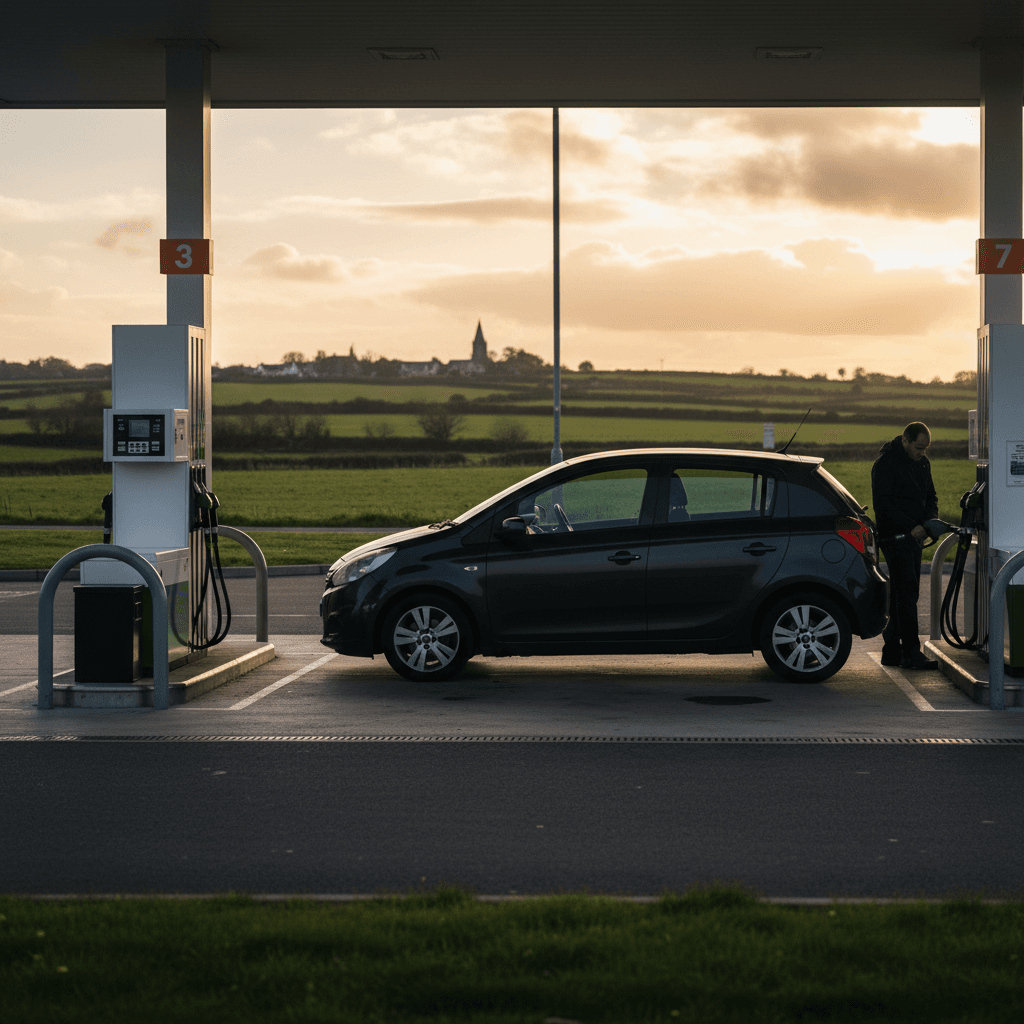
- Budget 2027 is on Tuesday 6 October 2026.
- Temporary fuel excise reductions run to 31 October 2026, then are restored in four steps to the end of February 2027.
- The Government puts the reductions at 27 cent a litre on petrol and 32 cent on diesel.
- A carbon tax increase postponed to 14 October 2026 is undecided. We do not price it in.
- None of this applies in Northern Ireland, which is under UK fuel duty.
If you are pricing an Irish road trip for October half-term, Christmas or next spring, the fuel line in your budget has a scheduled increase built into it. Not a forecast — a published Government timetable.
This page separates the two things people mix up. What is confirmed — dates, and the tax rates Revenue actually publishes. And what is not decided — which is most of what happens on 6 October.
We do not publish a predicted pump price. Nobody can honestly give you one. What we can do is give you the arithmetic and the condition it runs under, so you can put a number on your own trip.
The timetable, as it stands
| Date | What is scheduled | Status |
|---|---|---|
| 31 October 2026 | Current excise reductions expire | Confirmed by Government decision, August 2026 |
| 1 November 2026 | First of four steps restoring excise | Confirmed as a plan; per-step amounts not published |
| 6 October 2026 | Budget 2027 delivered | Confirmed |
| 14 October 2026 | Postponed carbon tax increase falls due | Undecided — Government says no decision made |
| End of February 2027 | Excise fully restored | Confirmed as a plan |
The Government agreed in August 2026 to extend the reductions to the end of October and then unwind them gradually rather than in one jump. The package was reported at about €407 million and also extended the reduced NORA levy to 31 October 2026 and the enhanced Diesel Rebate Scheme for hauliers to the end of December 2026.
Two words matter in that table. Scheduled is not enacted. Excise rates are set by law and can be changed again — they already have been, twice this year. Treat the dates as the Government's stated intention and check back.
What the tax on a litre is today
This is the part that is not a plan. Revenue publishes the rates, and these are the ones in force from 15 April 2026, checked on 29 August 2026.
Mineral Oil Tax, € per 1,000 litres
| Fuel | Non-carbon component | Carbon component | Total |
|---|---|---|---|
| Petrol | €338.58 | €164.30 | €502.88 |
| Auto-diesel | €181.81 | €190.04 | €371.85 |
Per litre that is 50.29 cent on petrol and 37.19 cent on diesel. VAT at 23% then applies to the whole pump price, excise included.
The carbon component is calculated at €71 per tonne of carbon dioxide, the rate in force on auto fuels since 8 October 2025. It works out at 16.43 cent a litre on petrol and 19.00 cent on diesel — the figures above, divided by a thousand.
So on a litre of petrol at the July 2026 national average of €1.75, excise and VAT together come to about 83 cent, or 47% of what you hand over, before the NORA levy is counted. On a €1.73 litre of diesel it is about 70 cent, or 40%.
Where the 27 and 32 cent come from
The Government describes the reductions still in place as worth 27 cent a litre on petrol and 32 cent on diesel. Revenue's own rate tables get you most of the way there and are worth showing, because it is the only part of the figure anyone can check.
Before the reductions, Mineral Oil Tax stood at €706.14 per 1,000 litres on petrol and €615.76 on auto-diesel. Against today's rates that is a cut of 20.33 cent a litre on petrol and 24.39 cent on diesel. Add VAT at 23% and you get exactly 25 cent and 30 cent at the pump. The remaining couple of cent is the NORA levy reduction, which the same package extended.
We are not going to invent a per-step breakdown. The four steps have been announced; the amount restored at each one has not been published, and the figures quoted in press coverage do not agree with each other. When Revenue publishes the rates, this page gets them.
What it does to a week's driving
Here is the conditional, and the condition is doing real work: if the reductions are restored in full as planned, and if nothing else in the pump price moves. Oil markets and the euro will both move. This is the tax component only.
A 1,500 km week — Dublin, Galway, the Cliffs of Moher, Killarney, Cork and back — at 7 litres per 100 km is 105 litres.
| Fuel | Today (AA Ireland, July 2026) | Extra if fully restored |
|---|---|---|
| Petrol at €1.75/litre | €183.75 | +€28.35 |
| Diesel at €1.73/litre | €181.65 | +€33.60 |
On a single 50-litre fill that is €13.50 more for petrol and €16.00 more for diesel.
Two honest caveats. Diesel rentals are usually more efficient than 7 L/100 km — at 5.5 L/100 km the same week is 82.5 litres and the increase is €26.40, not €33.60. And a March 2027 trip is fully on the restored rates; an October 2026 trip is almost entirely on today's. The middle of that window is where a budget needs a margin.
If you want the underlying numbers, the fuel guide has current prices by forecourt type and the budget road trip guide has the rest of the daily spend.
What is not decided
Everything in this section is a decision that has not been made. Nothing here is priced into the figures above.
The carbon tax increase postponed to 14 October 2026. An increase due on 1 May 2026 was postponed to 14 October 2026. In August 2026 the Tánaiste said no decision has been made on whether it proceeds. The Irish Times reports that the postponed increase is the one on home-heating fuels, and that transport fuels took their step last October. Past annual steps on auto fuels have been worth roughly 2 to 2.5 cent a litre. We are not adding that to anything until it happens.
Budget 2027 itself, on 6 October. The Budget sets excise, VAT and motor tax for the year ahead, and it can change the restoration timetable as easily as it set it. It has already been changed once. Nothing in the Budget is knowable before the day.
Whether the restoration completes. The reductions were originally to be restored from September 2026 and were extended instead. That is the second extension this year. A third is a political decision, not a forecast we are going to make.
Northern Ireland: a different tax regime entirely
Irish excise and Irish carbon tax stop at the border. If your drive crosses into Antrim, Armagh, Derry, Down, Fermanagh or Tyrone, none of the timetable above touches the price you pay.
- Fuel in Northern Ireland is priced in pounds per litre, not euro.
- Duty is UK fuel duty, set at Westminster: 52.95 pence per litre on both unleaded petrol and road diesel, in force since 23 March 2022 (HMRC, checked 29 August 2026).
- UK VAT is 20%, not 23%.
- There is no equivalent of the Irish carbon tax on road fuel, and no Irish-style excise restoration scheduled.
Two practical consequences. Fill on whichever side is cheaper on the day — the gap moves with the exchange rate and there is no rule of thumb worth trusting. And if you are budgeting a cross-border week, budget it as two currencies, because it is two tax systems. The fuel guide covers the pump-side practicalities.
Donegal, Cavan and Monaghan are in Ulster but in the Republic. Irish rates apply there in full.
What to actually do about it
- Budget the trip in the window it falls in. Before November, today's prices. March onwards, add the full restoration. December to February, add part of it and leave yourself a margin.
- Add a fuel contingency of about €30 on a week. That is the size of the scheduled change, so it is the size of the mistake if you ignore it.
- Do not pre-buy fuel from a rental company. A pre-paid tank is dearer than the pump on any day of this timetable. The fuel guide explains why full-to-full is the only policy worth taking.
- Check the live price rather than any guide. Pumps.ie for forecourt prices, the AA Ireland monitor for the national average. Both move faster than this page can.
- If you are considering an EV, read the electric vehicle guide first. Public rapid charging is not automatically cheaper than petrol at current rates, and none of the excise timetable applies to electricity.
When this page changes
This page will be updated after Budget 2027 on 6 October 2026, and again as Revenue publishes each restored rate between November 2026 and February 2027.
Everything above was checked on 29 August 2026. If you are reading this after Budget day and the page still says 29 August 2026, treat the forward-looking sections as out of date and go to the sources.
Sources
Rates and dates, from the State and the operator rather than from a summary of them:
- Revenue: Mineral Oil Tax rates — the rates in force from 15 April 2026
- Revenue eBrief No. 078/26 — the April 2026 reductions and the carbon tax postponement to 14 October 2026
- Revenue: Energy Products and Electricity Taxes — Excise Duty Rates — current and previous rates, including the pre-reduction rates used above
- RTÉ, 1 April 2026: Budget to take place on 6 October
- gov.ie: Government announces extension of Excise Rate and NORA Reductions
- AA Ireland fuel price survey, July 2026 — petrol €1.75, diesel €1.73 national average
- HMRC: excise duty hydrocarbon oils rates — the Northern Ireland figures
- The Journal, August 2026: no decision made on the October carbon tax increase
- Irish Times, 27 August 2026: the excise cuts and what happens next
Related Guides
- Fuel in Ireland — prices, pumps, and where to fill cheapest
- Budget Road Trip Tips — the rest of the daily spend
- Electric Vehicle Guide — charging costs, which this timetable does not touch
- Toll Roads and the M50 — the other State charge on a driving day