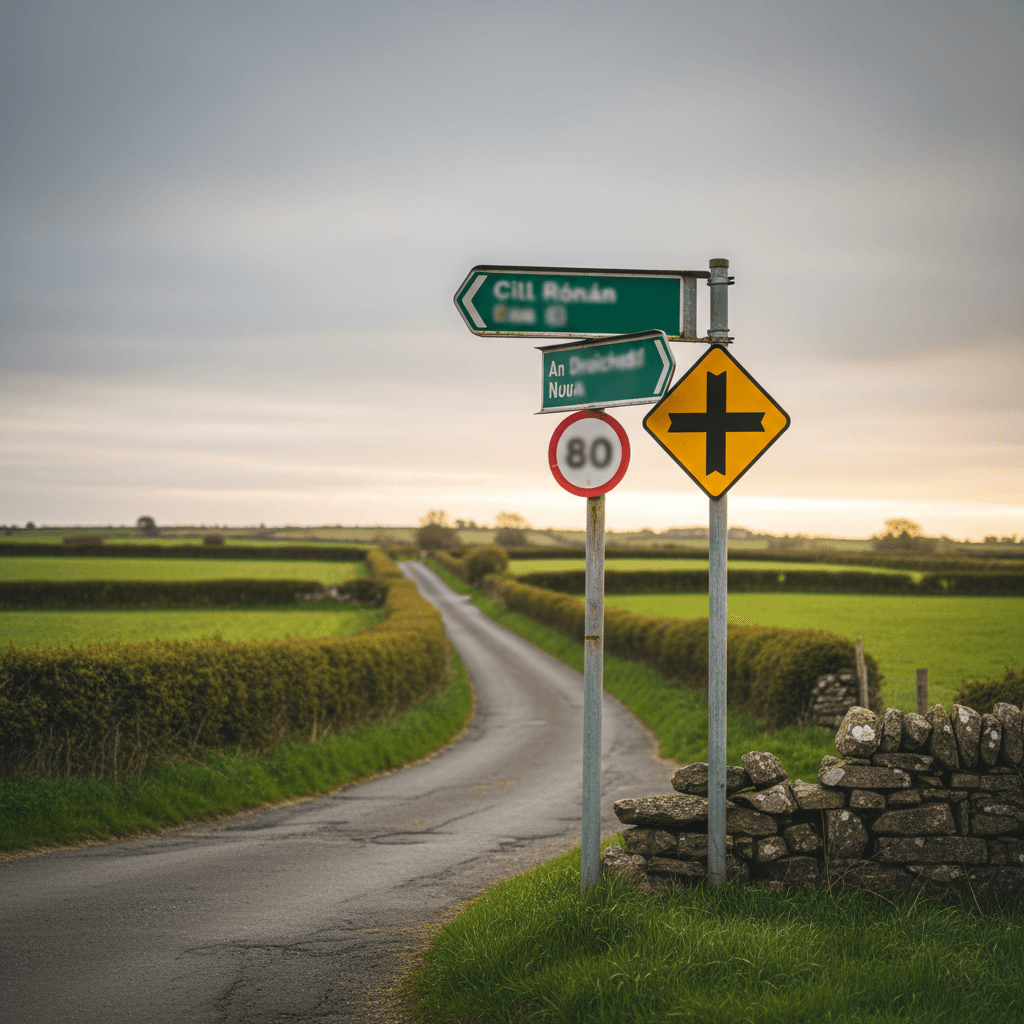
Ireland measures speed in three different ways, and a visitor who only knows about the vans is missing the two that are harder to see coming.
This page is about enforcement — who is measuring, with what, and where. The limits themselves are on the Irish speed limits guide, and what happens after a ticket arrives is on the traffic fines guide. We keep the numbers in one place each rather than repeating them.
Three kinds of speed enforcement, and only one of them is a van
| Type | How many | How it measures you |
|---|---|---|
| GoSafe mobile vans | 1,901 published zones | At a point, from a parked van |
| Static cameras | 9 fixed positions | At a point, always on |
| Average-speed zones | 5 zones | Over a distance, both ends |
On top of those, An Garda Síochána does its own enforcement directly, with handheld and tripod-mounted laser guns, vehicle-mounted Puma equipment in both marked and unmarked cars, and van-mounted radar. That is the part no published list will ever tell you about.
GoSafe vans: how the mobile enforcement contract works
GoSafe is a civilian contractor. It has operated mobile safety cameras on behalf of An Garda Síochána since November 2010, reaching full capacity in March 2011, and it is still the service provider today.
The vans do not roam. They work a defined list of safety camera zones — stretches of road picked from Garda collision data, weighted by whether the collisions there were fatal, serious or minor, with some added at the request of local communities. On 1 January 2026, 390 new zones went live, bringing the national total to 1,901, of which 55 came from community requests.
Two things about those zones are worth knowing before you drive.
The list is public. An Garda Síochána publishes every zone on its own website and makes it available for satnav and mapping providers to download. This is not a secret you have to buy an app to beat. The zones exist to slow traffic at places where people have been killed, and publishing them is the point rather than a leak.
A marked van enforces; an unmarked van does not. Enforcement is done from vans carrying high-visibility reflective markings and a safety camera symbol. An Garda Síochána also runs unmarked vans, but its own description of the contract is explicit that those do survey work — measuring what traffic actually does at a location — and not enforcement. If you are ticketed by a van, it was a van you could have seen.
Static cameras, and not one of them is on a motorway
This is where visitor expectations are furthest from the facts.
The Republic has nine static speed cameras. They were announced in May 2024, funded from the Garda budget at approximately €2.4 million, and every one of them is now operational:
| Road | Where | Live from |
|---|---|---|
| N17 | Mayo, northeast of Claremorris | 13 December 2024 |
| N59 | Galway, between Moycullen and Galway City | 13 December 2024 |
| N13 | Donegal, east of Letterkenny | 20 December 2024 |
| N69 | Limerick, east of Askeaton | 14 March 2025 |
| R772 | Wexford, at Ask near Gorey | 2 May 2025 |
| N22 | Cork, at Farnanes, between Lissarda and Ovens | 2 May 2025 |
| N80 | Carlow, between Barristown and Levitstown | 23 May 2025 |
| N25 | Kilkenny, between Glenmore and Luffany | 30 May 2025 |
| Dublin | Dolphin's Barn, Dublin 12 | 1 August 2025 |
Read that list again. Eight national and regional roads and one city street. No motorway. If your mental model of Irish enforcement is a gantry over the M-road, it is the wrong model — the single-carriageway N roads are where the cameras are, because that is where people die.
A static camera measures your speed at one point on the road, and issues automatically. Their locations are signed.
More are funded. In October 2024 the Minister for Justice announced €9 million under Budget 2025 for up to 100 new speed cameras, with locations to be chosen on the same collision-and-speed data. No locations have been published and no completion date has been announced, so treat the nine above as the current picture and expect it to grow.
Average-speed zones: the one that catches visitors
This is the enforcement type most likely to catch someone who has driven Ireland before, because it does not behave like anything you can slow down for.
How it actually works. There are two camera points, at the entry and the exit of a marked zone. Number-plate recognition records the time, date and location of your car at each. The system divides the distance by the time and that average is what is enforced. An Garda Síochána states it plainly: your speed is not recorded at the cameras themselves.
Two consequences follow, and both catch people:
- Braking for the camera is useless. You can pass both camera points at 70 km/h and still be prosecuted, if you did 140 in between.
- Changing lanes does nothing. All lanes are covered at both ends of the zone. There is no lane the system is not watching, and there are no flashing lights to tell you anything happened.
There are five zones in the Republic as of September 2026:
| Zone | Length | Live since |
|---|---|---|
| Dublin Port Tunnel | 5 km | 2017 |
| M7, Junction 26 (Nenagh West) to Junction 27 (Birdhill), Co. Tipperary | 9 km | 25 April 2022 |
| N5, Lislackagh to Cuilmore, Swinford, Co. Mayo | — | 25 October 2024 |
| N3, Kilduff to Billis, Co. Cavan | — | 25 October 2024 |
| N2, Cullen to Ballymagarvey, Co. Meath | — | 7 March 2025 |
All of them run in both directions. The M7 zone was Ireland's first mainline motorway system of its kind. The N5, N3 and N2 zones each enforce a posted limit of 100 km/h. We have left the lengths of the three most recent zones blank because An Garda Síochána and TII have not published them, and a distance we guessed at would be exactly the kind of number this site exists not to print.
They do catch people. An Garda Síochána reported that in the three years from 2022, over 22,500 fixed charge notices were issued in the M7 zone alone, on a stretch carrying more than 20,000 vehicles a day.
The Dublin Port Tunnel, which enforces its own limit
The tunnel is the oldest average-speed zone in the country and the one most visitors drive without thinking about it, usually on the way to or from the ferry.
The limit in the tunnel is 80 km/h, and it has been average-speed enforced since 2017 across the full 5 km zone. The tunnel carries more than 26,500 vehicles a day and is operated by Egis Road & Tunnel Operation Ireland on TII's behalf.
It works. TII reported that after the system went in, the share of drivers exceeding the 80 km/h limit fell from about 55% to just over 10%.
The toll is a separate matter entirely and is covered on the toll roads guide. Being tolled does not mean you are not also being measured.
What actually reaches you in a hire car
Nothing reaches you at the roadside. Every one of these systems issues automatically, to the registered keeper — which, in a hire car, is the rental company, not you.
What happens next, how long it takes, what the rental company charges for handling it and what you owe, is all on the traffic fines in a hire car guide. That page is the one home for those figures, and we do not repeat them here.
The practical point for this page is only this: there is no moment where a Garda waves you down and you talk your way out of it. You will be back in another country by the time anyone tells you.
Northern Ireland enforces differently, in mph
Cross the border and the whole apparatus changes. Enforcement is run by the Northern Ireland Road Safety Partnership, the limits are in miles per hour, and the penalties are in pounds. Nothing from the Republic carries across.
The Partnership's 2024 annual report — an Official Statistics publication, so the numbers are audited — records the fixed infrastructure as three fixed speed cameras, six fixed red-light cameras and three average-speed camera systems. That is a much smaller fixed network than the Republic's, and the work is done by vans instead: they were deployed 8,017 times in 2024, up 12% on 2023, and mobile cameras accounted for 98% of the 84,004 detections made that year.
The vans work permanently signed locations plus "community concern" sites, and they carry the Partnership's own logo rather than police markings. Operators have been civilian since December 2008.
The difference that matters most is what happens afterwards. In Northern Ireland a driver detected speeding may be offered a speed awareness course instead of penalty points, and more than half take it up: 44,424 of the 83,816 drivers detected for speeding in 2024, or 53%, completed one. There is no equivalent in the Republic. A driver who is used to the northern system and expects the same offer south of the border will not get it.
Current Northern Ireland penalty amounts are published by nidirect, and we do not reproduce them because they change on a different schedule from the Republic's and a stale figure is worse than none.
What "a tolerance" is worth, and why we will not publish a number
You will find a specific tolerance quoted all over the internet: a percentage, or a few km/h, that you supposedly get before anything happens.
Neither An Garda Síochána nor the Road Safety Authority publishes one. There is no State source for a margin, which means every number you see is somebody's inference from anecdote, and repeating it here would be inventing an actionable figure out of nothing.
So we will not. The posted limit is the number. On an average-speed zone in particular the arithmetic is unforgiving: you do not need a tolerance, you need the average, and the average is the whole zone.
And a limit is a maximum rather than a target. On a wet N-road with a bend you cannot see round, the posted number is far more speed than the road can take, and the law still requires a speed appropriate to the conditions.
The short version
- Three systems. 1,901 published GoSafe van zones, nine static cameras, five average-speed zones. Plus Gardaí with laser guns, who publish nothing.
- The zone list is public. An Garda Síochána puts it on its website and hands it to satnav providers.
- The motorways are the least covered part of the network. No static camera is on one. Do not assume the opposite.
- Average-speed zones cannot be outrun by braking. Two points, one average, all lanes, no lights.
- The tunnel is 80 km/h and has been average-speed enforced since 2017.
- Northern Ireland is a different system in mph, with a speed awareness course the Republic does not offer.
- There is no published tolerance. Drive the sign.
Sources
Checked for this page in September 2026:
- An Garda Síochána, "Mobile Safety Camera System Expansion 2026" (December 2025) — the 390 new zones, the 1,901 total from 1 January 2026, the 55 community request zones, and the GoSafe contract history.
- An Garda Síochána, "Safety Camera Network" — the marked-versus-unmarked van distinction, and the list of Garda-operated speed detection equipment.
- An Garda Síochána, "Static Safety Camera Detection" — the nine static camera locations and the date each became operational.
- An Garda Síochána, "An Garda Síochána Announces Locations of Nine Static Speed Safety Cameras" (May 2024) — the €2.4 million cost and the selection criteria.
- An Garda Síochána, "Average Safety Cameras Operational on N5 Co. Mayo and N3 Co. Cavan" (October 2024) — the N5 and N3 extents, the ANPR mechanism, the M7 9 km figure and the M7 fixed charge notice count.
- An Garda Síochána, "Average Speed Safety Cameras Operational on N2 from Friday, 7th March 2025" — the N2 extent and go-live date.
- Transport Infrastructure Ireland press releases on the M7 and Dublin Tunnel average speed camera systems — the M7 go-live of 25 April 2022, and the fall in tunnel speeding from about 55% to just over 10%.
- Dublin Tunnel (Egis Road & Tunnel Operation Ireland), speed enforcement page — the 80 km/h limit and the enforcement mechanism.
- gov.ie, Department of Justice, "Minister McEntee announces €9 million in funding for up to 100 new speed cameras" (October 2024) — the Budget 2025 allocation and the National Road Safety Camera Strategy.
- Northern Ireland Road Safety Partnership, 2024 Annual Report, published 18 June 2025 — the NI camera counts, the 8,017 van deployments, the 84,004 detections and the speed awareness course figures.
We did not take a penalty amount from any of them. For current fines and penalty points see the Road Safety Authority and An Garda Síochána in the Republic, and nidirect in Northern Ireland.
For the rest of the practical picture:
- Speed Limits in Ireland — what the numbers are
- Traffic Fines in a Hire Car — what arrives afterwards
- Best Navigation Apps for Ireland — which app warns you, and where it stops working
- Irish Driving Rules — the rest of the Rules of the Road
- Toll Roads & the M50 — the tunnel's other charge