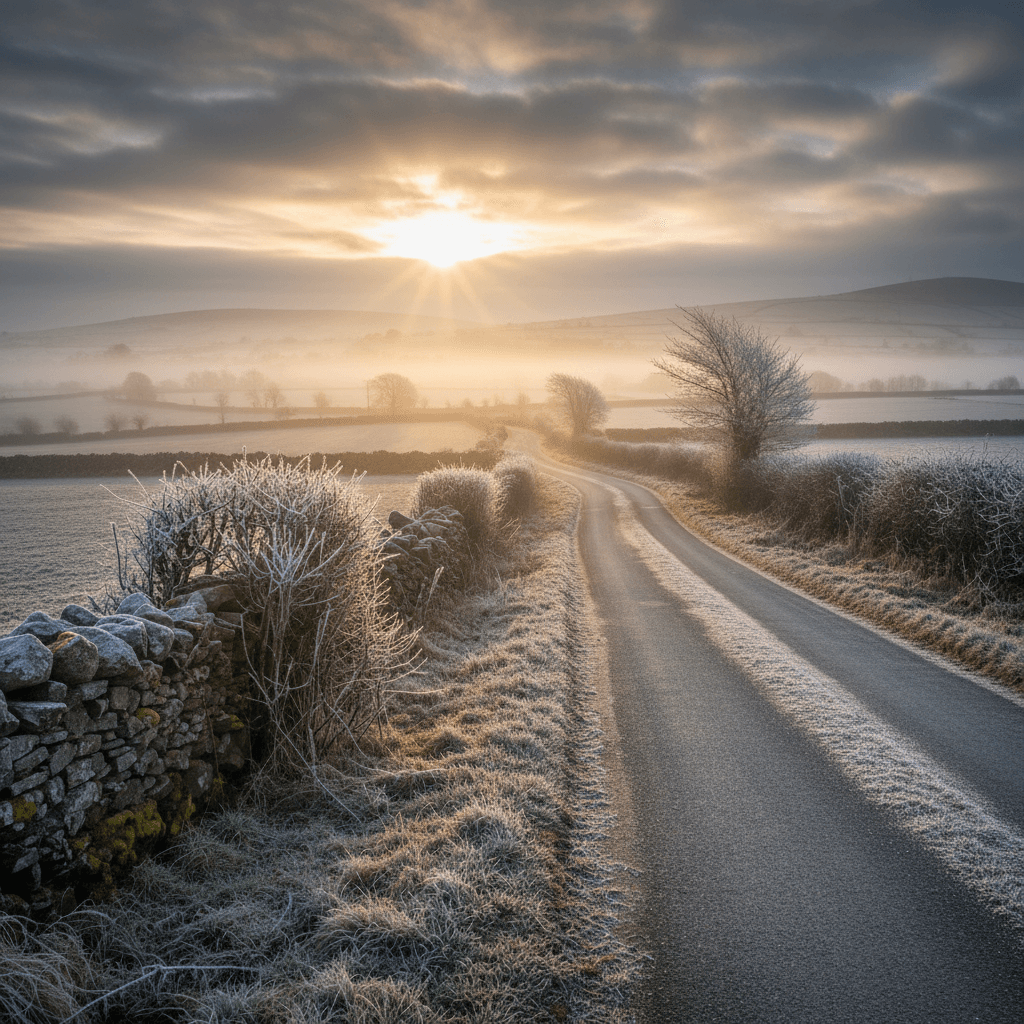
You land at Shannon in the early evening in late November. The hire desk takes forty minutes. By the time you reach the car park it is dark, and your hotel is two hours away down roads you have never seen, in a car you have never driven, on the left.
That is the situation this page is for. It covers what Irish law says about lights, what an unlit country road is actually like, and why the speed limit tells you very little after dark. Where we quote the law we give the instrument and the month we checked it. We have not driven these roads at night for this page. The practical advice is general guidance, not a test report.
When your lights have to be on, by law
In the Republic the rule is in the Road Traffic (Lighting of Vehicles) Regulations 1963, S.I. No. 189 of 1963. It defines the key term like this:
"lighting-up hours" means the period commencing one half-hour after sunset on any day and expiring one half-hour before sunrise on the next day
Article 20 then sets the rule for headlights:
Where a vehicle to which this Part of these Regulations applies is being driven in a public place during lighting-up hours, the head lamps with which the vehicle is required to be equipped under these Regulations shall be shown duly lit.
So: half an hour after sunset, headlights on. Half an hour before sunrise, they can go off.
Three exceptions sit in the same article. Headlights need not be lit for a reasonable period at the start or end of lighting-up hours if visibility is adequate, while you are stopped in traffic, or in good visibility on a road with continuous street lighting where a speed limit applies. None of those helps you on a dark country road.
Daytime counts too. The same article requires headlights in the day "when, due to failing light or atmospheric conditions visibility is so reduced as to render the use of the head lamps necessary for safe driving." Heavy rain, fog or a dark winter afternoon can bring you under that rule. It does not wait for sunset.
Fog lamps are for fog. Article 49 says a fog lamp "shall be used only in fog or while snow is falling." A rear fog light left on in clear weather dazzles the driver behind you.
Quoted from S.I. No. 189/1963 on the Irish Statute Book, checked October 2026. We checked the instrument's amendment listing in the Legislation Directory at the same time. The 1963 regulations have been amended many times, but none of the listed amendments changes the definition of lighting-up hours, the headlight rule in Article 20, or the dipping rule quoted below.
What an unlit Irish road is actually like
Motorways and most national roads are marked, signed and wide enough to forgive a mistake. Once you leave them, three things change at once.
- There is no light but yours. Most rural regional and local roads have no street lighting at all. Away from towns the dark is complete.
- The edges disappear. Many local roads have no edge line and no centre line. Hedgerows and stone walls run right to the tarmac, and there is often no verge to drift onto.
- Bends arrive without warning. On a narrow road between hedges your headlights light the hedge, not the road beyond the bend. You see the turn when you are already in it.
Add a car you do not know and a lane on the left that still feels wrong, and an hour of this is far more tiring than an hour on a motorway. Plan for that. A route that looks like a short evening hop on a map is often the hardest driving of the day.
The 60 km/h sign, at night
Most rural local roads show a white circle with five diagonal black lines across it and no number. It means 60 km/h. That has been the limit since 7 February 2025, when it came down from 80 km/h. Our speed limits guide has the full table and the background.
At night that number is a ceiling, not a target. A simple test is to ask whether you could stop within the distance your headlights show you. On a lane with high hedges and a bend every hundred metres, the honest answer at 60 km/h is often no. Drive at the speed that lets you stop in the lit part of the road, even if that is half the limit.
Local drivers will know the road and may drive it faster. Let them past at the next safe gap. You do not have to keep up, and on a narrow road a car close behind you is a reason to pull in, not to speed up.
Dipped versus full beam, and the bit that catches hire-car drivers
On an unlit road with nobody ahead of you, use full beam. The 1963 regulations say headlamps "shall not be dipped whenever the driver's field of vision would thereby be rendered so insufficient, having regard to the speed of the vehicle, as to be likely to cause danger."
Article 49 then sets out when you must dip. In short:
- in good time before you meet an oncoming vehicle;
- when you are travelling close behind another vehicle, except while overtaking;
- in good visibility on a road with continuous street lighting;
- in dense fog or falling snow, where full beam reflects back at you.
That last point matches our winter driving guide: in fog, dipped headlights, not full beam.
Find the controls before you leave the car park. This is the part that catches visitors. In an unfamiliar car, the light switch may be a stalk, a dial on the dashboard, or an "Auto" setting that decides for you. Do not find out on the first bend. Before you drive off:
- Find how to switch between dipped and full beam, and back.
- Find the rear fog light switch, so you can turn it off as well as on.
- Check the dashboard symbols. The dipped-beam symbol is usually green and the full-beam symbol usually blue.
- Do not assume daytime running lights are headlights. If you are not sure, switch to dipped beam manually rather than trusting the "Auto" setting.
Our left-hand driving guide covers the rest of the car-park routine for a right-hand-drive car.
How short the day gets
Ireland sits between roughly 51° and 55° north. In December that means a short day, and an afternoon drive that starts in daylight often ends in the dark.
We have not printed sunrise and sunset times on this page. We could not reach a primary source for a table when we wrote it, and an unsourced time is worse than none. Two things hold true without one:
- The west is later than the east. On any given day the sun rises and sets later in Galway or Mayo than in Dublin. A drive west in the afternoon gains a little light. A drive east loses it.
- The north has the shortest winter days. Donegal and Antrim get less December daylight than Cork and Kerry.
For planning, look up sunset for your date and your destination, then work back. Our winter driving guide has a month-by-month daylight table and a plan for short days.
Pedestrians, cyclists and animals you will not see coming
Many rural roads have no footpath. People walk on the road itself, often in dark clothes, and cyclists may be poorly lit. Expect them near every village, pub and church, especially on a winter evening.
Animals are the other surprise. On open mountain and bog roads, such as the Sally Gap on the Wicklow Mountains route or much of Connemara, sheep graze unfenced and wander onto the road. Deer cross roads in wooded areas. Cattle are sometimes moved along local roads.
We do not have a sourced figure for how often these collisions happen, so we do not give one. The practical advice is the same as for bends: drive at a speed that lets you stop in what you can see, and slow right down when you see eyes in your headlights.
Tiredness
Driving in the dark is tiring, and a first night after a long flight is the worst case. We have no sourced statistic on tiredness and collisions to print here, so here is the advice instead. It comes from rule 91 of the Highway Code for Northern Ireland, published on nidirect. The same body clock applies south of the border.
- Do not start a journey tired.
- Avoid long journeys between midnight and 6am, "when natural alertness is at a minimum".
- Take a break of at least 15 minutes after every two hours of driving.
- If you feel sleepy, stop somewhere safe. The rule names two cups of caffeinated coffee and a short nap of up to 15 minutes as the most effective counters.
That matches the two-hour break advice in our solo travel guide.
Rule 91 quoted from nidirect, checked October 2026.
Northern Ireland: hours of darkness, mph, and its own regulations
Northern Ireland has its own lighting law: the Road Vehicles Lighting Regulations (Northern Ireland) 2000, S.R. 2000 No. 169. Read it as its own rule, not as a copy of the Republic's.
Its key term is "hours of darkness", not "lighting-up hours". Regulation 2 defines it as:
the time between half an hour after sunset and half an hour before sunrise
Regulation 28 requires dipped-beam headlamps to be kept lit "during the hours of darkness" and "in seriously reduced visibility".
nidirect's advice for visitors sums up the rule as follows. You must use:
- sidelights between sunset and sunrise;
- headlights at night, between half an hour after sunset and half an hour before sunrise;
- headlights when visibility is seriously reduced, which nidirect describes as "generally to less than 100m".
The Highway Code for Northern Ireland adds that you should keep your headlights dipped when overtaking until you are level with the other vehicle, and then change to main beam if necessary, unless it would dazzle oncoming traffic.
Speeds change at the border. Northern Ireland's Department for Infrastructure has authorised a "Welcome to Northern Ireland" sign stating that speed limits are in miles per hour for eight main roads in, but on a minor crossing, and in the dark, the first mph limit sign may be your only clue. For a car, nidirect gives these limits:
| Road | Limit |
|---|---|
| Built-up areas | 30 mph |
| Single carriageway | 60 mph |
| Dual carriageway | 70 mph |
| Motorway | 70 mph |
The 30 mph limit usually applies on roads with street lighting unless signs say otherwise. On a dark, narrow road in the Glens of Antrim or Fermanagh, 60 mph is no more a target than 60 km/h is in Kerry. Your hire car's speedometer shows both scales. North of the border, read the mph one.
Checked against legislation.gov.uk and nidirect in October 2026.
When not to drive at night at all
Some drives are better left until morning. Our advice:
- Your first night. If you land in the afternoon in winter, book the first night near the airport. Collect the car the next morning, or drive only on the motorway to a nearby town. This is the advice our solo travel guide gives too: avoid rural night driving early in the trip.
- Mountain passes. A road like the Conor Pass on the Dingle Peninsula or the Sally Gap in Wicklow is narrow, high and unlit. You will see nothing of the view and all of the drop. Drive it in daylight or not at all.
- Fog after dark. Fog and darkness together leave you with almost nothing to steer by. If fog is forecast for the evening, stop early. Our weather warnings guide explains what Met Éireann's fog warnings mean for drivers.
- Making up time. If the day has run late, shorten the plan, not the night. The last hour of a long day, in the dark, on a road you do not know, is where a holiday drive goes wrong.
Sources
Checked for this page in October 2026:
- Road Traffic (Lighting of Vehicles) Regulations 1963, S.I. No. 189/1963 — Irish Statute Book, https://www.irishstatutebook.ie/eli/1963/si/189/made/en/print. Definition of lighting-up hours (Article 3), headlight rule (Article 20), dipping and fog lamp rules (Article 49). Amendment listing checked in the Legislation Directory for 1963 statutory instruments.
- Road Vehicles Lighting Regulations (Northern Ireland) 2000, S.R. 2000 No. 169 — legislation.gov.uk, https://www.legislation.gov.uk/nisr/2000/169. Definition of hours of darkness (regulation 2) and the headlamp rule (regulation 28).
- nidirect, "Driving in Northern Ireland: road safety for visitors" — the sidelight and headlight summary.
- nidirect, "Speed limits and penalties for breaking them" — the Northern Ireland limits for cars.
- nidirect, Highway Code for Northern Ireland, rules 89 to 102 (rule 91, tiredness) and rules 103 to 158 (rule 115, lights).
The 60 km/h rural limit is sourced on our speed limits guide. The Road Safety Authority is the primary source for driver fatigue and night-time collision figures in the Republic, but its website could not be reached when this page was written, so this page carries no such figure.