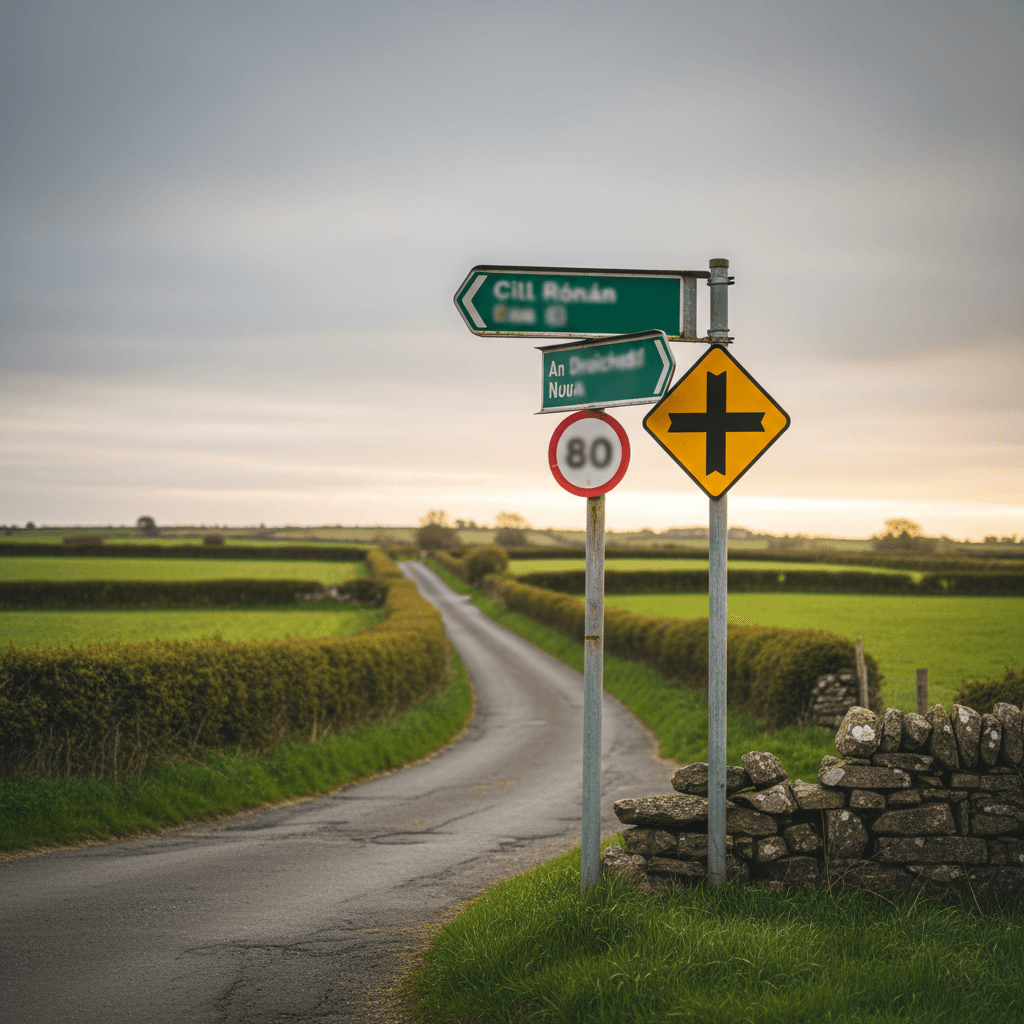
- Republic: 50mg per 100ml of blood if you hold a full licence, 20mg if you are a learner, passed your test inside two years, or are driving professionally.
- Northern Ireland: 80mg. Higher, unchanged, and nothing at the border tells you.
- The low bands can be settled by notice: €200 or €400. Both come with a disqualification — 3 months or 6 months. Paying is accepting the ban.
- Above 100mg it is the District Court. Maximum €5,000 or six months, and a mandatory ban of at least two years on a first offence — three if you are over 150mg.
- Refusing the test is an offence in its own right, with the same maximum penalty as being over the limit.
- A disqualification crosses the border; penalty points do not. A ban imposed in one jurisdiction is recognised in the other.
A driver who is legal in Newry is over the limit in Dundalk. Nothing on the road tells you the alcohol limit has changed — no barrier, no checkpoint. The "Welcome to Northern Ireland" sign that the Department for Infrastructure has authorised for eight main roads in says speed limits are in miles per hour; it says nothing about drink. Otherwise it is the speed limits switching between mph and km/h and a different colour of line paint. This page is the two sets of numbers, what happens if you are over either of them, and where the change actually bites.
The limits: 50mg, and 20mg if you are a learner, novice or professional
Section 4 of the Road Traffic Act 2010, as amended, sets two limits in the Republic rather than one. Which applies to you depends on your licence, not on your car.
| Blood | Urine | Breath | |
|---|---|---|---|
| Fully licensed driver | 50 mg per 100 ml | 67 mg per 100 ml | 22 µg per 100 ml |
| Learner, novice, professional | 20 mg per 100 ml | 27 mg per 100 ml | 9 µg per 100 ml |
The Act calls the lower group specified persons, and the definition in section 3 is wider than most visitors expect. It covers the holder of a learner permit; the holder of a first driving licence within two years of its issue; anyone driving a bus, lorry, minibus or trailer category; a licensed taxi driver while working; and anyone driving a category they are not licensed for.
That second one is the trap for a visitor. If you passed your test less than two years ago, the number that applies to you is 20 mg, not 50 mg — a threshold low enough that a single drink can reach it. The RSA states the same two figures on the page it writes specifically for tourists.
Northern Ireland has one limit and it is higher. More on that below, because it is the part that matters most on a cross-border drive.
(Sources: Road Traffic Act 2010, sections 3 and 4, as revised by the Law Reform Commission; and the Road Safety Authority's information for tourists. Checked September 2026.)
What "50mg" is in drinks, and why nobody can tell you
There is no conversion, and no State body on this island publishes one.
nidirect states it directly: it is impossible to say exactly how many drinks the limit equals, "as it is different for each person." The RSA's drink-driving campaign material does not publish a driving equivalence either — it points people to the HSE's standard-drink guidance, which is about weekly health limits rather than about being fit to drive.
Every plausible-looking "two pints for a man" table you find online is somebody's guess dressed as arithmetic. Body mass, sex, what you ate, how fast you drank and how long ago all move the answer, and none of them is on the intoxilyser printout. We are not going to publish a number here, because there isn't one to publish.
The practical consequence is not moral, it is logistical. If your route includes a distillery tour, a brewery, or a long lunch, the drinking and the driving have to be different people, or different days.
What happens if you are over: the fixed charge route
The two lowest bands in the Republic can be disposed of by a fixed penalty notice instead of a court appearance. Section 29 of the Road Traffic Act 2010 sets the amounts. What changed in 2018 is what the notice costs you: the Road Traffic (Amendment) Act 2018 replaced the three penalty points that the lowest band used to carry with a three-month disqualification.
| Concentration in blood | Fine | Disqualification |
|---|---|---|
| Up to 80 mg per 100 ml | €200 | 3 months |
| Over 80 mg, up to 100 mg | €400 | 6 months |
In urine and breath the same bands read: up to 107 mg / up to 35 µg for the first row, and over 107 up to 135 mg / over 35 up to 44 µg for the second.
Two things about the table are not obvious.
The second band is only available to a fully licensed driver. Section 29(2) caps the notice route for a learner, novice or professional driver at 80 mg. Over that, a specified person goes to court.
Paying does not keep your licence. This is the point that gets misread more than any other on the subject. The notice states the charge and the disqualification, and section 29(8) makes the ban follow from payment. You are buying your way out of a court appearance and a conviction, not out of the ban.
The conditions, and the clock
- 28 days to pay, running from the date on the notice.
- You must hold a driving licence in force at the time of the offence and not already be disqualified. If you do not, you are not eligible and the matter goes to court.
- You must not have paid a fixed penalty notice for a similar offence in the previous three years.
- Paying when you know you are ineligible is itself an offence, carrying a fine of up to €5,000 or a month's imprisonment.
What it means if your licence was issued abroad
The Act contemplates this directly and the answer is not comfortable. After payment, the Minister issues a notice stating that the disqualification begins 14 days later, and directing you to submit your licence — to the licensing authority in the case of an Irish licence, or "to such place as specified in the notice, in the case of a foreign driving licence." Not complying with that direction is a separate offence with a fine of up to €2,000.
This is a different process from the ordinary Fixed Charge Notice for speeding or a phone, which reaches you through the rental company and carries penalty points. A drink-driving fixed penalty notice is served on the driver, and carries a disqualification rather than points. Our guide to traffic fines in a hire car covers the ordinary notice, the 28 + 28 day clock and the administration fee, and it is worth reading for the contrast rather than as the same machinery.
(Source: Road Traffic Act 2010, section 29, as revised, cross-checked against Citizens Information's drink and drug driving page. Checked September 2026.)
What happens if you are well over: court
Above 100 mg — or in the lower bands where you are not eligible for a notice — the matter goes to the District Court, and the outcome is not discretionary in the way people assume. Every drink-driving conviction carries a mandatory disqualification.
| Concentration in blood | First offence | Second offence |
|---|---|---|
| Up to 80 mg per 100 ml | 6 months | 1 year |
| Over 80 mg, up to 100 mg | 1 year | 2 years |
| Over 100 mg, up to 150 mg | 2 years | 4 years |
| Over 150 mg | 3 years | 6 years |
Those are minimum periods. The judge may go longer.
The separate offence of being under the influence of an intoxicant to the point of being incapable of proper control of the vehicle — the charge used where no specimen figure exists — carries a minimum disqualification of 4 years on a first offence and 6 years on a second.
The maximum penalty for a drink-driving offence is a fine of up to €5,000, imprisonment for up to six months, or both.
Refusing to provide a specimen is not a way out. It is an offence in itself, carrying the same maximum penalty — up to €5,000, up to six months, or both. The practical effect of refusing is that you face the harder charge without the mitigation of a low reading.
(Sources: Road Traffic Act 2010 as revised, sections 4 and 65 and the associated disqualification table, cross-checked against Citizens Information. Checked September 2026.)
Northern Ireland is 80mg, and no border sign tells you
Northern Ireland is a different legal system with a different number, and it is higher, not lower.
| Republic | Northern Ireland | |
|---|---|---|
| Blood | 50 mg per 100 ml (20 mg for new and professional drivers) | 80 mg per 100 ml |
| Urine | 67 mg per 100 ml (27 mg) | 107 mg per 100 ml |
| Breath | 22 µg per 100 ml (9 µg) | 35 µg per 100 ml |
| Lower limit for new drivers | Yes, 20 mg | No |
| Fixed-penalty route | Yes, for the two lowest bands | No — court |
| Fines in | euro | pounds sterling |
So the same driver, the same drink, two legal answers. A reading of 60 mg is under the limit in Newry and an offence in Dundalk, and the A1 becomes the N1 in between with nothing on the road that mentions alcohol.
The change that was legislated and never happened
You will find a lot of writing online saying Northern Ireland's limit is 50 mg, or is about to be. It is not, and it is worth being precise about why.
The Road Traffic (Amendment) Act (Northern Ireland) 2016 does contain the lower limits — section 2 would insert a 50 mg limit and a 20 mg limit for learner, novice and professional drivers, in the same shape as the Republic's. But section 26 of that Act provides that it comes into operation only on a day appointed by order of the Department, and no such order has been made for the drink-driving Part. legislation.gov.uk marks section 2 as prospective: a provision that "has never come into force."
That is not a technicality about an abandoned Act, either — the rest of the same Act is being switched on around it. The learner and new-driver Part is commenced by S.R. 2026/125 with effect from 1 October 2026, which is the Graduated Driver Licensing change covered in our driving rules guide. The drink-driving Part sat still while that one moved.
The limit in Northern Ireland today is 80 mg. We are not going to write "will change in 2027" without a commencement order to point at.
The penalties in the north
There is no fixed penalty notice for drink driving in Northern Ireland. The graduated fixed-penalty scheme is in sections 7 to 11 of the same uncommenced Part, and nidirect's own penalties page describes every outcome as one decided by a District Judge. If you are over the limit in the north, you are going to court.
nidirect states the penalties as:
- Driving or attempting to drive over the limit, or unfit through drink or drugs — up to six months' imprisonment, a fine of up to £5,000, a ban of at least 12 months (three years if convicted twice in ten years), and a driving test before your licence is returned.
- Refusing to give a specimen — up to six months' imprisonment, up to £5,000, and a ban of at least 12 months.
- Being in charge of a vehicle while over the limit — up to three months' imprisonment and a fine of up to £2,500.
- Causing death or grievous bodily injury by careless driving under the influence — up to 14 years' imprisonment, an unlimited fine, a ban of at least two years, and an extended test.
Note the shape of that first one against the Republic's. For driving or attempting to drive over the limit, the minimum ban in Northern Ireland is twelve months, where the Republic's lowest band on the notice route is three.
A ban follows you across
The one thing that does travel is the disqualification itself. As we set out in the traffic fines guide, the RSA states that penalty points are not transferred between Ireland and the UK, but that disqualifications are mutually recognised — and drink driving and refusing to provide a specimen are both on the list of offences that arrangement covers. Being banned on one side of the border is not a clean licence on the other.
(Sources: nidirect's drink driving and drink driving penalties pages; the Road Traffic (Amendment) Act (Northern Ireland) 2016, sections 2, 7 and 26, on legislation.gov.uk, which records section 2 as up to date with all changes in force on or before 8 September 2026. Checked September 2026.)
Checkpoints, refusing a test, and the morning after
Checkpoints. An Garda Síochána can require a breath specimen from any driver stopped at a mandatory alcohol testing checkpoint without having formed any opinion about that driver first. The checkpoint must be authorised in writing by a Garda Inspector or higher, and it can be anywhere public — a main road, outside a venue, a rural junction on a Sunday morning. The RSA says the same thing in one line on its tourist page: the Gardaí "have powers to set up random breath-test checkpoints."
What the law does not permit is pulling a car out of moving traffic purely to breathalyse the driver at random. But once you have been stopped for any road traffic reason at all, or have been involved in a collision, the power applies — so the distinction is smaller in practice than it looks on paper.
Refusing. Failing or refusing to provide a specimen of breath, blood or urine is an offence on both sides of the border, with the same maximum penalty as being over the limit. In the Republic that is up to €5,000, up to six months, or both. Contacting a solicitor does not suspend the requirement to provide the specimen.
The morning after. This is the one that catches road-trippers rather than night-drivers, because a road trip has an early start in it. nidirect puts it as well as anyone: you may be over the legal limit many hours after your last drink "even if you have slept all night," and "sleep, breakfast, coffee or a cold shower will not sober you up — only time will reduce the alcohol in your body."
If the plan is a long evening in a pub in Dingle and a 9am departure for the Conor Pass, the plan is wrong.
(Sources: Citizens Information on drink and drug driving; the RSA's information for tourists; nidirect. Checked September 2026.)
What it does to your hire car and your cover
Two separate questions, and we can answer one of them with a source.
Can you rent a car at all after a drink-driving conviction? Yes, eventually, and the delay is longer than people expect. Irish Car Rentals publishes a driving-record table in its terms setting out which endorsements it will accept. Driving or attempting to drive under the influence of drugs or alcohol is "acceptable after 3 years from date of offence," with only one such endorsement allowed. Failing to provide a specimen is the same three years. Causing death through careless driving when unfit through drink or drugs is five. That is one operator's published table and not an industry rule — every company sets its own — but it tells you the order of magnitude: a drink-driving endorsement is a years-long problem rather than a months-long one, and it is declared at booking rather than discovered at the desk. Check the acceptance criteria of the company you are booking with before you pay.
Does being over the limit void your cover? We are not going to pretend to more precision than we have. We could not find an Irish rental operator that publishes that clause on an open terms page, so we are not quoting one and we are not going to assert a general rule from nothing. What we can tell you is where the answer is, and it is a document you already have: the exclusions section of your own rental agreement, which is where a collision damage waiver is voided by driving in breach of the agreement, and the policy wording of any separate excess policy you bought. Read both before you collect the car. Our car hire insurance guide explains what the waiver actually is and what the excess means, which is the context you need to read that clause in.
The cross-border version has a second layer. Driving a car hired in the Republic into Northern Ireland is a named condition on the rental agreement, not something to assume — and a driver whose cover is already in question for one reason does not want to find a second reason attached to it.
The only safe rule on a road trip
The numbers on this page describe a legal threshold, not a target, and the honest summary is that they are close enough to zero that nobody can plan around them.
Decide who is driving before the first drink, and let that person have none. Many Irish distilleries and breweries will hand a driver a sealed sample to take away instead of a tasting, and the food and drink theme pages are built on the assumption that somebody in the car is staying dry.
For the rest of the rules of the road, north and south, see the Irish driving rules guide and the speed limits guide.