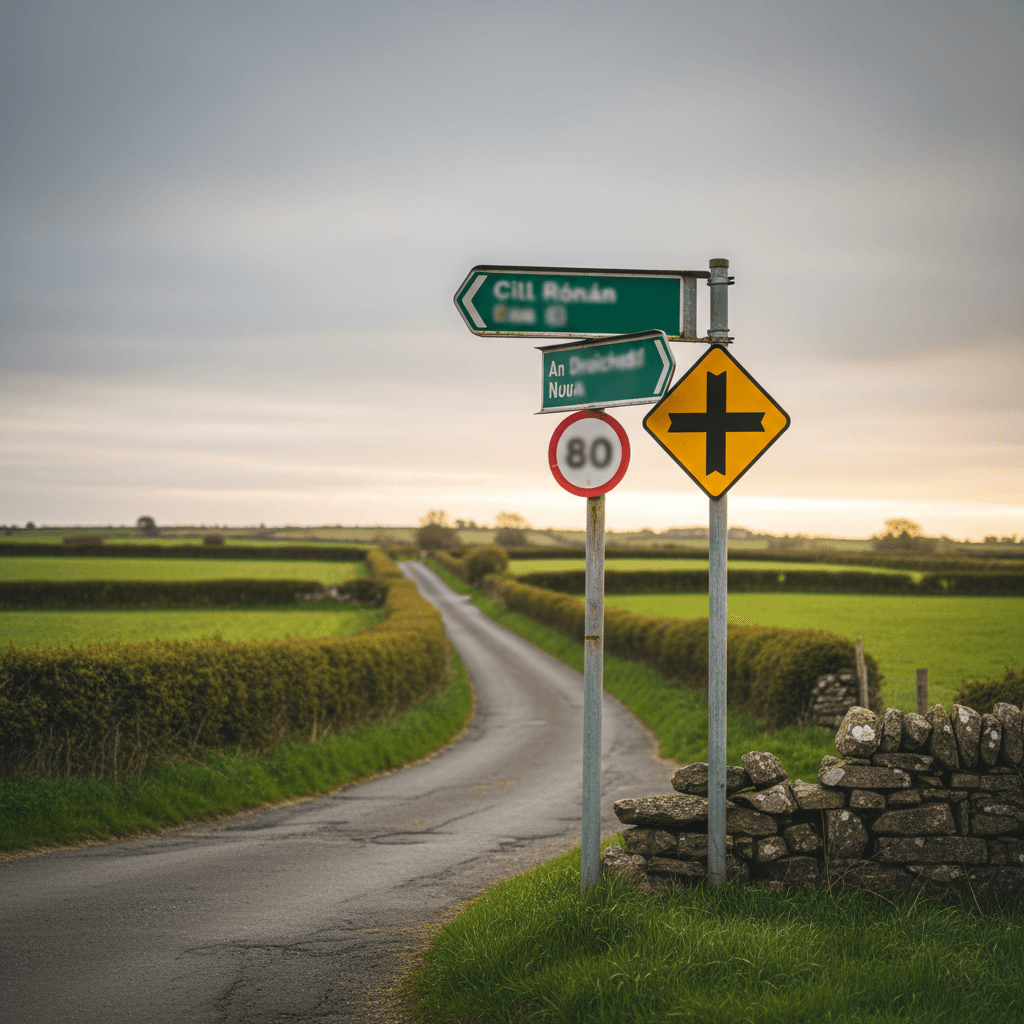
- The Republic and Northern Ireland run two separate schemes: the Disabled Persons Parking Permit in the Republic, the Blue Badge in Northern Ireland.
- The Republic recognises permits from any other State that show the wheelchair symbol. That includes the UK Blue Badge.
- Northern Ireland's law recognises the Republic's permit. We could not confirm from a primary source whether it recognises badges from other countries.
- Wherever you are, the local rules apply, not the rules of the place that issued your badge.
- The toll exemption is for the vehicle, under the Revenue scheme. A parking permit does not give you one.
- Hand controls are available on hire with notice. Enterprise quotes 48 hours. Automatic cars are the scarcer booking in Ireland, so book early.
If you travel with a disability, the questions that decide your trip are practical ones. Will my parking badge be honoured? Does it still work after I cross the border? Can I hire a car I can actually drive? Am I exempt from the tolls?
Ireland gives two different answers to most of these, because the island has two jurisdictions. The Republic and Northern Ireland run separate parking schemes, under separate laws, in different currencies. This guide takes them one at a time and says plainly where the two meet.
Everything here comes from the issuing bodies and the law itself — the Irish Wheelchair Association, the Disabled Drivers Association of Ireland, the Department of Transport, the Irish Statute Book, TII and the toll exemption scheme, Revenue, nidirect and legislation.gov.uk — checked in October 2026. Where we could not confirm something from a primary source, we say so.
The Republic: the Disabled Persons Parking Permit
Who issues it
The permit is issued by two bodies: the Irish Wheelchair Association (IWA) and the Disabled Drivers Association of Ireland (DDAI). The Department of Transport names both. You apply to one of them, not to a council.
Who can get one
You must be resident in Ireland. The DDAI says permits are issued to people resident here, whatever their citizenship. A visitor cannot apply. If you are visiting, you use your own country's badge — see the recognition section below.
To qualify, you need one of these:
- a permanent condition or disability that severely restricts your ability to walk, certified by your GP
- a Primary Medical Certificate
- to be registered blind
The IWA says the card is generally not issued to children under three.
Cost and how long it takes
The DDAI charges €35 for a permit, and it is valid for two years. Checked October 2026. The DDAI says first-time applications are taking up to six weeks, and renewals up to five working days plus postage. The IWA does not publish its first-issue fee or a processing time on the pages we read.
What it lets you do
According to the DDAI, in the Republic the permit lets you park:
- in designated on-street disabled bays
- in parking-meter and disc-parking areas free of charge, unless signs say otherwise
- without a time limit, except where the local council sets one
It does not let you park in bus lanes, loading bays, clearways or other restricted areas. The IWA adds single and double yellow lines to that list.
Private car parks — hospitals, airports, shopping centres — set their own terms. The DDAI warns that you may be charged there.
Fines for misuse
The DDAI gives the fine for parking in a disabled bay without a permit as €150, rising to €225 after 28 days. Misusing a permit is €200, rising to €300. Checked October 2026.
Northern Ireland: the Blue Badge
Northern Ireland runs the Blue Badge scheme. It is a different scheme from the Republic's permit, with different rules.
Who issues it
The Department for Infrastructure's Blue Badge Unit issues it. nidirect says the scheme applies to Northern Ireland residents only.
Cost and how long it takes
The badge costs £10 and lasts up to three years. nidirect says you get a decision within six to eight weeks. Checked October 2026.
What it lets you do in Northern Ireland
nidirect sets out the rules:
- On-street disabled bays: free and without a time limit, unless signs say otherwise.
- On-street pay-and-display: free and without a time limit, unless a local traffic order sets a limit.
- Yellow lines: up to three hours, if it is safe, but not within 15 metres of a junction or where there are loading restrictions.
- Council off-street car parks that charge: the Blue Badge does not give you free parking.
- Misuse: a fine of up to £1,000.
Northern Ireland does not require a parking clock. nidirect notes that England and Wales do in some cases, so if you have driven over from Britain, that rule does not follow you here.
All figures checked against nidirect in October 2026.
Crossing the border, and visiting from abroad
This is the part of the trip where a wrong assumption gets you a fine. The answer is not the same in both directions, so we give each one separately.
Your permit in the Republic
Recognised, if it shows the wheelchair symbol. The Road Traffic (Traffic and Parking) Regulations 1997 recognise permits issued by "an authority of any other State", provided the permit shows the pictorial symbol of a person sitting in a wheelchair. The Department of Transport says the same. The DDAI tells holiday visitors it will recognise their badge here.
That covers a Northern Ireland or UK Blue Badge. The UK government's own table of where the Blue Badge is recognised lists Ireland as yes.
It also covers an EU parking card or another country's permit, as long as it carries the wheelchair symbol.
Once you are in the Republic, you park by the Republic's rules — the list above — not your home rules.
The Republic's permit in Northern Ireland
Recognised. The Disabled Persons (Badges for Motor Vehicles) (Amendment) Regulations (Northern Ireland) 2010 define a recognised badge as a disabled person's parking permit granted in Ireland under the 1997 Irish regulations. Once you are in Northern Ireland, Northern Ireland's rules apply: three hours on yellow lines, no free parking in council car parks that charge.
Other countries' badges in Northern Ireland
Not confirmed. The Northern Ireland law we found names the Republic's permit specifically. We could not find a nidirect or Department for Infrastructure page that says whether a badge from the United States, Canada or an EU country is honoured in Northern Ireland. If that is your situation, contact the DfI Blue Badge Unit before you travel and get the answer in writing.
A permit from the US or Canada in the Republic
The 1997 regulations recognise a permit from any other State that shows the wheelchair symbol. The IWA describes the Irish card as "generally recognised in the USA and Canada", but that describes how the Irish card is treated abroad, not the other way round. If your home permit carries the wheelchair symbol, the Irish rule covers it. If it does not, it is not covered.
Tolls
In the Republic
There is a toll exemption, but it is narrower than many people expect.
The Disability Toll Exemption Scheme (DTES) is run by Easytrip on behalf of Transport Infrastructure Ireland. TII says it covers disability-modified vehicles that qualify under the Revenue Commissioners' scheme for drivers and passengers with disabilities. The scheme's own wording is that "the vehicle is exempt, not the individual".
That means:
- A parking permit or Blue Badge does not, on its own, give you a toll exemption. The exemption follows the Revenue-scheme vehicle.
- You apply online at dtes.ie or by phone. The scheme sends a windscreen disc, valid for two years.
- The Revenue scheme itself needs a Primary Medical Certificate, and the vehicle must be specially built or adapted.
We could not find any statement from TII or the scheme on whether a hire car or a foreign-registered car can be registered. Assume it cannot unless the scheme confirms otherwise.
Booth tolls and the M50 work differently
This matters because the two kinds of toll need different things from you.
- Booth tolls (every toll except the M50): with a DTES disc you must use a staffed booth, where a member of staff lifts the barrier. The scheme says you cannot use the express lane.
- The M50 around Dublin has no booths at all. Cameras read your registration. eFlow says it automatically recognises exempt vehicles and that eligible motorists register through the DTES. There is no booth where you can show a disc. If the vehicle is not registered, the toll is due like any other, by 8pm the day after you travel.
The rest of the M50 rules are in our toll roads guide.
In Northern Ireland
Tourism Northern Ireland says Northern Ireland has no tolls on its roads.
Hiring a car you can drive
Hand controls
Enterprise Ireland says it is happy to provide cars with hand controls, at no extra charge, ready within 48 hours of the reservation. If you need a permanently adapted vehicle, Enterprise asks you to phone. Checked October 2026.
We could not find a page from Hertz, Avis or Europcar setting out adapted hire in the Republic. Hertz's European page on adapted vehicles lists a number of countries but does not list Ireland. Ask any operator directly, and get the confirmation in writing before you fly.
Wheelchair-accessible vehicles
- Enterprise Flex-E-Rent offers short- and long-term hire of wheelchair-accessible vehicles in Ireland, from cars for one wheelchair user up to minibuses. It is a commercial service, priced by quote.
- Zingly hires self-drive wheelchair-accessible cars, manual or automatic, from its depot in Swords, north Dublin. Collection is Monday to Friday, 9am to 5pm. Its terms require drivers aged 21 to 70, with a full licence held for more than three years and no endorsements. Checked October 2026. Its prices are on its own site; confirm the total for your dates before you book.
Automatic transmission
If you need an automatic, book it early. Manual is the default hire car in Ireland. Automatics are the scarcer booking and usually cost more. Our manual vs automatic guide covers this in detail.
Driving into Northern Ireland in a hire car
Taking a hire car across the border is a named condition on the rental agreement. If your car has adapted controls, confirm both the cross-border permission and the adaptation with the operator. See the car rental guide.
Access at the sites our routes visit
Parking is half the question. The other half is what happens when you get out of the car. These are the sites our routes send people to most, with what their operators say. Checked October 2026.
- Brú na Bóinne (Newgrange and Knowth), Co. Meath — OPW. The OPW says universal access is limited at the monuments. The passage at Newgrange is low and narrow. There is no access to the chambers at Knowth. You reach the monuments by shuttle bus from the visitor centre. Wheelchair users are asked to email [email protected] before booking. On the Boyne Valley route.
- Glendalough, Co. Wicklow — OPW. The Visitor Centre is fully accessible. The OPW says access to the graveyard is very difficult for wheelchair users. On the Wicklow Mountains route.
- Muckross House, Killarney, Co. Kerry. Access is possible for most of the house but limited in places by the historic building. A courtesy wheelchair is available inside the house. There is no parking charge.
- Giant's Causeway, Co. Antrim — National Trust. The Visitor Centre and the Green Trail are fully accessible, and there is a Changing Places toilet. Wheelchairs and scooters are lent free to ticket holders and members. Blue Badge parking is first-come, first-served and only for Visitor Experience ticket holders, National Trust members and Neighbour Pass holders. A Blue Badge on its own does not get you a free space. On the Causeway Coast route.
Accessible toilets in Northern Ireland council areas often use the RADAR key. Causeway Coast and Glens Borough Council sells one for £5, checked October 2026.
What we could not confirm
- Whether Northern Ireland recognises disabled parking badges from countries other than the Republic.
- The IWA's first-issue fee and processing time.
- Whether a hire car or a foreign-registered car can be registered for the toll exemption.
- Adapted hire from Hertz, Avis and Europcar in the Republic.
- Access details for Kilkenny Castle and the Rock of Cashel. The OPW pages we read did not set them out.
If you need any of these answered before you travel, ask the issuing body directly. A wrong guess about permit validity ends in a fine.
Related guides
- Parking in Ireland — pay and display, discs and clamps
- Toll Roads & the M50 — every toll point and how to pay
- Car Rental Guide — cover, excess and crossing the border
- Manual vs Automatic — why the automatic is the one to book early