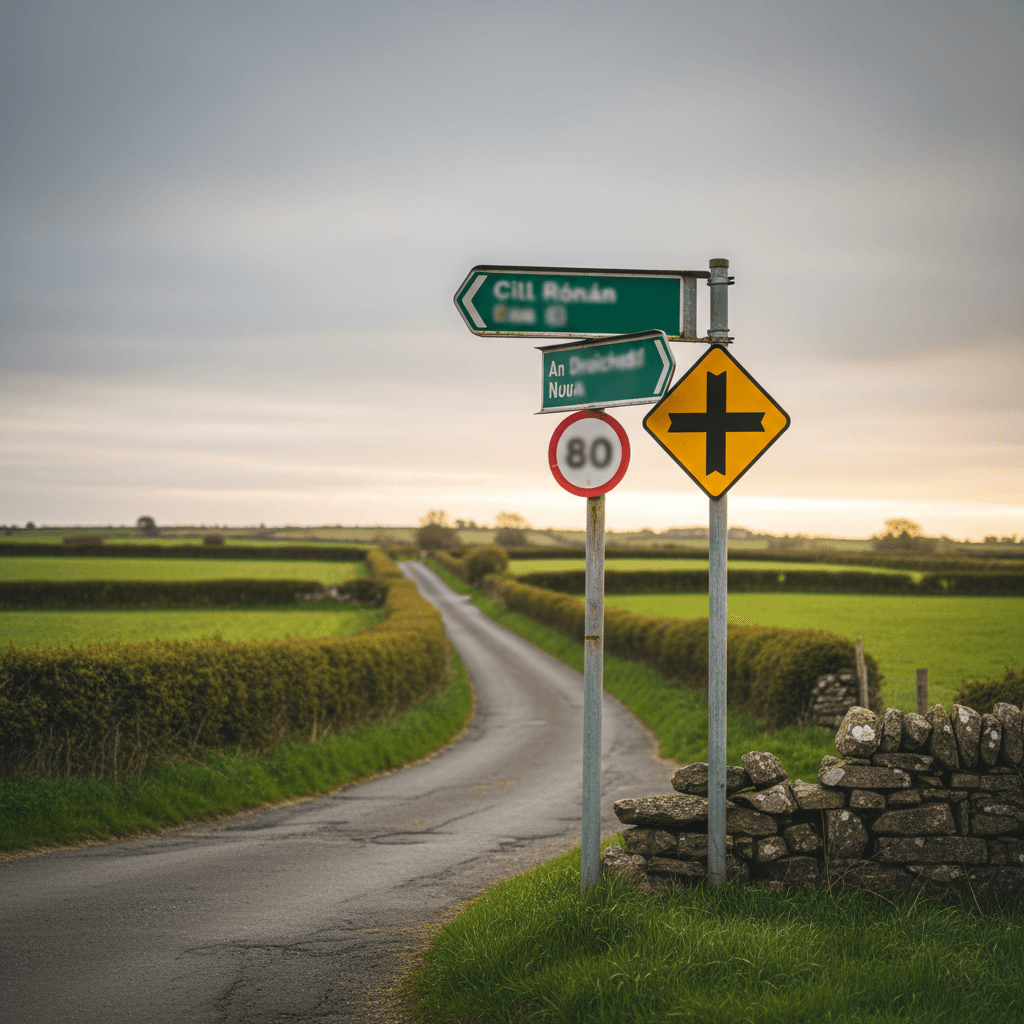
- Read the plate, not the paint. A with-flow bus lane only binds you during the hours on the plate under its sign.
- A contra-flow bus lane has no hours. A car may never enter one.
- Yellow box: do not enter unless you can clear it without stopping. The one exception is a right turn.
- A continuous white line on a cycle track keeps you out except for access. A broken one does not.
- Bus lane, yellow box and cycle track offences carry a €60 fixed charge in the Republic.
- Northern Ireland runs its own rules: a bus lane Penalty Charge Notice there is £90, or £45 within 14 days.
Most of Ireland's road rules come at you on open road. These ones wait in town: a lane painted red with BUS in it, a junction covered in yellow criss-cross lines, a strip of green tarmac beside the kerb, a tram line down the middle of the street. None of them has a barrier. All of them can produce a notice that reaches your hire company after you have gone home.
This page quotes the rules from the regulation that makes them, for the Republic, and from the Department for Infrastructure's own pages for Northern Ireland. Where we could not find a State source, we say so.
Which version we read. The Republic's rules are in the Road Traffic (Traffic and Parking) Regulations 1997, S.I. No. 182/1997, which has been amended many times. We read Articles 14 (cycle tracks) and 32 (bus lanes) as substituted by S.I. No. 473/2025, made on 9 October 2025, and Article 29 (box junctions) as substituted by S.I. No. 332/2012. We checked the Irish Statute Book's legislation directory, updated to 17 September 2026, for later amendments to those three articles and found none. All checked 13 October 2026.
The rule that covers most of it: read the plate, not the paint
Paint tells you what a lane is. The small rectangular plate under the round sign tells you when it applies and who it applies to. Article 32 of the 1997 Regulations ties the bus lane rule to "the period of operation of the bus lane indicated on an information plate", and Article 14 lets a cycle track carry its own periods of operation on a plate too.
So a red lane with BUS painted in it is not, on its own, a lane you can never use. The plate decides. And a lane you are sure you can use at 8pm may be closed to you at 8am.
Bus lanes: when the lane is a bus lane, and when it is just a lane
A with-flow bus lane runs in the same direction as the traffic beside it. It is signed with sign RUS 028 or RUS 029 and the road marking RRM 024. A contra-flow bus lane runs against the traffic. It is signed RUS 030 with the same marking.
The rule for each is different (Article 32, as substituted by S.I. No. 473/2025):
(2) A person shall not enter a bus lane with a vehicle, other than a large public service vehicle, a pedal cycle, an e-moped or an electric scooter, during the period of operation of the bus lane indicated on an information plate.
(3) A person shall not enter a contra-flow bus lane with a vehicle, other than a large public service vehicle, a pedal cycle, an e-moped or an electric scooter.
Sub-article (2) has hours. Sub-article (3) has none. You may never drive a car into a contra-flow bus lane.
A bus-only street follows the same pattern: Article 32(4) keeps every other vehicle out "except for the purpose of access".
There are two narrow exceptions for crossing a bus lane, and they are exactly this narrow:
(5)(a) Sub-articles (2) and (3) do not apply to a vehicle crossing a with-flow bus lane or a contra-flow bus lane solely for the purpose— (i) of entering or leaving premises or property adjacent to such a bus lane, or (ii) of entering or leaving a road inset adjacent to such a bus lane in order to load or unload goods.
That is crossing, not driving along. It does not let you use the lane to get past a queue, and the article does not mention pulling in to drop someone off.
Taxis. You will see taxis in bus lanes during their hours, and that is not because the plate allows them. Article 32(5)(b) exempts "a taxi or a wheelchair accessible taxi which is being used in the course of business" from the with-flow rule. The exemption does not cover a contra-flow bus lane, and it does not cover a hire car. Following a taxi into a bus lane is following a vehicle that has an exemption you do not.
Box junctions: the one junction you may not block
A box junction is marked with yellow cross-hatching, road marking RRM 020. The rule is in Article 29, as substituted by S.I. No. 332/2012. It applies at a junction or on a public road, "whether the junctions are controlled by ... traffic lights, or otherwise":
notwithstanding any indication to the contrary that may be given by such traffic signs, a driver of a vehicle shall not enter, either partly or wholly, the cross-hatched area unless the vehicle can clear the area without stopping.
A green light does not let you in. If the traffic on the far side has not moved and you would stop inside the box, you wait at the line, even on green.
The exception is a right turn, and only a right turn:
(2) Sub-article (1) does not apply where the driver of a vehicle intending to make a right hand turn at a junction enters the cross-hatched area for that purpose.
So you may move into the box and wait there to turn right. Going straight on or turning left, you may not enter until you can get out the other side.
There is a third case worth knowing in Dublin. Article 29(3) puts a yellow box at the end of some bus lanes, so that buses leaving the lane can merge. There, everyone except a vehicle "exiting the bus lane" is held to the same clear-it-or-wait rule.
Cycle tracks: it is the line, not the colour
A cycle track is often green tarmac, but the colour is not what the law looks at. Article 14, as substituted by S.I. No. 473/2025, defines a cycle track by its signs and markings: the cycle track sign, a cycle symbol painted on the road, and the line along its edge. The line is what decides whether your car may touch it.
- A continuous white line (RRM 022) on its right-hand edge, or a painted cycle symbol: a car "shall not be driven along or across" it, "save for the purposes of access to or egress from a place adjacent to the cycle track or from a roadway to such a place". Article 14(5)(b) makes that cover driving "wholly or partly" along or across it, so putting two wheels on it counts.
- A broken white line (RRM 023), or a cycle symbol with "elephant's footprint" markings (RRM 038): Article 14(5)(c) says that restriction "does not apply".
A broken line is not an invitation to drive in the cycle lane. It only means the strict ban above does not apply, and you still give way to anyone cycling in it. If you park where a cycle track has hours on its plate, Article 14(6) requires the car to be gone before those hours begin. Parking fines are covered in the parking guide.
Bus gates: the quays, College Green, and the ones a satnav does not know about
A bus gate is a short stretch of road, or a single turn, that only buses, taxis and bicycles may use. In Dublin there are three you are most likely to meet.
The Liffey quays at O'Connell Bridge. These are timed, 7am to 7pm, and the detail of which turns are closed is in our driving rules guide, which keeps the one full account of them.
College Green. Dublin City Council made the College Green bus gate, in front of Trinity College, a 24-hour restriction for private vehicles from May 2023. When we tried to read the council's current pages on 13 October 2026 they were unavailable. So we are not quoting you hours or exceptions we could not confirm today. Treat College Green as closed to your car, and read the signs at the junction.
Westland Row and Pearse Street, beside Pearse Station, has a 24-hour bus-only left turn. That is also in the driving rules guide.
A satnav that does not know about a gate will route you straight through it. The sign at the junction overrides the screen, every time. Our navigation apps guide covers keeping the maps current.
Luas tracks: sharing a street with a tram
Dublin's Luas trams run on three kinds of track, and the operator's own advice on driving near them sorts them like this (TFI Luas, checked 13 October 2026):
- Tram lanes — most of the network. "Road vehicles are not allowed in Tram Lanes; Tram Lanes are dedicated areas for trams only." They are signed at the start and usually marked by a continuous white line. The operator says driving in one is a contravention of Irish road traffic legislation and you could be prosecuted.
- Junctions where the tracks cross the road, most of them controlled by traffic lights. Cross directly, look both ways, listen for the tram's horn and bells, and leave room for the traffic in front to clear the tracks and any yellow box.
- Shared tramways, a small number of streets used by trams, cars and bikes together. The operator's rule of thumb is the right one: "if you are not 100% sure you can drive there then don't."
A tram cannot steer round you and takes far longer to stop than a car. If you are ever stopped on the tracks, that is the moment the box junction rule exists for.
What it costs if you get it wrong
In the Republic, three of these are fixed charge offences with a €60 fixed charge, set by S.I. No. 227/2024, the Road Traffic Act 2010 (Part 3) (Fixed Charge Offences) Regulations 2024 (Schedule 6, Part 1, item 5; checked 13 October 2026; the Statute Book directory lists no amendments to it):
- "Driving in bus lane or on bus only street" (Article 32)
- "Entering yellow box other than in accordance with that Regulation" (Article 29)
- "Driving mechanically propelled vehicle, other than mechanically propelled wheelchair, along or across a cycle track other than for access or egress" (Article 14)
A Fixed Charge Notice in a hire car goes to the rental company first, and runs on the 28 + 28 day clock in our hire car fines guide. That guide also explains the separate administration fee the rental company will charge you.
Penalty points. No bus lane offence appears on the RSA's list of offences incurring penalty points at 27 October 2022. We have not checked the points position for box junction or cycle track offences against a current State list, so we are not telling you there are none.
The quays gates and College Green are signed restrictions, and we have not found a penalty figure published by the council or the State for those gates. We are not going to quote one at you.
Northern Ireland: the same paint, a different rulebook
Cross the border and none of the Republic's regulations above apply. Bus lanes and box junctions in Northern Ireland come under Northern Ireland law and the Department for Infrastructure. Speeds and distances are in miles, and penalties are in pounds.
Bus lanes. nidirect says the times and days of operation vary from lane to lane and are shown on the signs. "Where no times are stated, the bus lanes are operational 24 hours, Monday to Saturday." They operate on all bank holidays in Northern Ireland. Belfast's lanes are enforced by fixed and mobile CCTV, with no flash to tell you you have been recorded.
Unlike the Republic's article, nidirect spells out when you may cross one: to turn left into a side road or right across the lane, as close to the junction as possible ("within one vehicle length"), or to reach a lay-by or private entrance. You may not queue in a bus lane to turn left, or straddle it with your wheels in it.
A bus lane Penalty Charge Notice is £90, reduced to £45 if paid within 14 days of the notice. It goes by post to the registered keeper, which in a hire car is the rental company (nidirect, checked 13 October 2026).
Box junctions. Rule 174 of the Highway Code for Northern Ireland: "You must not enter the box until your exit road or lane is clear. However, you may enter the box and wait when you want to turn right, and are only stopped from doing so by oncoming traffic, or by other vehicles waiting to turn right." At signalled roundabouts, you must not enter unless you can cross it completely without stopping.
Cycle tracks in Northern Ireland: this page does not cover them. Do not assume the Republic's line-by-line rule above applies north of the border.
The short version
- The plate under the sign gives the hours. Outside them, a with-flow bus lane is an ordinary lane.
- A contra-flow bus lane is never yours.
- Taxis are exempt from the bus lane rule. You are not.
- Do not enter a yellow box unless you can clear it, unless you are turning right.
- A continuous line along a cycle track keeps your wheels off it.
- Stay out of Luas tram lanes, and never stop on the tracks.
- €60 in the Republic. £90, or £45 within 14 days, for a bus lane in the North.
For more on driving in Irish towns and cities, see:
- Irish Driving Rules & Road Signs — the Dublin quays bus gates in full
- You Got a Fine in a Hire Car in Ireland — what arrives afterwards
- Parking in Ireland — a bus lane as a parking offence, not a driving one
- Best Navigation Apps for Ireland — why the satnav does not know about the gate
(Sources: S.I. No. 182/1997, Articles 14, 29 and 32, as substituted by S.I. No. 473/2025 and S.I. No. 332/2012, on the Irish Statute Book, with the legislation directory updated to 17 September 2026; S.I. No. 227/2024, Schedule 6; the RSA penalty points list at 27 October 2022, as previously checked for our fines guide; TFI Luas, "Safe Driving Around Luas"; nidirect, "Bus lanes and bus-only streets" and "Enforcement of bus lanes and bus-only streets"; nidirect, The Highway Code, rules 159 to 203. All checked 13 October 2026 unless stated.)